
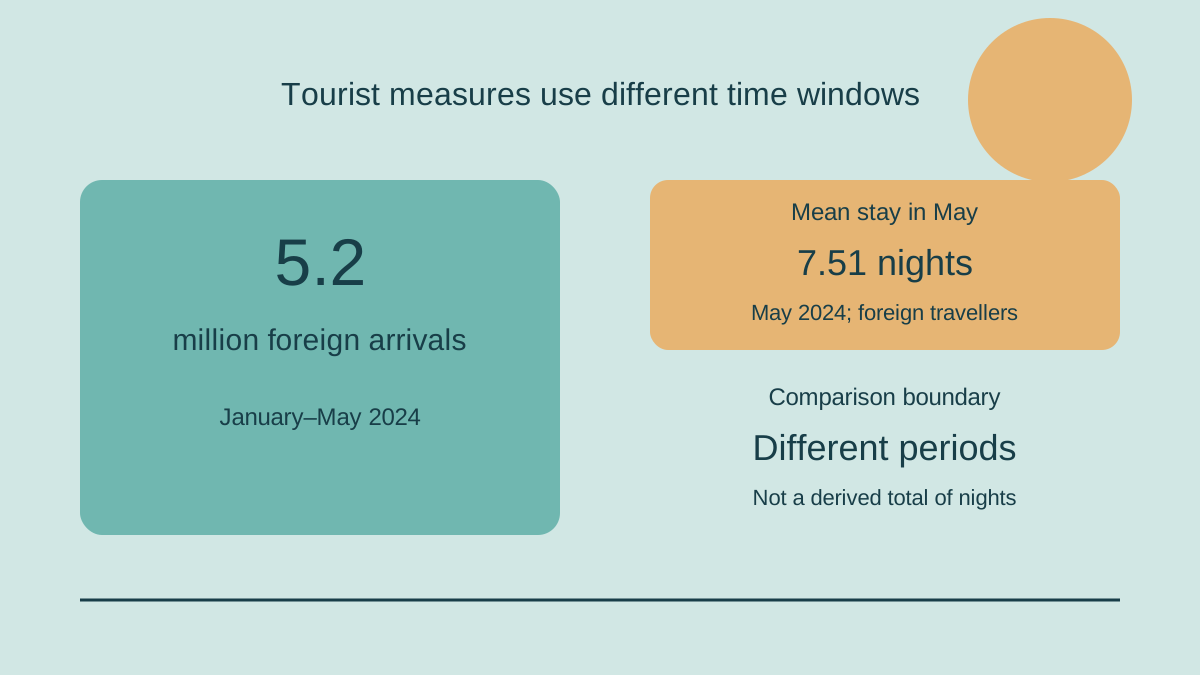
Foreign tourist arrivals in Indonesia reached 5.2 million from January to May 2024, according to ANTARA’s July 1 report, citing Statistics Indonesia. The same article reports a mean stay of 7.51 nights for May, including foreign travellers crossing borders. These figures concern different time windows and should not be multiplied into an asserted total of nights.
The distinction opens a practical demand question. Arrivals count entries into a defined statistical account, while a mean stay describes an average within its own account. Neither is automatically a hotel occupancy measure. Original analysis can explain how a changing mix of visit lengths affects the average without inventing the composition behind the reported figures. The examples below are explicitly hypothetical and do not reconstruct the national data or forecast a particular tourism business’s results.
The observation window belongs to the number
A number becomes interpretable when its period is stated alongside its subject. A cumulative count across several months and an average for one month answer different questions. Combining them requires more than their appearance in the same report. The reader would need to know that the average describes the same set of observations as the count. Without that connection, multiplication may be arithmetically tidy while the resulting quantity lacks an established statistical meaning.
This is a useful distinction for an article that places several tourism indicators together. The indicators can each be accurate while their direct combination is unjustified. A cumulative count gives a view of recorded volume over its period. A monthly average gives a view of stay length for the population and period it describes. The report’s organisation does not turn those boundaries into one common observation window or make the monthly average representative of every preceding month.
A careful business reading therefore preserves the period before asking what the figure implies. It can describe the cumulative count and the monthly mean as two reported indicators without constructing a total that the source has not established. That approach still allows an informative discussion of tourism demand. It simply directs the next question towards compatible observations, rather than presenting a calculation whose inputs refer to different groups or different parts of the year.
An arrival is not automatically a unique person
A count labelled arrivals should retain that label. Treating it as a count of unique people would add a definition that needs its own support. In an abstract example, one person could make more than one visit, so entries and people would be different objects. This possibility is enough to show the importance of the label; it does not establish how repeated visits are handled in the reported national statistics or how frequently they occur.
The same caution applies when the count moves into a discussion of customers. A national arrival is not automatically a customer of a particular hotel, restaurant or transport service. The business would need evidence connecting the statistical population with its own service. An arrival indicator can provide context, but the context does not itself supply bookings, transactions or a local customer count. Those are separate observations with their own boundaries.
Keeping the original label also improves a comparison across time. A reader can ask whether both periods use the same arrival definition before interpreting a difference as a change in unique visitors. The article does not claim a revision to the official definition. It identifies a question that should remain visible whenever a general tourism count is translated into a more specific business account. A change in wording should not silently change the object being measured.
A mean is a relationship between two totals
For the hypothetical examples in this article, mean stay is defined as total visit-nights divided by the number of visits in the same invented group. A visit-night is simply one night associated with one visit in that model. This definition is deliberately limited to the example and is not presented as a reconstruction of the official calculation. It allows the reader to follow how the average changes when the model’s visit mix changes.
The definition makes clear that the mean has both a numerator and a denominator. A change in the number of visits can affect the denominator, while a change in their lengths affects the numerator. Looking only at the resulting average can hide the movement in both totals. The average remains useful, but it answers a narrower question than either the count of visits or their combined nights.
It also explains why two groups with different sizes should not automatically receive equal weight in a combined mean. If one group contains more visits, those visits contribute more observations to the total. The example therefore builds the mean from the underlying counts and nights, rather than averaging two group averages as if the groups were the same size. This is ordinary arithmetic, not an estimate of the real distribution of tourist stays.
A hypothetical mix with two visit lengths
Imagine an entirely invented group of one hundred visits. Forty last two nights each, and sixty last eight nights each. The people, visits and lengths are fictional for explanation; they are not Indonesian tourist data or bookings at a real establishment. The shorter group contributes eighty visit-nights and the longer group contributes four hundred and eighty. Their combined total is five hundred and sixty visit-nights, producing a mean of 5.6 nights per visit.
Now imagine another invented group with eighty two-night visits and sixty eight-night visits. The total becomes one hundred and forty visits. The shorter group contributes one hundred and sixty visit-nights, while the longer group still contributes four hundred and eighty. The combined total becomes six hundred and forty visit-nights. Dividing that total by one hundred and forty gives a mean of approximately 4.57 nights per visit, rounded to two decimal places.
- Keep the first group’s one hundred visits separate from its five hundred and sixty visit-nights.
- Identify forty short visits and sixty long visits as the first invented mix.
- Identify eighty short visits and sixty long visits as the second invented mix.
- Calculate each mean from the visits and nights belonging to that same group.
- Retain the higher total of nights in the second group alongside its lower mean.
- Describe the result as a mix effect in the model, not an explanation of national tourism performance.
The second group has more visits and more total visit-nights, yet a lower average stay. Neither visit length has changed. The result follows from the greater share of the shorter group. This demonstrates one way a mean can fall without a fall in either visit count or total nights. It does not prove that this mechanism caused any reported change, because the article has not observed the real composition of the statistical population.
A changing mean does not identify its own cause
A lower mean could be associated with a changed mix, changed lengths within groups or a combination of changes. An aggregate average alone does not distinguish those explanations. The invented example holds the two lengths constant specifically to isolate the mix effect. A real explanation would need evidence about the relevant groups and their periods. Without that evidence, choosing one mechanism would be speculation rather than an interpretation established by the report.
The same logic applies to a higher mean. It is not automatically evidence that every visitor stayed longer or that a particular service became more attractive. An average can change when the balance of observations changes. The useful follow-up question asks which underlying totals or group shares changed, rather than attaching a positive or negative business narrative to the direction of the mean alone.
This does not diminish the value of the average. It identifies what the average can and cannot answer by itself. A headline indicator can make a question visible, while a more detailed account would answer it. For the tourism update, that distinction allows the mean to remain part of the discussion without becoming an invented explanation of visitor behaviour, destination quality or the effectiveness of a particular tourism initiative.
Visit-nights are not occupied room-nights
The invented visit-night total records the model’s nights associated with visits. It does not specify accommodation type, room sharing or which establishment received a booking. An occupied room-night is a different object: a room occupied for a night within an identified accommodation account. Moving from one object to the other requires information that the example does not contain. The article therefore does not turn its arithmetic into hotel occupancy or a claim about the official figures’ accommodation coverage.
This difference matters to a business reading because national tourism indicators can sound close to the quantities a hotel manages. Their relationship may be relevant, but it still needs evidence. A hotel account would identify its available rooms, occupied rooms and observation period. A general tourism arrival or stay indicator does not supply those fields. The business can use the national report as context while relying on its own compatible records to discuss its occupancy.
The distinction also prevents a simplified revenue calculation. Visit-nights do not establish paid room-nights, prices, transactions or receipts. Even a confirmed occupancy count would need further information before supporting a revenue statement. The original analysis does not provide investment advice or forecast a hotel’s income. It keeps the units clear so that a useful background indicator is not mistaken for a complete account of a particular business’s demand.
A national indicator does not allocate local demand
A national count does not, by itself, say where each visit’s nights were spent. An invented visit could include more than one location, but the article does not assign actual itineraries or infer their prevalence. The logical point is that a national total and a local service count have different geographical boundaries. A local business would need an additional connection between the broad population and the place in which it operates.
That connection should not be manufactured from a destination’s prominence. A widely known destination can be relevant to a tourism story without receiving every observation in the national count. Likewise, an arrival through an entry point does not automatically describe the full location of a stay. The article avoids making either inference. It asks for evidence about the actual geographical account when the question shifts from national tourism volume to a particular local demand.
A clearer reading can therefore preserve the national indicator and identify the local question separately. The national report provides one context; the local account would supply another. Their relationship could then be discussed using observations that share a defined period and geography. Until that information is present, the report should remain a background signal rather than a substitute for bookings or service use at an individual destination.
Comparisons need the same object and a stated period
A comparison becomes more meaningful when both observations describe the same kind of object. Arrivals should be compared with arrivals under an identified definition, and means with means whose population and period are explained. Comparing a cumulative count with a monthly average can be informative as a description of different indicators, but it is not a direct comparison of like quantities. A clear account states that difference before drawing a conclusion.
The invented groups can be compared because their visit-night definition and two length categories are held constant. If those definitions changed, the model would need the change stated. Otherwise, an apparent mix effect could come from a different counting rule. The example does not assert a change in the official method. It demonstrates why a comparison should preserve definitions alongside values, rather than relying on the familiarity of a tourism label.
Historical reporting also needs its own boundary. A dated update describes the evidence available in that report. Later related articles on the page are not observations from the original period. The analysis therefore uses the dated main article rather than importing later tourism developments into its historical account. This keeps the original statistical question intact and avoids presenting a later outcome as if it were already known when the update was published.
A demand story should preserve its separate indicators
Arrivals, mean stay and a compatible total of visit-nights can each contribute to a demand discussion. They need not move in the same direction to be meaningful. The hypothetical example shows how a changing mix can increase the first and the total while reducing the mean. Keeping all three objects visible gives the reader a more precise account than selecting whichever single indicator supports the most attractive narrative.
For a business, the next useful question concerns the connection to its own service: which population, period, location and unit would explain the demand it actually observes? The national report does not answer every part of that question. It can prompt the enquiry without supplying an invented customer count, occupancy result or financial benefit. This is a reason to seek compatible evidence, not a reason to dismiss the broader tourism indicator.
The strongest conclusion from the July update is therefore about careful interpretation. The reported count and mean retain their own time windows. The invented mix illustrates a possible arithmetic relationship, not the composition behind the report. A demand story that preserves these boundaries can describe the tourism indicators clearly while leaving their connection to local business results to evidence that actually measures those results.