
Kommersant reported on September 16, 2026 that NF Group forecast the introduction of 1,200 new quality hotel rooms in Moscow, Russia, during 2026. That is a forecast of rooms entering a defined inventory, not a measurement of the nights for which those rooms will be available.
The original analysis below examines that difference. Its examples are invented and describe no actual property, opening schedule or demand outcome. They show why a count of new rooms needs a calendar before it can answer a question about supply over a period. Neither the forecast nor these calculations establishes bookings, revenue, profitability or an investment return.
A room count and a room-night answer different questions
A room is an inventory unit. A room-night combines that unit with one night in a specified reporting period. One room available for ten nights contributes ten available room-nights. Ten rooms available for one night also contribute ten. The totals are equal, although the operating calendars are very different. Keeping both dimensions visible prevents a supply total from implying a particular distribution across dates.
A forecast of additional rooms describes a change in the inventory covered by that forecast. It need not describe how many nights fall between each opening and the end of the year. A property entering the inventory near the end of a period can contribute the same room count as an otherwise identical property entering earlier. Its contribution to the available room-night total over that period can nevertheless be much smaller.
The distinction is not a reason to reject a room-count forecast. It is a reason to identify the question it answers. Someone comparing the scale of announced additions can use the room count, subject to the forecast's coverage. Someone comparing the calendar exposure of those additions needs opening dates and availability assumptions. Replacing one measure with the other without explaining that change would conceal information rather than improve precision.
An invented example makes the calendar effect visible
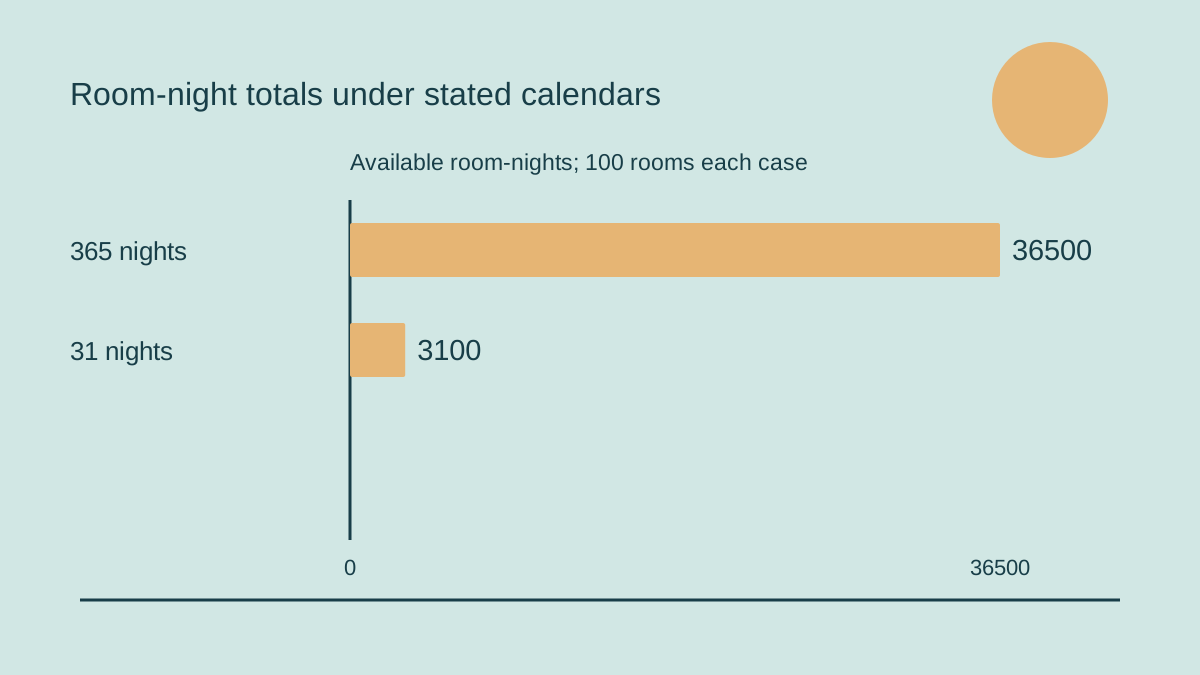
Consider two deliberately simplified cases in a hypothetical year with 365 nights. In the first, 100 rooms are available throughout all 365 nights. They contribute 36,500 available room-nights. In the second, 100 rooms become available for only the final 31 nights. They contribute 3,100 available room-nights. Both cases add 100 rooms to the inventory, but their contributions within the specified year differ by 33,400 room-nights.
The calculation assumes that every room in each group is available on every counted night. It is not an estimate of actual hotel operations. It does not assume that a guest occupies any of the rooms. An available room-night is an opportunity to provide accommodation, whereas an occupied room-night describes its use. The example has deliberately stopped before that second question, because no booking information has been supplied.
If the second group remains available throughout the following 365-night year, its contribution becomes 36,500 available room-nights in that new period. The inventory has not gained another 100 rooms merely because the calendar exposure is now longer. This is the central comparison problem: a larger annual supply flow can arise from a full year of availability for an existing addition, even when the opening count for that following year is zero.
The reporting boundary belongs in the calculation
The beginning and end of the reporting period determine which nights enter the total. A calendar year, a rolling twelve-month interval and an opening-to-anniversary interval are different windows. The same room can contribute different counts in those windows without any discrepancy in the underlying record. A comparison therefore needs dates as well as the phrase annual supply. Annual alone does not identify a shared observation boundary.
Counting also needs a convention for the opening night. The arithmetic can include the first night on which a room is available for a stay, provided that convention is applied consistently. A ceremonial opening, an announcement and a first available stay need not be treated as equivalent entries merely because all can be associated with the word opening. This is a proposed reporting distinction, not a claim about the sequence at any named Moscow property.
A concise note can identify the period, the availability rule and the information cutoff used for a forecast. Those three items let a reader distinguish a calendar assumption from a confirmed observation. If a date is unknown, the report can retain that uncertainty rather than assign an apparently exact annual total. Precision in multiplication cannot compensate for an opening date that has never been established.
Phased availability requires more than one start date
A single property-level opening date is sufficient for the invented examples above because all 100 rooms become available together. A more detailed hypothetical case can split the inventory into groups. Suppose 60 rooms are available for 100 nights and another 40 for 50 nights within the same reporting period. The contribution is 6,000 plus 2,000, or 8,000 available room-nights. Applying the first date to all 100 rooms would instead produce 10,000.
The difference comes from assigning each group its own exposure, not from changing the number of rooms. A report could therefore retain a room group and a start date in the same row. It need not infer that a phased opening is good or bad. The purpose is to prevent the calendar attached to one group from silently becoming the calendar attached to the entire property.
Where availability later changes, a start date alone may no longer describe the whole period. A temporary interruption or a change in the number of available rooms would require an additional interval in the hypothetical record. This does not establish that such interruptions occurred in the reported market. It identifies what the chosen unit would require if those circumstances were present and included in the reporting definition.
Available does not mean occupied, booked or sold
The word available can itself carry several meanings. A physical room count, a room offered for a particular date and a room that remains unbooked at the moment of a search describe different states. For the calculations here, available means included in the hypothetical operating supply for the night. It does not mean still open for sale at a particular instant. Without that distinction, a successful booking could appear to reduce supply rather than use it.
A booked stay can also differ from a completed occupied night. A reservation might refer to a future date, while an occupancy record refers to the period being measured. No cancellation or completion rate has been assumed here. The point is simply that a forecast of opening rooms contains neither kind of utilisation record. Converting its room total into calendar exposure does not supply the missing demand information.
For the same reason, room-nights should not become guest-nights through a change of wording. Two guests staying in one room for one night occupy one room-night and may account for two guest-nights under an appropriate guest-based definition. A comparison that alternates between those units can create growth on paper without describing any additional rooms. The unit belongs beside every number, not only in the first paragraph.
Forecast coverage is separate from calendar weighting
Calendar weighting cannot reconcile different inventory definitions by itself. A forecast may cover a particular geography, class of accommodation or set of projects. Before comparing its room count with another estimate, a reader needs to know whether the covered objects match. A room-night calculation applied to unlike populations still describes unlike populations. Multiplying each by the same number of nights does not make their scopes equivalent.
The quality category in the reported forecast is therefore part of the factual boundary, rather than a label to discard when discussing the entire market. This analysis does not independently establish the category's detailed inclusion rules. It preserves the reported qualification and refrains from treating the count as a complete census of every form of accommodation. A broader claim would require evidence beyond the compact source fact used here.
A useful comparison would separate two questions: which rooms belong to the forecast, and for how many nights each is expected to be available within the chosen period. An unexplained difference between forecasts could arise from either question. Averaging their headline counts before checking those boundaries would hide the reason for disagreement. A numerical midpoint is not evidence that the underlying definitions have converged.
A new-opening cohort differs from the whole inventory
The examples so far isolate rooms introduced during a specified year. That cohort is only one possible subject of a supply report. The whole inventory includes whatever earlier rooms remain within the report's definition, together with eligible additions and any exclusions. An opening forecast supplies information about additions; it does not by itself describe the starting inventory or the movement of every previously included room.
Consequently, additional available room-nights from new openings should not automatically be described as the net change in the whole market. A net comparison would need consistent information about both periods and the rooms included in each. This is an accounting boundary, rather than an assertion that a particular closure offsets a particular opening. No actual closure has been inferred from the Moscow opening forecast.
For an editorial chart or written explanation, the cohort can remain explicit in the title: calendar contribution of hypothetical new openings. That wording tells the reader what the calculation contains. Calling the same result total market capacity would require a larger data set. Careful naming is especially valuable when the arithmetic is simple enough to look authoritative despite a limited observation boundary.
Scenarios should retain their conditional character
An unknown opening date can be represented by alternative calendars, provided they are labelled as scenarios. For example, the invented 100-room group could be considered over 31, 100 or 365 available nights. Its conditional contributions would be 3,100, 10,000 or 36,500 room-nights. These are consequences of chosen assumptions. They are not three estimates with known likelihoods, and their average would not become an independently justified forecast.
A scenario can help a reader see which input drives a result. Holding the room count fixed while changing available nights isolates the calendar effect. Changing both the room count and the opening date at once would answer a different question. Neither approach establishes which case will happen. A transparent explanation identifies the changing assumption rather than presenting the resulting number as an observed trend.
When a forecast is later updated, the old and new calculations should retain their information dates. Otherwise a comparison may treat a revised opening schedule as if it had been known all along. A historical report can explain what was expected at its publication date without silently replacing those expectations with subsequent outcomes. Forecast revision and realised opening are related subjects, but they are not interchangeable records.
The information date also helps distinguish a missing input from a zero. If an opening date is unavailable, the associated contribution is unknown under this calculation; it is not automatically zero room-nights. Zero would mean that the stated assumptions place no available nights inside the period. Keeping those states separate prevents an incomplete record from looking like a confirmed absence of supply. The same distinction belongs in a written comparison even when no table is shown.
A compact reporting checklist
A reader does not need a complicated model to recognise these boundaries. A short accompanying note can make the essential distinctions visible before anyone interprets a room count as annual operating supply. The following checklist is an original reporting proposal for the hypothetical calculations, rather than a description of the source's forecasting method.
- Name the inventory covered: geography, accommodation category and new-opening cohort or whole inventory.
- State the observation period and the information date used for any forecast.
- Keep rooms, available room-nights, occupied room-nights and guest-nights as separate units.
- Assign availability intervals to the room groups actually covered by each assumed date.
- Label unknown dates, invented scenarios and later revisions clearly.
- Avoid turning supply arithmetic into an unsupported demand, revenue or profit conclusion.
The resulting distinction is modest but consequential. A forecast of new rooms can identify the expected scale of an inventory addition. A calendar-weighted calculation can identify how much exposure that addition contributes within a stated period, if the required assumptions are available. Keeping the two together preserves the room count while explaining what it cannot answer alone. The date boundary becomes part of the meaning of supply, rather than an invisible multiplier behind the headline.