Australian Manufacturing’s August 18, 2025 report describes preliminary work towards a national solar-panel reuse and recycling scheme in Australia, led by New South Wales. The state government’s announcement of the same date confirms the agreement to progress that work. These announcements establish preparatory work, rather than an operating national collection system or measured processing results.
The original analysis below examines an accounting question raised by such an initiative: how should a report distinguish panels removed from use, panels collected, items awaiting a destination and completed processing? Its categories are conceptual and its numerical examples are constructed. They are not descriptions of an actual scheme’s rules or performance. The discussion does not assess whether any panel is suitable for reuse, describe handling or installation procedures, or interpret legal obligations.
Installed stock and removal flow need separate lines
An installed population is a stock observed at a particular time. Removals are events occurring over a period. A forecast about removals therefore describes a different object from a count of panels currently installed. Both can contribute to planning, but a report must state which one it presents. A large installed population does not identify how many panels will enter a collection channel during a particular reporting window.
The distinction also applies to a count of panels expected to leave use and a count actually received by an organisation. Between those descriptions are events that require evidence. A panel might have a recorded removal date without a recorded collection receipt in the same period. The absence of a receipt in one account does not establish its destination. It means the account has not established that relationship for the stated window.
A clear planning discussion can retain forecasts while naming them as forecasts. It can then place recorded removals and recorded receipts in separate lines. That structure avoids presenting an expected future stream as material already available to a processor. It also avoids treating an incomplete collection account as proof that unrecorded items followed one particular route. Each line describes what its evidence supports, leaving missing links explicit.
Define the boundary of a collection receipt
Collection can refer to several events: a booking, a pickup, an arrival at an intermediary or an arrival at a destination. These are useful milestones, but they are not interchangeable. A report should identify the event that creates its receipt count and the organisational boundary at which it occurs. Otherwise the same word may describe a planned service in one period and a completed transfer in another.
An editorial account could describe receipts at one named boundary without claiming to cover the entire national stream. Its scope might be a particular reporting organisation or a stated group of reporting participants. The article does not assert that such a dataset exists for the proposed scheme. It identifies the description that would be necessary before a collection total could be interpreted as a measured result.
Bookings are especially important to keep separate. A booking can show an intention to transfer items, while a receipt shows an observed arrival under the account’s definition. A cancelled or postponed booking may never produce that receipt within the period. Reporting both can be informative, provided the reader can see which event was counted. A combined total would obscure whether the report describes demand for collection or collection that actually occurred.
Keep the opening and closing stock visible
A receipt during a period is an inflow. Items remaining at a boundary at the beginning or end are stocks. A processing total is another flow if it records items completing an identified route during the period. Joining these concepts requires a common boundary and consistent units. If the report switches from counts to mass or changes the reporting group, the account needs an explanation before its lines can be reconciled.
Consider a fully constructed example with an opening stock of 20 panels, receipts of 80 and 50 panels leaving the stated pending account through an identified completed route. With no other movements, the closing pending stock is 50: 20 plus 80 minus 50. This is simple accounting arithmetic. The figures are invented and do not estimate volumes, storage or processing at any actual collection organisation.
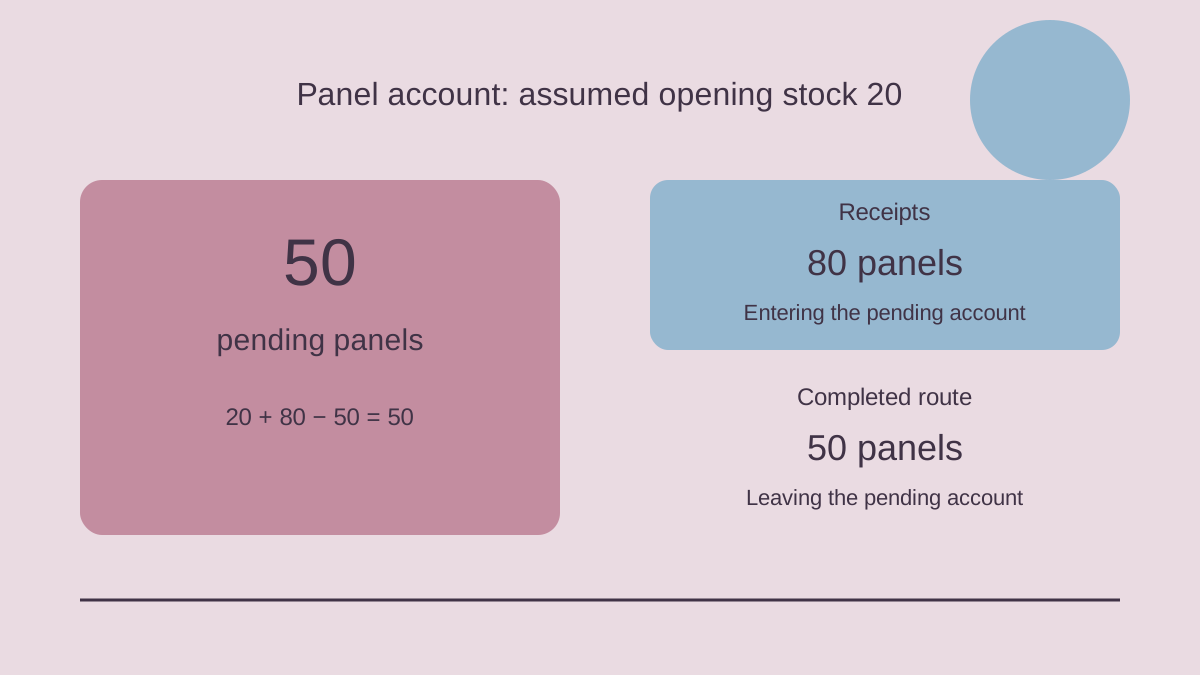
The example shows why a receipt total cannot stand in for a completion total. Eighty panels entered the account, while 50 left through the defined route. Some completed items may have been present at the start, so the report cannot assume that all 50 came from the period’s new receipts. The account needs information about cohorts if it wants to answer that further question. An accurate balance and a matched-cohort result are different descriptions.
Time windows can create a misleading apparent rate
Dividing completions in one period by receipts in the same period creates a ratio, but its meaning depends on whether those events concern the same items. An organisation can complete older receipts while receiving a new group. In that situation, the ratio does not measure the fraction of the new group that completed its route. It describes two period totals. A reader needs that distinction before interpreting the number as a collection outcome.
A constructed month might record 40 new receipts and 60 completions, including items held from an earlier month. The ratio is 150 percent. This can be consistent with a valid stock-and-flow balance and does not mean that more than all of the new panels were processed. It also does not establish an extraordinary recovery result. It indicates that receipts and completions have different time origins within the account.
For a cohort question, a report would follow an identified group of receipts to its later states and retain the observation cutoff. Some items could remain unresolved at that cutoff. A later account might add their completed route when evidence becomes available. It should not assign a future outcome to make the rate look complete. Time-window clarity permits a limited result to be useful without converting it into an unsupported claim about every receipt.
A transfer can appear in more than one account
A panel can pass through more than one reporting boundary. A receipt at an intermediary and a later receipt at another organisation may both be valid events. Adding them as though they were different panels can double-count the object. A network-wide count therefore needs a stated rule for distinguishing items from transfer events. The article does not specify the technical means by which a real scheme should perform that task.
In an invented illustration, 30 panels arrive at organisation A and are later transferred to organisation B. Each organisation records 30 receipts. There are 60 receipt events across their accounts, but only 30 panels in this constructed movement. A total of receipt events can describe handling activity. A total of unique panels describes a different question. The report should name the chosen unit rather than let an event count imply unique coverage.
This does not make the intermediary’s record redundant. It may provide evidence of one part of the route. The issue is how the records are aggregated and what conclusion the aggregate supports. An account can preserve local receipts while reporting an explicitly bounded network total. Where unique objects cannot be established, it can report transfer events honestly instead of presenting an unsupported estimate of distinct collected panels.
Counts and mass cannot be joined by an unexplained conversion
A panel count and a mass total describe different units. A conversion between them needs evidence about the population represented and the measurement basis. A report cannot assume a common weight merely to reconcile a count with a mass forecast. Different objects or different treatments of packaging and associated items can change the relationship. This article provides no estimate of panel weight or of the composition of any actual collected stream.
A useful account could show a measured count and a measured mass separately, explaining the boundary of each. If a mass includes other items while the count covers panels alone, that difference belongs in the description. A calculated estimate can also be useful if its assumptions are explicit, but should remain an estimate. It should not be presented as a weighed receipt or used to claim measured material recovery.
The same distinction matters when comparing collection and downstream outputs. An input mass, a product count and a recovered-material mass occupy different stages and units. A reader needs a defined basis before comparing them. A planning conversation can ask for that basis without asserting how a plant processes material or what recovery it achieves. The first useful step is to avoid giving incompatible measurements the appearance of one continuous total.
Reuse and material recovery require distinct outcome accounts
Reuse concerns a product following an identified further-use route. Material recovery concerns outputs from a different kind of route. A collection receipt establishes neither outcome by itself. Nor does a stated intention to send an item towards one route prove that the route was completed. A report should retain the difference between a planned destination, an observed handoff and evidence of a completed outcome.
This distinction is about reporting, rather than technical suitability. The article does not say how a panel should be tested, whether it is fit for service or what conditions apply to installation. Those are separate questions requiring appropriate evidence and expertise. A collection account can identify that an item was referred for an assessment without describing it as accepted for further use. The referral and the assessment result should not be merged.
Likewise, delivery to a material-processing organisation is a recorded handoff if the evidence supports it. It is not automatically a measured recovery output. A later account may add documented output information, with its own scope and units. Keeping these stages separate prevents the word recycling from carrying several unexamined meanings in one sentence. It also makes a subsequent result more informative because the reader can see which stage new evidence has established.
Pending inventory is a state, rather than an outcome
Items awaiting a further event may be part of a pending stock at a cutoff date. That description does not establish why they are pending or whether the condition is acceptable. It records that the selected endpoint has not yet been observed within the account. A report should avoid assigning a final destination merely because an item appears in a receipt list. It should also avoid treating every pending item as a confirmed failed outcome.
A pending account could retain dates or defined age groups where records support them. This would let a reader distinguish recent receipts from items recorded earlier. The article does not prescribe storage arrangements or infer actual waiting periods. It identifies how a temporal description can improve the interpretation of a stock. An age profile and an explanation of its causes remain separate pieces of information.
The boundary of pending stock must remain stable across periods. If a later report removes a category from its coverage, a lower closing stock might reflect a reporting change rather than more completions. A reconciliation can show such changes openly. Without one, the reader may wrongly interpret a smaller reported stock as evidence that more items reached an outcome. Definition changes should therefore appear beside the account rather than disappearing inside a trend.
Physical flows and environmental claims need different evidence
A count of collected panels establishes a physical or recorded flow within a stated scope. It does not by itself quantify avoided waste, avoided emissions or a net environmental benefit. Those conclusions require additional boundaries, comparisons and evidence appropriate to their units. This article makes no environmental performance estimate for the proposed initiative or any hypothetical collection account.
A report can discuss the purpose of an initiative while retaining that distinction. An intention to redirect items towards reuse or recycling is a policy or organisational aim. A measured result must identify what actually happened to a defined group. A further environmental comparison then asks another question. Combining all three into a collection total would let one observation support conclusions that its evidence cannot establish.
The same caution applies to wider economic claims. A collected stream does not determine jobs, profitability or market demand without further information. Such effects can be investigated separately. Keeping the physical account legible gives that investigation a clearer starting point, but it does not supply the answer in advance. A modest, well-defined flow measure can be useful precisely because the reader understands what remains outside its scope.
Questions for a solar-panel flow report
The following editorial checklist could help assess a later account of actual collection. It does not claim that the proposed national work already uses these fields, nor does it provide a scheme implementation manual. Its purpose is to keep the object, event, boundary and period visible when figures are presented as evidence of progress. Each answer should describe existing records or an explicit gap.
- Does the figure describe installed stock, removals, bookings or observed receipts?
- Which organisational boundary and reporting period define each event?
- How do opening stock, inflows, completed routes and closing stock reconcile?
- Are period totals distinguished from outcomes for a matched receipt cohort?
- Are unique panels distinguished from repeated transfers across organisations?
- Are count, mass, destination and documented output kept as separate measures?
The August announcements give a historical reason to ask how a proposed national approach would be described through actual results. A useful later report would distinguish what entered an account, what remained pending and what reached a documented endpoint. It would also retain the units and observation windows behind every rate. That would allow collection progress to be assessed through a coherent stock-and-flow account while reuse, material recovery and any wider claimed benefit retained their own requirements for evidence.