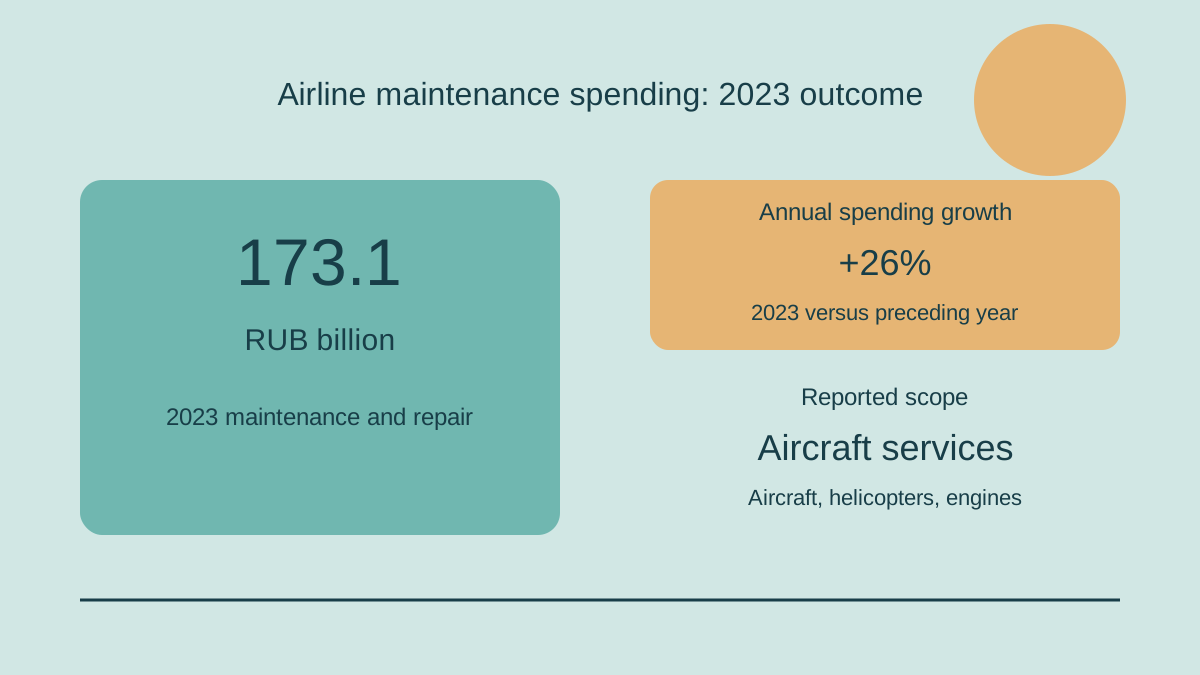
Maintenance and repair spending by airlines in Russia rose by 26 percent in 2023 to 173.1 billion rubles, according to an Interfax report published on April 26, 2024, citing materials from the industry’s air transport operators association. The reported category covers aircraft, helicopters and aircraft engines.
The annual spending figure is not a unit price for a repair. The original analysis below explains the distinction with an invented two-service account. All job counts and monetary units in that account are hypothetical, and neither service category represents a specified aviation procedure. The calculation does not reconstruct the reported costs, explain their actual causes or assess maintenance quality. It shows which extra observations would be needed to separate the quantity of work, its composition and its unit charges.
A category total contains more than a quoted rate
A spending total combines the amounts attached to the entries included in its category. A unit charge describes an amount for a defined service unit. The two quantities are connected only after the services and their counts have been identified. If an account includes several service types, its total can change when a charge changes, when the number of units changes, or when the proportions of those units change. The annual total by itself does not identify which of these movements occurred.
The reported category also has a stated scope. A discussion of one repair price would be narrower than a category covering maintenance and repair across several kinds of aviation equipment. An analyst cannot resolve that difference by selecting a representative-sounding job and assigning the category’s growth rate to its price. The selected job would need its own observations. The broad category remains informative as a spending measure, while a statement about a particular price requires a more specific unit and a comparable charge.
Dates are part of the scope as well. The publication belongs to 2024, but the annual result described in its opening concerns 2023. Treating publication year as spending year would move the observation to another period. A follow-up can preserve both dates without difficulty: one tells the reader when the report appeared, and the other tells the reader which annual account it describes. Neither date supplies a missing service-level price series, so the interpretation must still remain proportionate to the reported total.
Construct two service lines with explicit units
For the invented account, call the categories service A and service B. In period one, service A has 50 counted units at a charge of 2 abstract monetary units each. Its spending is 100. Service B has 10 counted units at a charge of 10 each, also producing spending of 100. Combined spending is therefore 200 monetary units. The account has 60 counted service units, but the labels do not imply that one A unit requires the same work as one B unit.
In period two, service A has 40 counted units at a charge of 2.5, producing spending of 100. Service B has 20 counted units at a charge of 12, producing spending of 240. Combined spending is now 340. The total number of counted units remains 60. Total spending has risen by 140, or 70 percent relative to the original 200. This percentage belongs entirely to the invented account and must not be substituted for the reported annual growth rate.
Several changes coexist in the account. The charge for A has risen by 25 percent, and the charge for B by 20 percent. The count for A has fallen, while the count for B has risen. A reader can reproduce each line by multiplying its own count by its own charge. That line-level transparency explains why a 70 percent increase in the combined bill is not a 70 percent increase in either unit charge. The total reflects charges and the changed composition of counted services together.
Hold the earlier service mix fixed to examine charges
One comparison applies the new charges to the old counts. Fifty A units at 2.5 would cost 125, and ten B units at 12 would cost 120. The resulting hypothetical bill is 245. Compared with the first period’s 200, the difference is 45, or 22.5 percent. This is a charge comparison weighted by the first period’s service composition. It answers what the invented earlier set of counted services would cost at the invented later charges.
That question is useful precisely because it specifies what stays fixed. It does not claim that the second period actually contained the first period’s counts. Its 245-unit total is an alternative calculation, not a third observed period. Describing it as the actual second bill would erase the real second-period counts in the model. Describing its percentage as a universal rate increase would also hide its weights. The fixed composition belongs beside the result so that another reader can reproduce its meaning.
Changing the weights would change this comparison. A different invented starting account with many more B units would place more weight on B’s 20 percent charge increase. An account dominated by A would place more weight on A’s 25 percent increase. Both calculations could be correct for their specified starting sets. There is no reason to expect one unweighted average of those percentages to describe every possible service mix. The weighting choice is therefore part of the calculation, rather than a detail to omit after obtaining a convenient number.
Hold the earlier charges fixed to examine composition
A second comparison applies the old charges to the new counts. Forty A units at 2 would cost 80, while twenty B units at 10 would cost 200. The hypothetical bill is 280. Compared with the initial 200, the difference is 80. Total counted units remain 60, but their composition has shifted toward the more expensive B category at the old charges. This illustrates a mix effect within the invented count-based account, rather than an increase in total counted units.
The distinction between count and workload must remain explicit. Sixty counted services in each period do not establish equal labour hours, equal complexity or equal equipment availability. The example supplies none of those measures. Its stable total count is sufficient for demonstrating a change in category composition, but insufficient for a claim that the amount of work stayed constant in every practical sense. A real workload comparison would need its own defined unit and records, rather than borrowing the count because it is already available.
The two categories are intentionally generic. Naming A as a particular inspection and B as a particular repair would invite the reader to infer technical equivalence, duration or necessity that this account does not establish. The arithmetic needs only counted categories and charges. It can explain why different service proportions change a combined bill without suggesting how any aircraft should be maintained. A clear analytical example is stronger when its labels do not smuggle in unsupported operational assumptions.
The order of a spending bridge changes its components
The total difference between the invented periods is 140. Starting with the old counts, a charge-first bridge moves from 200 to 245, adding 45. Updating the counts after that moves from 245 to 340, adding another 95. The sum is 140. This bridge is internally consistent, but its second component values the count changes at the new charges. Calling that component a pure change in physical workload would overstate what the calculation represents.
A count-first bridge instead moves from 200 to 280 at the old charges, adding 80. Updating the charges afterward moves from 280 to 340, adding 60. Again, the sum is 140. The two bridges reach the same endpoint but allocate the difference differently. The difference between their charge components is 15, and the difference between their count components is also 15 in the opposite direction. This is not an arithmetic error; the calculation order assigns the combined effect differently.
For an explicit three-part account, the old-count charge effect is 45, the old-charge count effect is 80, and the remaining combined effect is 15. Together they equal 140. The combined term can be reproduced directly: A’s count change of minus ten multiplied by its charge change of 0.5 gives minus five; B’s count change of plus ten multiplied by its charge change of two gives plus twenty. Their sum is fifteen. This decomposition is chosen for the example and is not a measured explanation of the reported airline spending.
An average bill per counted service is a mixture
Dividing the initial bill of 200 by 60 counted units gives approximately 3.33 monetary units per counted service. Dividing the later bill of 340 by 60 gives approximately 5.67. Both are rounded to two decimal places. Neither average equals the charge for A or B. They are averages across the account’s chosen categories. The average can therefore rise because of changed charges, changed category proportions, or both, even though it is expressed as an amount per counted unit.
A reader should be cautious when the phrase “average repair cost” has no accompanying description of the counted unit. It could mean a bill per account entry, per completed job, or per some other defined observation. Those alternatives are not interchangeable. The invented example chooses counted service units and keeps that choice visible. It does not make its average comparable to any real published repair-cost average without evidence that the units, category coverage and observation periods match.
The same limitation applies to using fleet size as a convenient denominator. A total divided by a fleet count would produce spending per counted aircraft under a defined coverage, not a price for a maintenance service. The example does not provide a fleet denominator, because it is unnecessary for its question. Adding one would require defining whether the fleet observation and spending account concern the same equipment and period. A readily available count is not automatically the denominator that answers the author’s intended question.
Separate a billed service from the timing of payment
The invented multiplication account treats each line as an amount assigned to counted services within its defined period. It does not specify when cash was paid. A payment record could belong to a different period from a service record, so a cash total and a service-assigned bill total need not describe the same set of events. This is a definition problem for the proposed account, not a claim about how the airlines in the report recognise expenses or settle invoices.
An additional illustrative record could store a service date, an invoice date and a payment date separately. The author would then choose the relevant date for the question being asked and state that choice. Combining service quantities from one window with cash payments from another would produce a ratio whose numerator and denominator might not concern the same entries. Keeping the dates distinct allows a reader to see that mismatch before interpreting the result as a unit charge.
Missing dates should remain missing rather than being supplied from whichever date is most visible. An invoice announcement does not necessarily establish the service date, and a payment date does not necessarily establish when the underlying work occurred. A short explanatory note can preserve the uncertainty without making the article unreadable. The point is to keep each total attached to the events it actually counts. More precise wording follows from a precise account, rather than from additional decimal places in the output.
A follow-up needs service-level evidence for a price claim
The reported annual total can introduce a question about the sources of spending change, but it cannot answer that question alone. A follow-up attempting a unit-charge comparison would need compatible observations for the same defined services. A follow-up attempting a mix comparison would need category counts. The following fields form an original explanatory record for that purpose. They are neither a required reporting standard nor a description of an airline’s actual records.
- Category coverage: specify which services and equipment enter the account. A broad maintenance-and-repair category should not silently become a narrower claim about one repair type.
- Counted unit: state what one unit represents and preserve the definition between periods. Equal counts do not automatically establish equal hours, complexity or operational workload.
- Assigned amount: identify the amount attached to each counted service category and the monetary unit used. An undisclosed unit charge remains undisclosed rather than being inferred from an aggregate growth percentage.
- Observation period: attach the same comparison window to counts and amounts, and distinguish the service period from publication, invoice or payment dates where those distinctions affect the question.
- Comparison weights: show which period’s counts weight a charge comparison. If the bridge changes charges first or counts first, state that order so its components can be interpreted and reproduced.
- Evidence status: label the real reported total, the invented arithmetic and any alternative comparison separately. A correct teaching calculation does not become independent evidence of the actual causes behind the total.
The starting observation remains the association-attributed annual spending figure reported by Interfax, with its spending year and publication date preserved. The invented account shows why an aggregate increase cannot be assigned directly to a repair price. Counts, composition, charges and their combined effect each have a role in a defined comparison. A useful next report would add the relevant service-level observations, rather than asking the annual total to supply a price explanation it does not contain.