A forklift renewal programme can make an equipment register look healthier well before its operational benefit is established. Baltika’s announcement offers a useful case for examining that distinction. The 16 July 2025 Interfax report concerns the brewer’s operations in Russia and attributes the information to its press service. The relevant management question is how to move from a change in fleet composition to a demonstrated improvement in the service delivered by that fleet. This analysis proposes an evidence framework for answering that question. It does not claim access to Baltika’s maintenance records, dispatch data or internal approval process.
What the announcement establishes
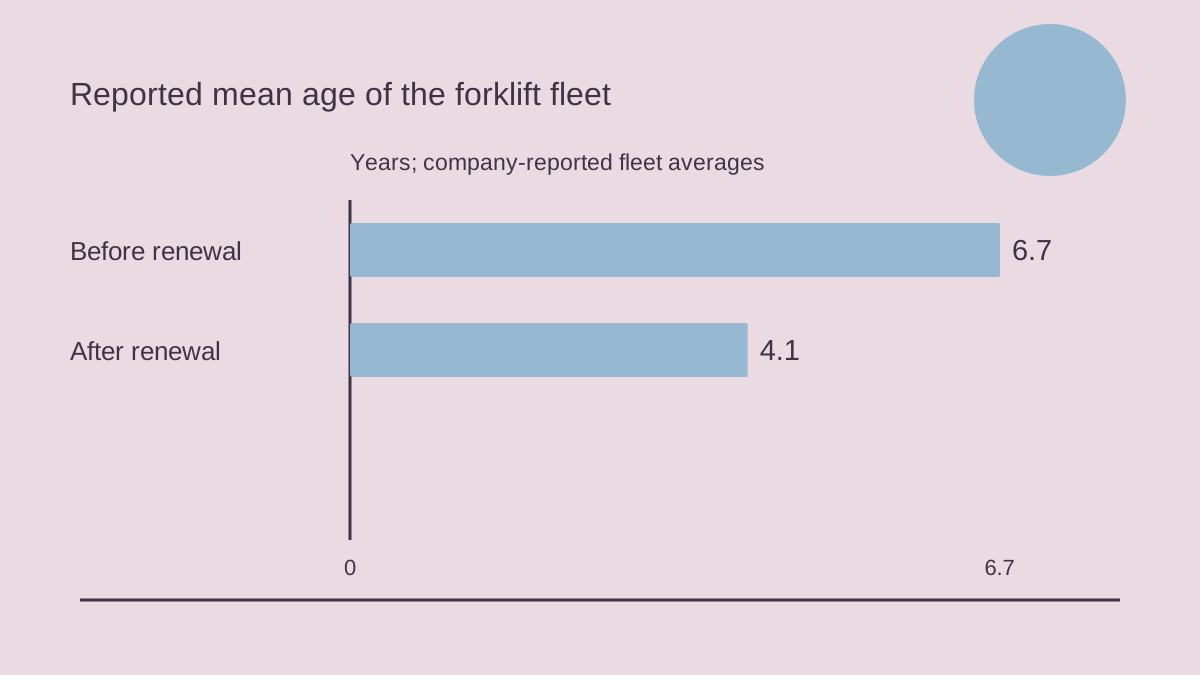
Baltika reported spending more than RUB 300 million on forklift renewal in spring 2025, without disclosing the number purchased. Its reported average fleet age fell from 6.7 to 4.1 years, and electric forklifts reached 50% of the forklift fleet. The company expected lower repair costs and said new equipment could account for a third of its logistics equipment by year-end. Those statements distinguish reported changes from an anticipated benefit. They also use different populations and dates: the electric share of forklifts and the prospective new-equipment share of logistics assets should not be treated as interchangeable percentages.
A same-day Vedomosti Northwest report also attributes the announcement to the company. Two publications carrying the same company-origin information do not constitute two independent measurements of repair savings. Their value here is to clarify the public reporting boundary. The announcement describes a programme and the company’s expectations, while the operating outcome remains a separate evidential question. That distinction permits a substantive analysis without inventing a return on the expenditure, a unit purchase price or a productivity gain. Each of those calculations would require inputs that the public announcement does not supply.
Average age is a composition measure
A lower average age describes the assets included in a calculation. It does not describe every asset, the distribution of working hours or the pattern of failures. A fleet with a few heavily used older machines can have the same average age as a fleet whose workload is more evenly distributed. These are hypothetical alternatives, rather than observations about Baltika. Their purpose is to show why an average cannot replace an asset-level record. Before interpreting the age change, an analyst should establish which machines enter the calculation, when their ages are measured and whether additions, removals or changes in the reporting boundary affect the comparison.
The operating question should then be attached to the relevant task. If a particular machine supports a time-critical movement, its availability may matter more to that task than the age of the fleet as a whole. Conversely, an older asset assigned to occasional work may have little influence on the busiest movement. This suggests a practical division between the equipment register and the service record. The register describes what the business owns or uses; the service record describes what those assets accomplish and when they are required. A renewal assessment needs both, connected through consistent identifiers, so an apparent improvement in one can be evaluated against the purpose of the other.
Define the service before measuring improvement
A proposed service definition should state the movement required, its completion point and the relevant time window. Counting movements without these qualifications can hide a change in the work itself. A short, straightforward movement and a more demanding movement are not necessarily equivalent units of service. For a useful comparison, the organisation should identify the task mix and record enough context to distinguish them. This is an analytical design principle, not a technical specification for operating a forklift. The public announcement does not identify Baltika’s tasks or their distribution, so no company-specific throughput estimate can be constructed from it.
The definition also needs to distinguish a completed task from a machine being present on site. An asset may be included in the register while awaiting commissioning, repair or assignment. Whether it should count as available depends on the agreed measure and the relevant period. A proposed assessment should therefore document the state being measured, rather than use “availability” as an undefined positive label. This prevents a change in recording practice from appearing to be a change in service. It also gives operations and maintenance a common question to resolve: whether the required task could be performed at the time it was needed.
Compare like workloads across time
A before-and-after comparison becomes more informative when it accounts for workload. Fewer breakdowns during a quiet period do not necessarily establish a lower failure rate under comparable use. Similarly, higher repair spending during a busy period does not automatically establish that equipment quality has deteriorated. A proposed operating record should therefore connect failures and maintenance activity with an appropriate measure of exposure, such as recorded operating time or clearly defined completed work. The choice depends on the task and the quality of the available records. It should be agreed before the result is inspected, so the denominator is not selected merely because it produces an attractive outcome.
Matched comparisons can also examine similar tasks or locations over comparable periods, while explicitly noting the differences that remain. This does not imply that every site provides a clean experimental control. Staffing, dispatch patterns and other changes can affect the result. The appropriate response is to document these potential influences and qualify the inference. A comparison may provide useful evidence without proving that renewal caused every observed change. The distinction between a measured association and a causal attribution is especially important when several programmes proceed together. Nothing in the published announcement identifies a design that would isolate Baltika’s renewal effect from all other operational influences.
Turn failure reports into a service record
A useful fault record should show the time a problem was reported, the time the asset became unavailable and the time it returned to the defined service. These timestamps answer different questions. A repair completed quickly after work begins may still follow a long wait for diagnosis or parts. Conversely, a recorded fault may not remove the machine from every task. The proposed record should preserve those distinctions instead of reducing each event to a single label. It should also identify whether the event was scheduled maintenance, an unplanned interruption or a change in assignment, because those categories should not silently become interchangeable.
Repeated events deserve a connection to the previous repair, rather than an entirely new entry without history. That connection can help distinguish a recurring problem from unrelated interruptions and show whether a corrective action produced a durable improvement. The point is to improve the evidence used in a renewal review, not to prescribe a diagnosis or make a safety judgement. Qualified operational staff remain responsible for technical decisions. At the analytical level, the records should allow a reviewer to trace how an interruption affected the agreed service and which part of the response consumed time. Without that trace, a lower repair invoice might coexist with an unresolved service interruption.
Evaluate costs over a consistent boundary
Repair expenditure is one part of an operating assessment. A proposed comparison should state whether it includes internal maintenance time, external service, replacement parts and other costs relevant to the chosen decision. If the boundary changes between periods, the apparent saving may partly reflect where costs are recorded. The same discipline applies to costs paid by another department or included in a service arrangement. They should be identified according to a stated rule rather than omitted because they are less visible in a workshop ledger. The announcement’s expectation of lower repair costs is therefore a question to test using a defined boundary and a comparable period.
The review should distinguish an observed reduction from an avoided cost estimated against a hypothetical alternative. An observed reduction compares recorded expenditure on a stated basis. An avoided cost depends on an assumption about what would have happened without the renewal. Both can inform a decision, but they carry different evidential weight. A proposed paper should identify the assumption, its source and the person responsible for it. It should also avoid counting the same benefit once as lower repair spending and again as a reduction in the cost assigned to interrupted work. Those measures may overlap, and a documented reconciliation is needed before they are added.
Fleet composition and readiness are separate tests
The share of electric equipment describes composition, while readiness concerns whether the equipment and its supporting arrangements can deliver the required service. A proposed review should connect the asset decision with the resources needed for its use, the responsibility for maintaining those resources and the contingency when they are unavailable. This is a planning question, not a claim that Baltika has a particular infrastructure limitation. The published percentage supplies no evidence of the condition or capacity of supporting facilities. It also does not quantify the company’s emissions, energy costs or operating performance. Those outcomes require their own definitions and measurements.
Replacing an asset can change the pattern of resources required even when the underlying movement task remains the same. A decision record should therefore state which supporting arrangements are included in the project and which are provided through existing operations. If responsibility is unclear, the apparent completion of an equipment purchase can precede completion of the service arrangement. The analytical remedy is to identify dependencies and obtain confirmation from the team that owns each one. It does not follow that the chosen technology is unsuitable. It follows that a technology share and a functioning service are different observations, and the latter should be verified on its own terms.
Locate the constraint in the whole movement
A more reliable machine does not automatically shorten every dispatch delay. In a hypothetical process, the task could wait for an instruction, a loading position or a receiving operation even when a machine is available. A proposed renewal review should therefore examine where time is spent across the complete movement, rather than attribute all waiting time to equipment. This gives the fleet decision a clear operating context. If the equipment was the relevant constraint, the records should show how removing its interruptions affected the agreed service. If another constraint dominates, renewal can still improve reliability while leaving the wider completion time largely unchanged.
The comparison should also preserve the distinction between a local improvement and a group-wide effect. A change that helps one location may have a smaller effect elsewhere because the work and constraints differ. A proposed rollout should specify which features make sites comparable and which require a separate assessment. The announcement that renewal reached the company’s regions does not supply those site-level findings. No uniform saving should therefore be inferred from the geographic coverage. A disciplined review can aggregate local evidence only after the underlying definitions have been aligned and differences have been retained, rather than erased by a single group average.
Make the acceptance evidence explicit
The following proposed checklist turns the announcement into questions that an operations team could answer. It describes an analytical approach, rather than Baltika’s documented internal procedure. Its purpose is to prevent the completion of purchasing from becoming the sole proof of operational success. Each item should identify the evidence required, the period covered and the person who can confirm it. A project can then be reviewed against the service it was intended to improve. Open items remain visible instead of being absorbed into a general statement that the fleet is newer, more modern or expected to cost less.
- Confirm the assets included in each age, composition and availability measure, with consistent dates and identifiers.
- Define the required movement service and record workload, task mix and interruptions on an agreed basis.
- Reconcile maintenance costs across departments and separate observed reductions from estimated avoided costs.
- Confirm responsibility for supporting resources, service arrangements and unresolved operational dependencies.
- Compare the resulting evidence with stated objectives, recording limitations and the conditions for a further review.
Acceptance criteria should be fixed before the team sees the final result. Otherwise, the review can drift toward whichever indicator happens to improve, leaving the original service objective unanswered. A proposed paper should specify what would count as success, what would trigger investigation and what remains undecidable with the available evidence. It should also identify a review period long enough for the agreed comparison, without pretending that one short observation establishes permanent performance. These are choices to document, not thresholds that can be derived from Baltika’s announcement. The public figures do not provide the inputs for a company-specific acceptance rule.
Read the renewal as the start of verification
The public announcement establishes a reported investment and a change in fleet composition. It also identifies an expected benefit that can be tested. A sound reading preserves that distinction: age and equipment shares describe the renewal, while repair savings and service improvement require operating evidence. The analytical framework proposed here links assets to tasks, tasks to interruptions and costs, and those records to a review with explicit responsibilities. It does not substitute assumed efficiency for missing measurements. That restraint is what makes the framework useful: it identifies the work needed to establish a result, instead of presenting the intended result as already achieved.
For a retailer, manufacturer or warehouse operator considering a similar decision, the transferable lesson concerns evidence design. Begin with the service that needs to improve, define a comparable observation and state the cost boundary. Then examine whether the equipment change contributed to the observed result, retaining other influences and unresolved questions. Baltika’s July announcement provides the occasion for that analysis, rather than a dataset capable of answering every part of it. The renewal may deliver the anticipated benefits, but a confident operating conclusion should follow the records that demonstrate them. A younger fleet becomes a verified business improvement when its measured contribution to the required service supports that conclusion.