The useful question behind a convincing simulation
Manufacturing Dive’s 1 July 2026 report describes discussions at Automate in Chicago, the United States. Vention executive Brendan Sterne discussed AI-assisted simulation, while Acme Manufacturing’s Patrick O’Neil stressed that automation still requires process-specific configuration. These are attributed speaker assessments, rather than an independent measurement of deployment results.
The distinction between a plausible digital demonstration and a usable production model is the central management issue. A screen can show a robot moving around a part, picking an object and reaching a destination. Those movements become useful for a factory decision only when the model’s assumptions correspond to the intended task. The question is not merely whether the picture looks realistic. It is whether a change considered in the model tells the project team something dependable about the physical cell it plans to build or modify.
This analysis proposes a way to frame that question. It concerns the evidence needed to use a model for a specific production decision; it does not certify a robot cell, prescribe a safety procedure or claim that a named supplier has passed the proposed review. Faster preparation of a model can be valuable, but preparation speed and model validity are different properties. A team needs to keep both in view if it wants a digital experiment to reduce uncertainty rather than give an uncertain decision a more persuasive visual form.
Define the decision before adding detail
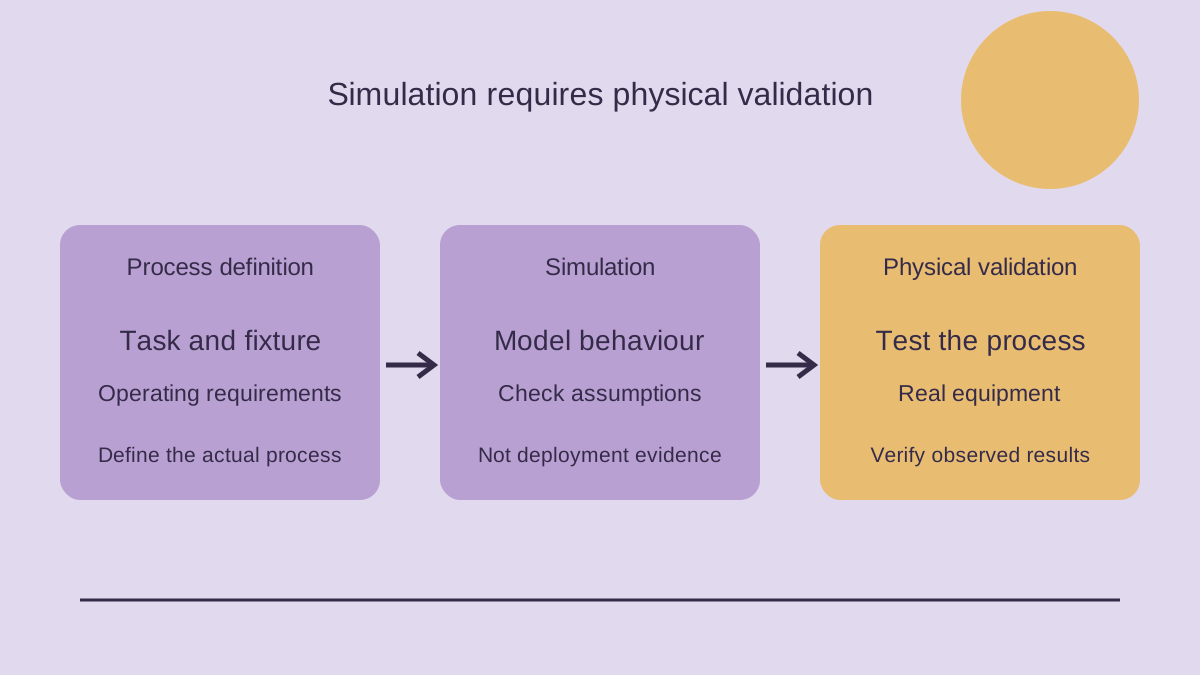
A model should begin with a decision stated in ordinary production language. The team may want to compare two layouts, examine whether a proposed sequence leaves enough time for a downstream operation, or investigate how a different fixture changes access to a part. Each question calls for different information. A layout comparison may require reliable geometry without requiring a detailed representation of every surface property. A gripping question may depend on properties that a general layout model does not describe. More visual detail is not automatically more useful evidence.
Defining the decision also establishes the boundary of the model. If the model ends when a robot places a part on a conveyor, it cannot by itself establish the throughput of a complete line that includes inspection, packaging and material replenishment. If it assumes an uninterrupted supply of parts, it cannot determine the consequence of an empty feed position. These limitations do not make the model worthless. They identify the question it can help answer and the questions that still require another source of evidence.
A useful project note would therefore state the decision, the represented process, the inputs taken as fixed and the outcomes to compare. It would also state what a favourable result would allow the team to do next. That last point prevents a digital exercise from becoming detached from the actual project. A model can support a choice between proposed layouts without being treated as approval to commission a complete production system. Keeping the next decision explicit makes the exercise easier to evaluate and easier to stop when it has answered its intended question.
Geometry needs an accountable origin
A simulated robot cell contains representations of several physical objects: the robot, its tool, the part, a fixture, surrounding equipment and the spaces through which material moves. Those representations need an identifiable origin. A project team should know whether a dimension comes from a current drawing, an older equipment record, a measured installation or a placeholder. The issue is not that every placeholder must disappear immediately. It is that an uncertain dimension should remain recognisable when the team uses the model to compare alternatives.
Configuration matters as much as the general shape. A tool attached to a robot changes the working arrangement; a fixture can alter the approach to a part; a different part variant can change a previously clear movement. A model of the right machine family may still represent the wrong installed configuration. For a layout enquiry, the team can ask which configuration the model represents and which objects have been simplified. This keeps a familiar equipment name from standing in for the actual geometry required by the decision.
Version information belongs beside the geometry. If a fixture drawing changes after the model is prepared, a convincing demonstration may continue to show the old arrangement. The team needs a practical way to identify the represented revision and the decision that used it. This need not involve a complex new reporting platform. A dated record connecting the model, the relevant drawings and the proposed comparison can be enough to make an assumption visible. The important point is that the geometry remains traceable as the physical design develops.
A motion sequence is not a cycle-time result
A digital movement can explain a sequence without establishing its duration under production conditions. The model may animate a pick, a movement and a placement while omitting waiting, inspection, retries or a change in the supplied part. The production question is therefore about the events included in the timing result. A team should ask where the clock starts, where it stops and which events are represented. An attractive animation should not silently turn an incomplete sequence into an asserted cycle time.
Waiting deserves separate attention because it often sits between the visible movements. A machine may wait for a part, a signal or space at the next station. A model that assumes those conditions are always satisfied can be useful for studying movement, but its timing result has a narrower meaning than a whole-line production rate. The team can preserve that meaning by separating represented movement time from assumed waiting conditions. This prevents a change in one part of the cell from being credited with an improvement that depends on an unexamined condition elsewhere.
Comparisons require the same boundary for both alternatives. If one proposed layout includes a checking step and the other omits it, their displayed durations do not answer a fair comparison question. The team should first align the included activities, then examine the differences caused by the proposed change. Where an activity remains outside the model, the project note can describe the separate information needed. This makes the timing discussion about equivalent work and avoids a claim of improvement produced by changing the definition of the task.
Make variation visible instead of hiding it in an average
Production involves variation in parts, presentation and the sequence of work. A digital model can be valuable precisely because it lets a team examine how a proposal behaves when a stated assumption changes. The choice of variations should follow the decision, rather than the desire to generate a large number of simulated runs. For a part-transfer question, relevant variations might concern the represented part position or the order in which different variants arrive. Those are example enquiries, not a claim about conditions at the companies mentioned in the source.
The team should distinguish a normal represented case from a case chosen to test a boundary. A model can show a smooth run under its normal assumptions while still needing examination of a delayed input or a part variant. Recording the distinction helps readers understand what a result means. It also prevents a selected difficult case from being presented as the expected frequency of a production problem. Testing a possibility and estimating how often that possibility occurs are different analytical activities and may require different information.
Results should retain the variation that matters to the decision. An average duration can conceal the difference between a consistently moderate sequence and a sequence with occasional long delays. That difference may affect a downstream station even when the averages appear similar. The model review can therefore ask which outcomes are reported, which cases produced them and which assumptions govern those cases. The objective is a clear explanation of the represented behaviour, not the invention of a precise probability when the available input data do not support one.
A hypothetical cell clarifies the boundary
Consider a hypothetical cell that transfers three part variants from a fixture to a checking station. The example is invented to explain the method and does not describe an actual supplier installation. Suppose a model represents all three variants with the same placement position and shows a completed transfer sequence. That result may help explain the proposed layout. It does not establish that the physical feed arrangement will present every variant in that position or that the checking station will always be ready to receive the next part.
The project team could separate the enquiry into three comparisons. First, does the represented geometry cover the intended variants and fixture arrangement? Second, how does the model behave under specified changes in part presentation? Third, what information is needed about availability at the checking station? These comparisons do not require the team to assume a fault in the actual design. They make explicit which part of the decision the model addresses and which part depends on another process. A favourable answer to the first question cannot automatically answer the third.
If the model helps the team choose a fixture arrangement, that is a useful result within the stated boundary. The next step can then seek evidence about the remaining dependencies. The team need not reject the model because it does not represent an entire factory. It should avoid extending the result beyond the question that was tested. This hypothetical example shows how a narrow model can provide practical value while remaining honest about its scope, and how a broad-looking demonstration can remain inconclusive when its assumptions are not visible.
AI assistance changes preparation, not the need for evidence
An assistant that helps retrieve technical information or prepare model objects can change the amount of work needed to begin an experiment. The management question is how the resulting inputs are checked. A fluent description of an equipment specification is not enough to show that the correct equipment configuration was selected. A prepared model object is not enough to show that its dimensions correspond to the drawing used by the project. The useful boundary separates assistance in preparing an input from acceptance of that input for the comparison.
The team can ask for the origin of each material input, the revision represented and any unresolved mismatch. If an assistant combines information from several documents, the result should not obscure which document supports a particular specification. If it creates a simplified object, the simplification should remain visible in the model note. These are proposed information controls, not assertions about undisclosed software implementations. Their purpose is to let a project reviewer examine the basis of a result without needing to reconstruct every step of model preparation from memory.
Revision creates a second challenge. A model can be prepared quickly and still become outdated when a tool or part changes. The team should know which changes require another comparison and which leave the existing result relevant to its original question. That judgement should be tied to the represented process and the decision boundary. Preparation speed is most useful when it enables a timely, traceable revision; it is less useful if a quickly generated result loses its connection to the design that the physical team is actually implementing.
Physical evidence should answer the remaining questions
A model review should leave a clear list of questions for physical evaluation. Those questions may concern the represented configuration, the behaviour of a supplied part or the timing of an interface between stations. The list is a bridge between the digital exercise and the project’s next activity. It is not a substitute for technical commissioning or applicable safety checks. The team should preserve the distinction between a result that supports a design comparison and evidence that a physical system can perform the required task under its intended conditions.
The physical evidence should use a comparable definition of the task wherever a comparison is intended. If the digital exercise ends at placement and the physical observation includes inspection, the two durations need different labels. If the installed fixture has changed, the team should identify that change before interpreting the difference. A mismatch between digital and physical results can be useful information, but only when the compared activities and configurations are clear. Otherwise, the project risks treating a change in measurement boundary as a change in performance.
A team can use the comparison to improve its understanding of the model. It can record which assumptions were supported, which need revision and which remain untested. This creates a practical learning record for the next design choice without pretending that one comparison validates every possible application. The value lies in knowing more about the represented cell than the team knew before the exercise. A model becomes a better decision tool when its limitations are updated alongside its successful comparisons, rather than removed from the discussion after a convincing demonstration.
Acceptance is a statement about a defined use
The end of a digital exercise should produce a clear statement about the use supported by the result. A team might accept the model for comparing two fixture arrangements while leaving timing and material presentation for further enquiry. That is a more informative conclusion than a general declaration that the digital twin works. It tells the next project participant what can be used, which revision the result concerns and which unanswered questions should accompany the result when it is passed to another team.
- State the factory decision and the process boundary before interpreting the display.
- Identify the origin and revision of the represented geometry and configuration.
- Keep movement duration, waiting assumptions and whole-line output separate.
- Describe the variants and boundary cases actually examined.
- Check assisted inputs against identifiable information rather than fluent descriptions.
- Carry the remaining questions into physical evaluation with comparable task definitions.
The discussions reported at Automate point toward more capable preparation tools and evolving automation software. Their practical value still depends on the relationship between a represented process and an actual production decision. A factory team can make that relationship clearer by defining the task, recording the assumptions and preserving the limits of the result. The strongest outcome is a decision whose basis another person can examine, with a clear next step for what the model has not yet established.