
A wider search needs a more precise description
In a 27 July 2026 Manufacturing Dive report, Sara Samora describes experts’ advocacy for skills-based hiring and broader recruitment of people with disabilities at a 22 July webinar. The discussion concerns manufacturing in the United States. These are attributed proposals, rather than a measured result for every employer.
The practical management question is how to turn a wider recruitment intention into a process that produces relevant evidence. Removing a broad education filter can open a conversation, but the employer still needs to explain the work and understand what the applicant can contribute. A factory role combines tasks, information, equipment and interaction with other people. Assessing it through a vague title can hide the difference between an ability needed immediately, an ability developed through training and an inherited requirement that nobody has recently connected to the actual job.
This analysis proposes a task-centred approach to that distinction. It does not determine a person’s medical condition, establish employment-law obligations or promise a particular productivity result. Its purpose is to examine how an employer can describe work, gather appropriate evidence of skill and connect selection with training. The approach treats an applicant as an individual and makes the job’s requirements visible. A disability label, an impressive qualification or a fluent interview answer should not silently replace evidence about the particular task under discussion.
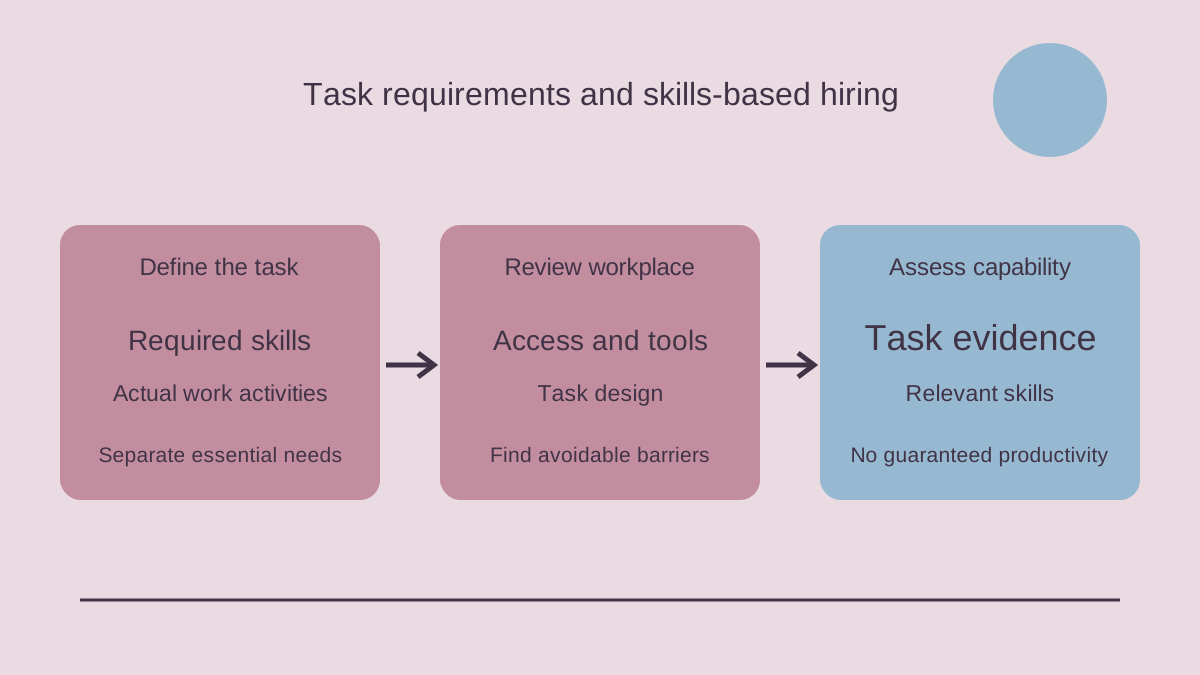
Describe the work before choosing the filter
A useful job description begins with the work that the person will perform. A production role might include understanding a work order, identifying the required material, following a defined sequence, checking a result and communicating an unresolved question. These are illustrative activities, not a description of a specific employer’s vacancy. The employer should determine which activities belong to its actual role and how they connect. A broad phrase such as general factory duties leaves too much room for different interviewers to assess different things.
The description should also distinguish the task from the conventional way it has been presented. Reading a work instruction, interpreting its content and acting on it are related but different activities. The organisation needs to know which capability it is trying to assess and which features of its presentation are merely familiar habits. A change in the presentation of information can be evaluated against the same intended work outcome. This is not an assumption that every task can be redesigned in the same way; it is a request to identify the actual requirement before judging a candidate against it.
That distinction makes recruitment more useful to the production team. Interviewers can explain why a requirement appears in the vacancy and which part of the work it supports. Applicants can discuss relevant experience instead of guessing what a broad label means. Where the team cannot connect a filter to a task, it has a question to resolve before using the filter to exclude people. The result should be a clearer description of the job, including what remains to be learned, rather than a vacancy that simply replaces one fashionable hiring phrase with another.
Separate evidence of skill from a proxy for it
A qualification or previous job title can be useful information, but it is a proxy for a capability rather than a complete observation of the work. Two applicants with similar credentials may have practised different activities. An applicant with an unfamiliar employment history may still be able to explain a relevant sequence or identify an error in a work record. The employer needs a defined question about the task before deciding what a credential establishes and what additional evidence would be useful.
A discussion of a past example can produce more information when the interviewer asks what the person did, what information they used and how they checked the result. The emphasis is on the applicant’s contribution to a relevant activity. A polished general account of teamwork does not necessarily show the skill needed for a particular handover, while a modest account of a specific task may explain it well. This does not mean that one interviewing method is suitable for every role. It means the evidence should remain connected to the capability the employer is considering.
The employer can record the evidence and its limits. A candidate may demonstrate an understanding of a process without yet having experience on the employer’s equipment. That is a useful distinction for a training plan. It should not be converted into either a claim of complete readiness or an automatic judgement of unsuitability. A task-based assessment becomes stronger when it can describe what was shown, what was not examined and what the employer expects to teach. That record is more informative than a single impression formed from an unfamiliar qualification or employment background.
Make the assessment accessible to the skill being examined
An assessment needs to let the candidate provide evidence of the intended capability. The employer should ask whether an incidental feature of the assessment prevents it from observing that capability. For example, a question intended to examine interpretation of an instruction may also depend on how the instruction is presented. The team needs to distinguish the interpretation question from the presentation barrier. This is a proposed review of assessment design, not a legal determination about an individual adjustment or an inference about any applicant’s health.
Different ways of presenting an instruction can still support a comparison of the same intended outcome if the employer defines that outcome clearly. The task, the information required and the basis of assessment should remain visible. Where a proposed change affects what is being measured, the team should identify that effect rather than assume that all formats are equivalent. The point is neither to make the work standard disappear nor to preserve an incidental obstacle simply because previous interviews used it. It is to make the assessment a useful enquiry about the role.
The applicant can be part of the discussion about the practical arrangement for the assessment. The employer should keep that conversation focused on what is relevant to presenting evidence of the task. It need not turn the selection exercise into a request for an account of a person’s medical history. A clear description of the assessment makes it easier to identify a workable arrangement and to understand what the resulting evidence means. The candidate and interviewer can then discuss the same activity instead of making assumptions from the label attached to a person.
A hypothetical work-order exercise shows the distinction
Consider a hypothetical role that includes checking a material identifier against a work order and explaining what to do when the two do not agree. The example is invented and does not describe a hiring process reported by the source. The employer might use a sample record to discuss the task, without asking an applicant to operate production equipment. Its intended enquiry is whether the candidate can understand the information, recognise the mismatch and explain the appropriate route for an unresolved question.
The team can specify what the exercise examines before interpreting an answer. It might distinguish identification of the mismatch from knowledge of an internal reporting route that a new employee has not yet been taught. It might also distinguish understanding the record from speed of navigating an unfamiliar presentation. The exercise can provide useful evidence about the first capability while leaving the other questions for explanation or training. This avoids treating an applicant’s lack of familiarity with the employer’s own documents as proof that the applicant cannot perform the underlying task.
The employer can then connect the result with the role. If the person explains the mismatch clearly, the team has a basis for a further conversation about relevant experience and learning needs. The example does not guarantee successful employment and does not replace role-specific qualification, technical or safety requirements. It shows how a narrow, defined assessment can produce a clearer record than a broad judgement about factory suitability. A useful conclusion states the capability examined, the evidence obtained and the questions that remain for the next stage.
Training should begin where the evidence ends
Selection and training should have a visible connection. If recruitment identifies relevant general skills but leaves employer-specific information unexamined, the training plan should identify that gap. The organisation can distinguish the ability to interpret a work record from knowledge of its own document system, or experience of a handover from familiarity with its own reporting route. These distinctions make it possible to explain what a new employee is expected to learn rather than assume that successful selection establishes complete readiness for every activity.
A practical training note could identify the task, the information to be introduced, the person responsible for instruction and the evidence used to understand progress. It should separate attendance at a session from demonstrated understanding of the relevant activity. Neither should be treated as an automatic description of independent readiness on equipment. This article does not prescribe a technical training or authorisation procedure. The management point is that the organisation needs an explicit connection between the training it provides and the work it expects the employee to perform.
The employee’s questions can improve that connection. A repeated question about an instruction may reveal that the instruction needs clarification, that a process boundary is unclear or that further explanation is needed. The team should examine the question rather than immediately attach it to a general judgement about the person. This is an opportunity to understand the relationship between the learner and the task. A training record can preserve what was explained, what was demonstrated and what still requires attention, giving the next instructor a more useful starting point than a vague impression.
Regional partnerships need a defined handover
A recruitment partnership can be useful when it connects candidates, training organisations and employers around a clearly described role. The employer should explain which capabilities the role requires and which activities it will teach. The partner can then help candidates understand the opportunity and prepare relevant evidence. A broad request for factory-ready applicants gives the partner less useful information than a task description with a clear training boundary. This is a proposed way to organise a partnership, not a claim about a named organisation’s undisclosed recruitment practices.
The handover should distinguish information about an applicant’s relevant experience from assumptions about what that experience means. A partner may know that someone completed a learning activity; the employer still needs to understand its content and relationship to the vacancy. Equally, an employer’s task description should not leave a partner guessing which qualification filters are essential and which are inherited preferences. A clear handover helps the organisations discuss equivalent requirements while leaving individual selection decisions connected to the evidence actually obtained.
Partnership success also needs a defined measure. The number of people referred, the number entering training, the number taking a role and the experience of those employees describe different stages. A referral total does not establish retention, while a successful training activity does not establish the outcome of every subsequent placement. The parties can decide which stage they are trying to improve and which information would show useful progress. This prevents a recruitment initiative from being judged only by the most visible early number while its practical purpose remains unclear.
Retention is a question about work after the offer
A wider recruitment process is incomplete if the employer learns nothing about the employee’s experience of the actual work. Once a person joins, the task description can be compared with the activities they encounter. Differences may concern the information provided, the sequence of work, the training available or the handover between teams. A role can have a clear selection process and still need a better explanation at the workplace. The relevant enquiry is about the specific difference, rather than an assumption that a broad group characteristic explains an individual’s experience.
The employee and supervisor can use concrete examples to discuss those differences. Which instruction was unclear? Which task required information that was not available? Which training activity helped, and which question remains unresolved? These examples can help the organisation understand its own process. They should not be converted into a diagnosis or a universal conclusion about employees with disabilities. The usefulness of the conversation comes from its connection to the actual role and the individual’s experience, with the task and the relevant support arrangement described plainly.
A retention record should also keep its time boundary visible. An early conversation describes an early stage of employment; it does not establish the experience of a whole year. A resolved information problem can be recorded as resolved without implying that every workplace question has disappeared. The employer can review the specific issue when new evidence appears. This makes the process a continuing enquiry about work rather than a one-time declaration that recruitment was successful. It also gives a subsequent supervisor a clear account of what was changed and why.
Judge the process by the evidence it produces
A task-based approach changes the question asked of recruitment. The employer is no longer relying only on whether a candidate matches a broad familiar profile. It is asking what evidence supports the person’s ability to perform defined activities, what remains to be learned and how the organisation will support that learning. Those questions can improve the clarity of the vacancy and the usefulness of the assessment. They do not remove uncertainty about a future working relationship, and they should not be presented as a guarantee of a particular outcome.
- Connect each selection requirement to an identifiable activity in the actual role.
- Distinguish a credential or job title from the capability it may indicate.
- Define what an assessment examines and identify incidental barriers to presenting evidence.
- Keep demonstrated skills and employer-specific learning needs separate.
- Give recruitment partners a task description and a clear training boundary.
- Use concrete workplace examples to review the role after employment begins.
The source discussion offers a reason to examine broader recruitment and the use of skill evidence. The practical next step is a better-defined process: a role explained through tasks, an assessment connected to those tasks and a training plan connected to the evidence. That structure lets an employer consider an applicant as an individual while making its own expectations easier to examine. The strongest result is a selection and learning record that another participant can understand, with the remaining questions stated rather than hidden behind a general impression.