
In an interview published by Manufacturing Dive on 29 June 2026, Furnace Record Pressing chief executive Ali Miller described the producer’s willingness to handle both small and large record runs. That is an attributed statement about the business, rather than a measured comparison of its production times. It raises a separate planning question: what happens to preparation workload when an unchanged number of items is divided among a different number of orders?
The following analysis is original. All quantities and time allowances below belong to invented workload models. They are not estimates for Furnace, vinyl pressing or any real production process. The models separate effort attached to an order from effort attached to an item. This distinction makes it possible to compare two portfolios with identical output while avoiding an unsupported claim that identical output must require identical work.
Output and the arrangement of orders
Imagine a fictional workshop with an accounting period containing one thousand items. One portfolio contains a single order for all one thousand. Another contains ten orders of one hundred each. The output totals agree exactly. The order counts do not. If some preparation occurs separately for every order, the second portfolio presents ten preparation episodes where the first presents one. Counting only the items conceals this difference before any question of the duration of preparation is considered.
An order in this example is a defined work package requiring its own preparation. It is not automatically identical to a customer, a product design or a delivery. A customer could place several work packages, and several deliveries could belong to one package. The model needs an explicit counting boundary because otherwise a change in terminology could appear to change workload. The useful unit is the event to which the assumed preparation allowance actually applies.
Nor does the contrast prove that one large order is preferable. The portfolios may serve different requirements, and the example supplies no revenue, customer value or actual operating constraints. It identifies a measurement gap: total item output does not reveal the number of preparation episodes behind that output. A comparison can preserve that observation without turning it into a recommendation to reject smaller customers or to combine orders that need to remain separate.
A deliberately simple workload calculation
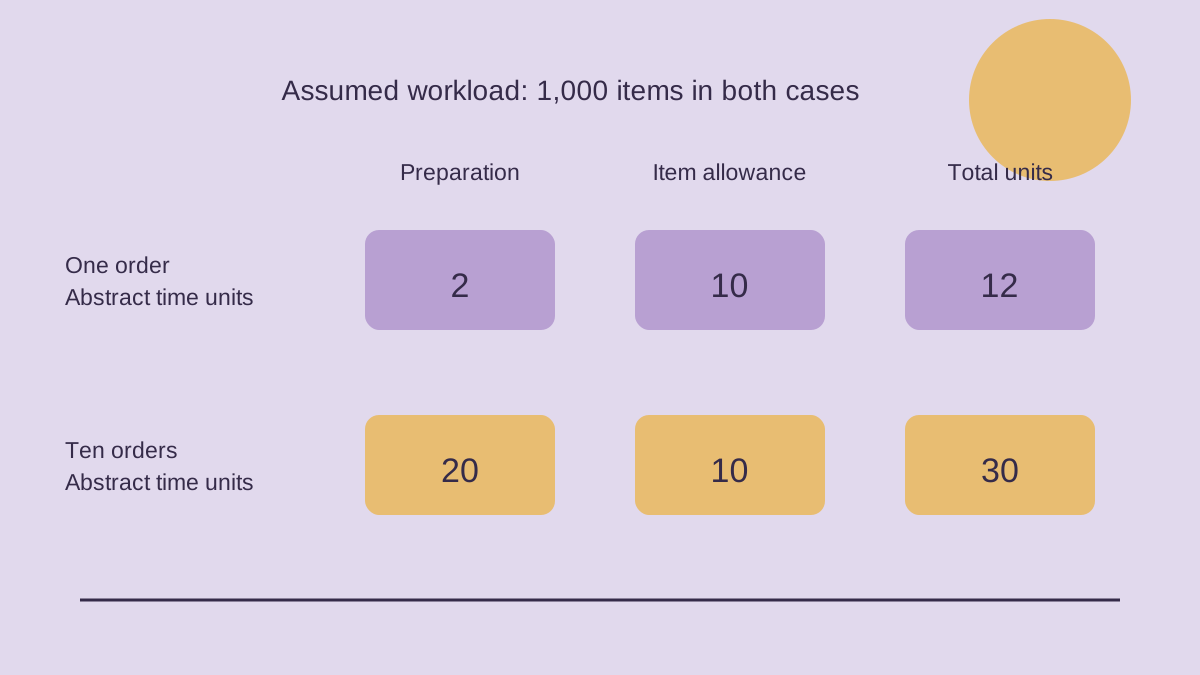
Assign an invented preparation allowance of two time units to every order. Assign an invented run allowance of one hundredth of a time unit to every item. These are abstract allowances chosen only to make the arithmetic visible. For one order containing one thousand items, preparation contributes two units and the item allowance contributes ten. The total recorded workload is twelve time units. Nothing in this construction identifies real minutes, machine speeds or staffing requirements.
For ten orders containing the same one thousand items, preparation contributes twenty time units. The item allowance still contributes ten. The total is thirty. The difference of eighteen comes entirely from the nine additional preparation episodes, each carrying the assumed allowance of two. The example has held the item quantity and per-item allowance constant. It therefore isolates order count as the changing input rather than disguising a change in product difficulty as a change in portfolio size.
The same calculation can be written in words: total workload equals order count multiplied by the preparation allowance, plus item count multiplied by the run allowance. This expression describes the stated model and its boundaries. It does not establish that actual preparation is constant, that actual processing is linear or that every workshop follows this structure. Its purpose is to show what a unit total omits when a separately counted order-level activity exists.
Average order size is a partial description
Dividing one thousand items by ten orders gives an average order size of one hundred. Dividing the same output by one order gives one thousand. Under the identical preparation allowance already stipulated, the average helps explain why preparation per item differs. In the first case, twenty preparation units are spread across one thousand items. In the second, two are spread across the same quantity. These are allocation descriptions within the model, rather than observed costs for a real manufacturer.
The average becomes less informative when orders have different preparation allowances. Consider another invented portfolio of ten orders, still totalling one thousand items. Five orders require one preparation unit each; five require three each. Preparation totals twenty, matching the previous ten-order example. Replace the mix with eight one-unit orders and two three-unit orders, and preparation totals fourteen. Both portfolios have ten orders and the same average size, yet their stated preparation workloads differ.
This extension does not invalidate the original calculation. It changes an assumption that was previously fixed. It shows why a comparison should disclose whether the preparation allowance is common to all orders or varies by a defined class. Average size can remain useful while being insufficient to describe the class mix. The wider lesson is to avoid asking one portfolio average to encode both quantities and differences in the activities associated with those quantities.
Preparation episodes need a counting rule
An order can contain several distinct preparation episodes in a more detailed fictional model. Suppose one work package is divided into two independently prepared parts. The package count is one, while the preparation count is two. A formula based on package count would understate the stipulated workload if it continued to apply only one allowance. The counting rule must follow the activity being represented, rather than whichever commercial label happens to be convenient on the order form.
The reverse possibility also needs a stated rule. Two commercial orders might share one preparation episode in an invented arrangement. In that case, two orders do not automatically mean two separate preparations. The original model explicitly assumed an independent preparation for every order; the shared arrangement changes that premise. It cannot be introduced silently while retaining the old interpretation of the order count. Showing the changed boundary makes the new calculation understandable and prevents apparently contradictory totals.
For a workload comparison, the following definitions would clarify the imagined record. They are proposed fields for this analysis, not claims about Furnace’s internal systems:
- The item quantity included in the accounting period.
- The commercial order count, using a stated definition.
- The independently counted preparation episodes.
- The allowance associated with each preparation class.
- The item-level allowance and the activities it includes.
- The treatment of shared, repeated or unfinished preparation.
With these definitions, a reader can tell whether an apparent reduction comes from fewer episodes, a different allowance or a different boundary. Without them, a shorter total may merely reflect work that has disappeared from the record rather than work that has disappeared from the proposed portfolio.
Combining orders changes more than a total
Within the first simple model, replacing ten independent orders with one order reduces the preparation allowance from twenty to two. The item allowance remains ten. That arithmetic is valid for the defined replacement. It does not establish that ten real orders can be combined without changing their requirements. The model supplies no evidence about delivery destinations, customer approvals, deadlines, distinct contents or any other condition that could make the orders independently meaningful.
A careful interpretation therefore states the condition: preparation workload falls if the replacement genuinely reduces the number of independent preparation episodes while preserving the assumed item workload. The condition is doing essential work. Merely assigning one common reference number to ten unchanged episodes does not satisfy it. That would alter the visible order count while leaving the preparation activity count intact. The arithmetic must track the activity rather than the appearance of administrative consolidation.
The same distinction protects comparisons between periods. If a fictional workshop changes how it groups orders on paper, a fall in recorded order count may not indicate a fall in preparation work. A comparison needs either a consistent episode definition or an explanation of the changed definition. Otherwise an administrative change could be mistaken for an operating improvement. The example offers no actual improvement claim; it explains the evidence needed to interpret such a claim.
Shared preparation requires a different allowance
A fictional arrangement might allow part of preparation to be shared while another part remains independent. Suppose each of ten orders retains one time unit of individual preparation, and the group needs a further two units of common preparation. The preparation total is twelve, rather than twenty or two. With the unchanged item allowance of ten, workload totals twenty-two. This is a third model, not a correction to either of the earlier models.
The three totals describe three different boundaries. Thirty applies when every order independently receives the full two-unit preparation. Twelve applies when there is one preparation for the entire replacement order. Twenty-two applies when common and individual activities are separated using the new allowances. Selecting among these descriptions requires knowledge of what is actually shared in the imagined arrangement. Calling an activity shared does not prove that all of its associated work has become common.
This reasoning can guide the wording of a proposal without predicting its result. The proposal could identify the activity intended to be shared, the individual activities retained and the observations that would test the distinction. Until those observations exist, the revised allowance remains an assumption. A transparent conditional calculation is still useful: it shows where an expected difference comes from and what would have to be true for that difference to describe the work.
Work quantity is different from calendar duration
The abstract totals so far represent amounts of work counted by the model. They do not specify the elapsed time from starting the first order to finishing the last. Two preparation episodes might occur at the same time if the invented setting allowed independent resources. Alternatively, one resource might perform them sequentially. The workload total can remain unchanged while the calendar arrangement differs. The example has not supplied a resource schedule, so it cannot establish either elapsed duration.
Even a sequential arrangement would require more information to promise a completion date. The accounting period might begin before some materials or approvals are available. Work could be interrupted, or completed items could await a later activity omitted from the model. These are possible conditions in an imagined schedule, rather than claims about any manufacturer. Their relevance is logical: an amount of stipulated work is not a complete description of when that work can occur.
A workload statement should therefore retain its own unit and scope. Thirty abstract time units under one set of allowances can be compared with twelve under another set. It cannot be converted into a promised number of days without additional assumptions about resources, availability and ordering. Preserving the distinction allows preparation load to be discussed precisely without presenting a small arithmetic example as a scheduling analysis for a real factory.
Unfinished and repeated preparation affect the record
Suppose the fictional accounting period ends after a preparation has begun but before its associated items are completed. A record counting only finished items could omit work already performed. A record assigning every preparation entirely to completed orders could make the following period appear unusually burdensome. These alternatives illustrate why the timing boundary matters. They do not prescribe a financial accounting policy; they concern the interpretation of the activity quantities used in this workload example.
Repeated preparation introduces another distinction. If an invented order needs its preparation performed twice, the commercial order count remains one but the episode count becomes two. Applying the allowance once would fail to represent the stipulated repetition. It would also obscure whether a difference between portfolios arises from more independent orders or more repeated work within the same orders. Those are different explanations even when their totals happen to be identical.
A useful comparison can identify preparation planned, preparation started and preparation completed as separate observations. These states should not be treated as interchangeable evidence. A planned episode contributes to a proposal; a completed episode contributes to a record of performed work. Comparing an estimate for one portfolio with an observed total for another requires explaining that difference. Otherwise the reader may assume that both numbers describe the same kind of evidence within the same period.
Allocation does not establish a price or a margin
In the first model, preparation per item is two divided by one thousand for the single order, and twenty divided by one thousand for ten orders. Those ratios describe how the stipulated preparation workload is spread across output. They do not identify a monetary rate for a time unit. They also do not identify other activities, overheads or commercial terms. A workload allocation therefore cannot independently establish a selling price, a profit margin or a financial saving.
One can make the distinction visible by holding the workload model apart from any imagined commercial decision. The portfolio with thirty work units has a larger stipulated load than the portfolio with twelve. Whether it also has greater value to a fictional business is a separate question for which the example provides no inputs. A smaller workload does not alone measure service value, customer relationships or the reasons for maintaining a varied order portfolio.
This limitation gives the calculation a clear purpose. It diagnoses a difference that an output total can conceal. It does not decide which customers deserve service or which order structure a real manufacturer should prefer. By staying within its scope, the model remains informative without borrowing the authority of a business interview to support commercial conclusions that neither the interview nor the arithmetic has demonstrated.
Reading an output total with its preparation boundary
The interview’s discussion of small and large runs does not supply measured preparation allowances. Its role here is to introduce a question about how an order portfolio is described. An item total answers how many items are included. An episode count answers how many independently counted preparations are included. A preparation-class record shows whether equal episode counts carry equal assumed allowances. These descriptions can agree in some comparisons and differ materially in others.
The invented examples retain one thousand items while changing one aspect at a time: the number of independent orders, the mix of preparation classes or the boundary between common and individual preparation. That method makes the explanation inspectable. A changed workload total has an identified cause within the stated assumptions. It cannot be mistaken for an observed change in Furnace’s productivity, and it does not require inventing the producer’s machinery, timings or private customer arrangements.
The resulting insight is practical but narrow. Identical output is compatible with different preparation loads when the activities behind the output are arranged differently. To interpret the difference, define the preparation episode, disclose the allowance and preserve the boundary between work quantity and elapsed time. These steps turn an attractive output comparison into a more informative workload comparison while leaving real scheduling, product requirements and commercial decisions to the evidence appropriate to those questions.
Source: Manufacturing Dive, 29 June 2026. All workload calculations and fictional examples are original.