A monetary result is the beginning of the enquiry
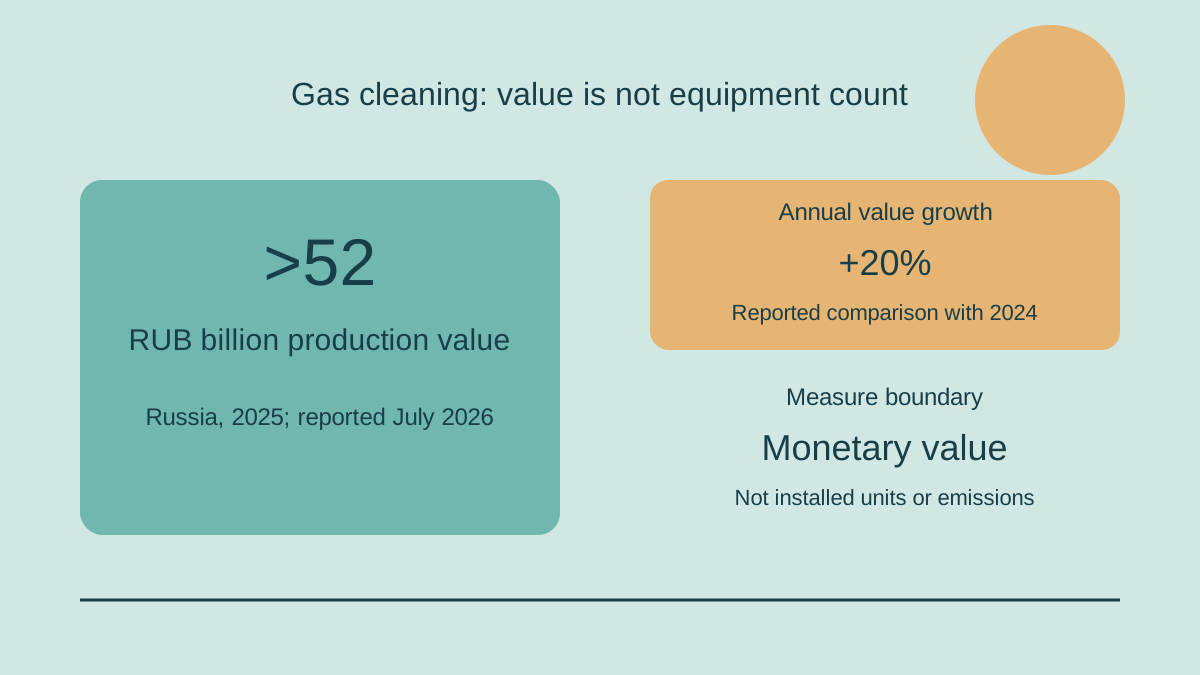
Interfax reported on 8 July 2026 that deputy industry minister Alexey Matushansky put 2025 domestic gas-cleaning equipment production in Russia above 52 billion rubles, up 20%. The measure is monetary production value, not a count of installed systems or a measured change in emissions.
This distinction determines how a factory should read a growing equipment market. A monetary total describes the reported scale of production. It does not tell a particular plant which equipment suits its process, how much installation work remains, or what evidence will support an assessment of the completed project. A market can become larger in money terms while the useful information for a buyer still needs to be assembled at the level of an individual operating system.
The practical analytical task is to connect those levels without confusing them. A market report can provide context for a discussion about supply. A plant project requires a description of the task, the equipment proposal, the interfaces with the existing process and the evidence expected after installation. The framework below is an original way to organise that discussion. It does not establish regulatory compliance, specify an engineering design or claim a particular improvement at any factory mentioned by the source.
Separate price, quantity and the mix of projects
Production value can change for several reasons. More equipment can be produced, the price of comparable equipment can change, or production can shift toward a different mix of systems. The reported monetary total alone does not allocate the change among those possibilities. A reader should therefore resist converting a percentage increase in value into the same percentage increase in installed capacity, equipment units or useful operating output. Those are different measures, and the source would need different information to establish them.
Consider a hypothetical producer supplying one hundred identical units at one hundred accounting units each. Its production value would be ten thousand accounting units. If the same quantity were valued at one hundred and twenty accounting units each, the total would be twelve thousand, a 20% increase with no increase in unit count. These invented numbers illustrate arithmetic only. They do not estimate the actual price movement or output of the reported market, and they do not establish that price explains its reported growth.
Product mix creates another boundary. One large integrated system and several smaller equipment items may have very different values and installation requirements. Counting them as units would also require a clear definition of the unit. A meaningful comparison should identify the measure and preserve its scope. A plant buyer can use the monetary figure as market context while asking separate questions about the relevant equipment category. This keeps the discussion from presenting a broad value measure as a detailed description of the supply available for one production process.
The factory question starts with operating conditions
A procurement enquiry for gas-cleaning equipment needs to describe the operating task before comparing general supplier statements. The intended process, the variation in operating conditions and the interface with existing equipment determine which questions the supplier must answer. This is a proposed structure for information gathering, not a technical design specification. The buyer should seek an accountable description of the conditions that the offer assumes, rather than infer suitability from the growth of the whole equipment market.
A supplier proposal can distinguish information provided by the plant from assumptions made to prepare the offer. That distinction is especially useful when an early enquiry contains gaps. An assumption may be reasonable for preparing an initial discussion, but it should remain visible until the appropriate project participant confirms it. Otherwise, an apparently precise proposal can conceal an unresolved input. The resulting difficulty may concern scope rather than the quality of the supplied equipment: the parties have not yet established that they are discussing the same operating task.
The buyer can also ask how a change in the stated conditions affects the proposal. If a production process is expected to operate in several modes, a single description should not silently stand for all of them. The project note can identify the represented modes and the questions that remain open. This does not assert that any actual plant has unstable conditions. It establishes a clear basis for evaluating the offer and prevents a general equipment description from being mistaken for evidence of suitability in every possible operating situation.
Equipment supply and installation have different boundaries
A quotation for equipment does not necessarily describe a complete installed project. Installation can involve interfaces with existing structures, utilities, process controls and access arrangements. The commercial enquiry should make clear which activities are included and which are to be organised separately. A buyer comparing quotations needs comparable scope before interpreting a price difference. A lower quoted figure may concern a narrower package rather than an equivalent completed system, while a broader package still needs a clear statement of its limits.
The useful record is an interface list linked to responsibilities. It can identify the points where equipment supply meets site work and where one participant needs information from another. The list is not an engineering instruction for how to make those connections. Its purpose is to explain which organisation is expected to resolve a question, what information it needs and how that resolution will be recorded. A project can have capable participants and still face delay if the boundary between their activities remains implicit.
Schedule comparison should follow the same principle. Equipment dispatch, arrival at site, completion of installation and readiness for evaluation describe different events. A supplier’s dispatch date does not itself establish when the factory can assess the operating result. The project team can place the events in a sequence and identify the dependencies between them. This makes the schedule useful for organising work around an existing production process and avoids crediting a delivery milestone with a level of completion that it does not yet represent.
State what an operating result would actually measure
A claim about successful operation needs a defined measure and a defined boundary. A project may be discussed in terms of equipment availability, process performance, maintenance requirements or a measured environmental outcome. These measures answer different questions. An installed system can be available for use while a particular performance question still requires evaluation. Conversely, a favourable observation over a selected period does not automatically describe performance under every operating mode. The evaluation plan should preserve those distinctions before results are interpreted.
The project team can identify the intended observation, the relevant operating conditions and the period represented. It can also identify the information needed to compare the observation with the original proposal. This article does not prescribe emission limits, measurement methods or compliance procedures. It proposes that the commercial and management discussion should clearly state which evidence is being used for which conclusion. A statement of completion, a performance observation and a compliance determination should not be treated as the same kind of record.
Changes in the underlying production process should remain visible in a comparison. If the operating mode or the represented material flow differs between two observations, the team needs to know that before attributing the difference to the equipment project. A result may still be informative, but its interpretation has a narrower boundary. The strongest management record explains the observed result, the conditions under which it was obtained and the unanswered questions. It avoids turning one favourable number into a universal judgement about the whole system.
A hypothetical project shows the handover problem
Consider a hypothetical factory replacing equipment while retaining part of its existing process infrastructure. This example is invented and does not describe a project reported by Interfax. Suppose the supplier has delivered the equipment and the site team has completed its planned installation work. Those are meaningful milestones. They do not yet establish that every interface has been checked against the project’s intended operating task or that the evaluation record contains the information needed by the team that will operate the system.
The next enquiry could distinguish three questions. What was supplied and installed? Which operating conditions have been represented in the evaluation? What information is still required before the operating team can interpret the result? Each question can have a different accountable participant. The project need not assume a defect to ask them. It needs a handover record that connects the delivered configuration, the completed site work and the observed behaviour. Without that connection, an administrative completion statement can leave the operating team uncertain about the meaning of the result.
The example also shows why a market-level growth figure cannot resolve a project-level uncertainty. A larger equipment market does not identify the unresolved interface at this hypothetical factory. Nor does it explain the conditions represented by a particular observation. The buyer can recognise the relevance of the market report while keeping the project assessment separate. This is a distinction between scales of evidence, not a prediction that the equipment will fail or an accusation that a supplier has made an unsupported statement.
Maintenance belongs in the operating enquiry
The assessment of an equipment project should consider how the operating team will obtain the information and support needed over time. An offer can identify the relevant maintenance information, the scope of supplier support and the dependencies on other participants. The factory can then ask whether those items match its intended operating arrangement. This is a management enquiry about continuing usefulness, not a proposed maintenance procedure and not a judgement about the service practices of any named supplier.
Consumables, replacement components and access to appropriate information deserve separate entries in that enquiry. Availability in a catalogue is different from availability when a particular operating team needs an item. A supplier’s general support statement is different from a defined response for the supplied configuration. The buyer can request a clear identification of the relevant items and the information supporting the availability statement. Where the response remains conditional, the condition should remain visible in the record rather than disappear beneath a broad promise of support.
The team should also preserve the distinction between planned operating arrangements and observed experience. An early proposal can describe a maintenance assumption, while later records can show how that assumption compares with use. The two records can be connected without pretending that the initial assumption was already a measured result. This makes the operating review useful for future enquiries and helps the team understand which information was supported, which changed and which still needs attention. It also keeps a one-time installation milestone from becoming the sole description of a continuing equipment relationship.
Supplier comparisons need equivalent questions
A growing monetary market can bring more attention to supplier choice, but supplier comparison still requires equivalent questions. The buyer should identify the process represented, the installation scope included, the support proposed and the evidence expected for the result. If the proposals differ on those points, their prices and schedules need corresponding explanations. The aim is a comparison that helps the project team understand the tradeoffs in the actual offers, rather than a ranking based on a single figure detached from scope.
Broad statements about domestic manufacturing or market competitiveness do not answer every project question. The buyer needs information about the relevant product configuration and the task it is expected to perform. A general statement can provide context, while a project response should identify the basis of a specific assurance. The comparison should avoid assuming that a supplier’s place in the wider market establishes suitability for every factory. It should equally avoid assuming that a smaller commercial presence rules out a useful, well-defined proposal for a particular operating need.
The outcome can be a short comparison note rather than a complicated scoring exercise. It can show the agreed question, each supplier’s answer, the supporting information and the unresolved differences. This record lets another participant understand why the team considers one proposal more suitable for the defined task. It does not require the editor to recommend a supplier or make a financial judgement about the factory. The practical value lies in exposing differences that matter to execution while keeping uncertain answers recognisable as uncertain.
Keep the project evidence separate from the headline
A market result is most useful when its measure remains visible. A factory can use that context without converting it into a statement about physical units, completed installations or measured environmental outcomes. Its project assessment should then proceed through information matched to the operating decision: the represented conditions, the included scope, the interfaces, the observation and the support needed after handover.
- Keep the monetary measure and its reporting period visible.
- Separate possible price, quantity and product-mix effects without inventing their contribution.
- Identify the operating conditions represented by the supplier’s proposal.
- Compare equivalent supply, installation and support scope.
- Define the observation and its conditions before interpreting a performance result.
- Preserve unresolved interfaces and dependencies in the handover record.
The growth headline and the factory enquiry can complement each other when their boundaries remain clear. One provides context about a reported market; the other provides a basis for understanding a particular equipment project. Connecting them requires disciplined questions rather than an assumption that growth already proves useful operation. A buyer’s strongest conclusion is one supported by identifiable project evidence, with a clear record of what the available information establishes and what the next enquiry still needs to resolve.