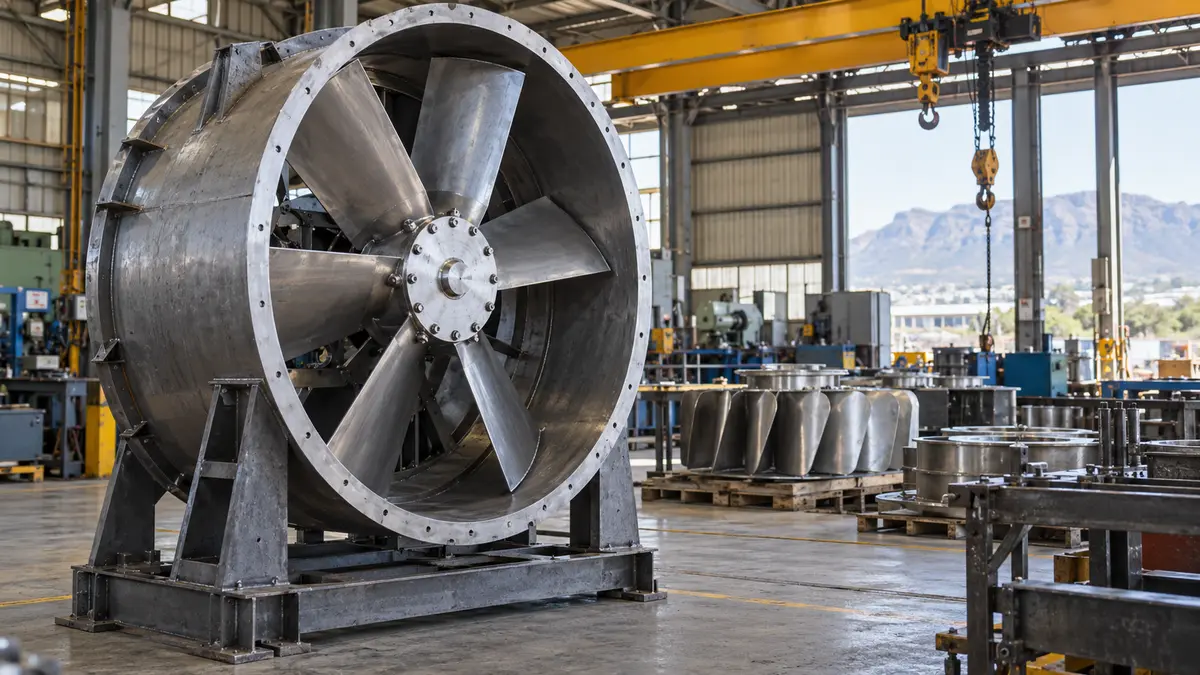
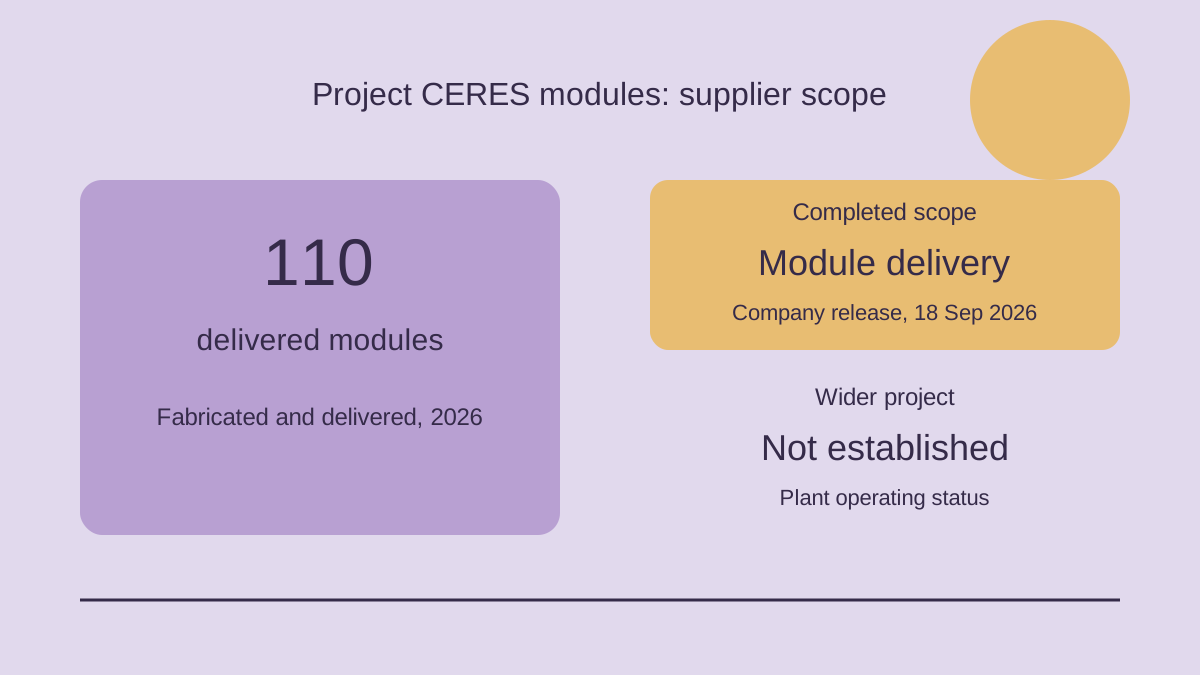
Australian Manufacturing reported on September 22, 2026 that Larsen & Toubro had completed fabrication and delivery of 110 modules for Project CERES in Karratha, Australia. The company's primary release presents modularisation as enabling parallel execution. Those are attributed statements about a defined delivery scope, rather than a measurement of the whole plant's operating status.
The original management analysis below examines the calendar meaning of parallel work. Its examples are invented, describe no actual CERES schedule and make no claim about engineering suitability or financial results. The central distinction is between adding task durations and measuring elapsed time through their dependencies. Working at more than one location does not, by itself, tell a reader which activities can overlap or which one determines the final date.
A completed scope needs a named endpoint
Completion is a relationship between work and its stated endpoint. A fabrication scope, a delivery scope and a complete operating project can have different endpoints. A report that identifies the first two does not automatically identify the third. Preserving the object of the completion statement is therefore essential. The reader should be able to tell what the reported milestone covers without importing a broader milestone from the surrounding project description.
This distinction can be made without questioning the achievement. A completed module scope can be substantial on its own terms. The analytical mistake would be to use that result as evidence that every other activity has also reached its endpoint. Conversely, discussing a wider project does not turn a completed supplier scope back into an unfinished one. The two statements can coexist because their boundaries differ, rather than because one cancels the other.
In an invented project record, each completion statement could therefore name the work package, the condition being reported and the observation date. A separate line could identify the wider endpoint whose calendar is under discussion. These are proposed reporting fields, not a reconstruction of the company's actual records. Their purpose is to retain the scope of evidence before a reader begins reasoning about the total project duration.
Task durations do not automatically add up to elapsed time
Consider a deliberately simplified hypothetical project with two independent activities, called the first branch and the second branch. The first takes three days and the second takes five days. A two-day joining activity can begin only after both branches finish. Assume both branches can start together, all necessary resources are available and no other work enters the model. Their combined task durations sum to ten days, but the model's elapsed duration is seven days.
The seven-day result follows from waiting for the longer branch, which finishes after five days, and then adding the two-day join. It is not obtained by adding three and five before the join. The shorter branch finishes two days before the longer one, but that earlier finish does not make the joining activity available immediately. The dependency rule still requires both inputs. The distinction comes from the sequence of permitted starts, not from ignoring work.
If the same branches must instead be performed consecutively, the model takes three plus five plus two, or ten days. No individual activity has become slower. The change is that the overlap has been removed. These calculations describe two different sets of assumptions, not a measured saving at a real plant. A claim that parallelisation shortened an actual schedule would require evidence of both the applicable dependencies and the baseline against which the calendar was compared.
The longer branch can determine the joining date
Within the seven-day hypothetical model, shortening the first branch from three days to one day does not change the joining date. The second branch still finishes after five days, and the join still requires two more. The project remains seven days long. Two days have been removed from one task's duration, but zero days have been removed from the model's elapsed duration. Both observations are correct under the stated assumptions.
Shortening the second branch from five days to four, while keeping the first at three and the join at two, changes elapsed duration to six days. Now the latest required input arrives a day earlier. The example shows why the location of an improvement inside a dependency structure matters. It does not establish that the longer activity deserves priority in every real project, where other objectives, constraints and evidence may be relevant.
A reader can therefore ask which endpoint moves when an activity is reported as faster. The answer might concern a local finish, the availability of a downstream input or the final modelled date. Naming the endpoint avoids assigning a whole-project effect to every local change. The arithmetic remains conditional: adding another dependency or changing a resource assumption can alter which branch determines the joining date.
Independence must be stated, rather than assumed from distance
Two activities performed in different places are not necessarily independent. Independence in the hypothetical model means that neither branch waits for an output from the other and that both can use the required resources at the same time. Geography alone does not establish either condition. A calendar explanation needs to describe the relevant relationship between activities, even if a headline describes the physical separation of their locations.
For example, the toy model could assign both branches to one shared resource that can perform only one branch at a time. Under that added condition, the branches cannot overlap, despite having no output dependency between them. They take eight days in sequence before the two-day join, producing ten days overall. This is an invented resource constraint used to explain the calculation. It identifies no actual resource bottleneck at CERES.
The distinction between a dependency constraint and a resource constraint helps keep the explanation precise. One says that an input must exist before work starts. The other says that a required means of doing the work is not simultaneously available. Both can prevent overlap, but they require different evidence. Removing one condition does not prove that the other has disappeared, and describing parallel work does not identify which constraints remain outside the reported scope.
A joining point is more informative than a count of simultaneous tasks
A list of tasks happening at once can describe activity without explaining the final calendar. The joining point shows where their outputs are needed together. In the invented example, it is the two-day activity after both branches. Without that point, the reader could see two early finishes and still have no basis for determining the project's endpoint. The model needs a connection between the branches and the question being measured.
Additional joins can make the relationship more complex, but complexity does not justify hiding it. A written explanation can identify which branches feed which endpoint and which reported dates refer only to intermediate work. It need not reproduce a detailed operational plan. For an editorial analysis, a small explicit dependency model is more useful than a broad statement that all workstreams run together when the underlying conditions have not been established.
A task count also cannot substitute for that structure. Three short tasks and one long task are four tasks, but their number does not reveal elapsed time. Nor does a count of physical modules identify the work relationship between them. A unit count belongs to the scope description; a dependency calendar belongs to the timing description. Linking them requires additional information rather than a percentage formed from the count alone.
Reported delivery and downstream readiness are different observations
A delivery milestone identifies movement within a named scope. A downstream activity may use that delivery as one of its inputs, but the milestone alone does not list every other required input or establish a start date. In the hypothetical dependency language, completing one branch is not equivalent to completing the join. This is a boundary of inference, rather than a claim that the actual project's downstream work is late or incomplete.
The same restraint applies to descriptions such as ready to install. Such wording identifies a stated condition of the delivered object; it does not supply a complete calendar for the receiving project. This analysis does not independently assess installation requirements or technical readiness. It asks only that a report retain the object and condition being described instead of treating a supplier's milestone as an observation of a different endpoint.
If a later report covers a broader endpoint, that new evidence can be presented separately with its own date and scope. There is no need to force every milestone into one interchangeable status. A sequence of precisely named observations can show progress more clearly than a single completion label that changes meaning between paragraphs. Historical reporting benefits from retaining what each source actually established at the time it was published.
A comparison needs the same baseline and boundary
The invented seven-day and ten-day calendars are comparable because they contain the same activities and endpoint; their overlap assumption differs. If one calculation excluded the joining activity, it would answer a narrower question. If another included additional work before the branches, it would answer a broader one. Calling either difference a saving without explaining the boundary would confuse changed coverage with changed execution.
A fair calendar comparison can therefore keep a short list of included activities alongside the assumed relationships. The baseline also needs a defined start. Beginning one clock at fabrication and another at a later delivery milestone changes the elapsed interval even when the underlying sequence is identical. A smaller number is not sufficient evidence of a faster process if the observation window begins later or finishes earlier.
Resources belong in that comparison as well. The ten-day shared-resource model and seven-day independent-resource model differ in more than the arrangement of boxes on a schedule. One permits simultaneous access to a necessary resource; the other does not. This article assigns no real cost or availability to that difference. It keeps the assumption visible so that a calendar illustration does not become an unsupported claim that overlap is free or universally feasible.
Uncertainty belongs to the inputs, not just the final date
The toy durations are exact because they were chosen for explanation. Actual reporting may instead contain an expected duration, an observed finish or a date that has not been supplied. Those are different forms of information. An unknown duration should not silently become zero days. Zero would be a specific model assumption, whereas unknown means the model lacks an input needed to calculate the associated endpoint.
Alternative durations can be shown as labelled scenarios. If the second branch in the independent model takes six days rather than five, the total becomes eight days with the same two-day join. That is a conditional consequence, not a forecast with an established probability. The scenario clarifies which input changes the endpoint. It does not establish that the longer branch will take six days in an actual project.
When expected dates are revised, retaining the information date prevents the new scenario from being confused with what was known earlier. A historical article can explain an announcement without replacing its scope with later assumptions. Observed completion, forecast completion and an invented calendar each belong to different evidence categories. Keeping them distinct allows an analytical example to clarify a source while leaving the source's factual limits intact.
Questions for a readable project calendar
A useful editorial explanation can remain compact even when the project itself is complex. The questions below are an original checklist for reading the hypothetical model. They are not a description of the company's scheduling method, a technical commissioning procedure or evidence that a particular constraint exists at the reported project.
- Which work package and endpoint does the completion statement cover?
- Which activities can begin together under the stated assumptions?
- Which joining activity waits for multiple inputs, and when does the latest input arrive?
- Does a shared resource prevent an otherwise independent branch from overlapping?
- Does the comparison retain the same start, finish, activity scope and resource assumptions?
- Are dates observed, forecast, unknown or invented for illustration?
Parallel work can change a calendar because permitted activities overlap. The size of that change follows from dependencies, durations and resource assumptions, rather than from the word parallel itself. A precise completion statement and an explicit joining point let the reader see what has been reported and what remains a conditional calculation. That is enough to discuss the management meaning of modular delivery without inventing an operating date for the whole plant or turning a supplier milestone into a broader conclusion.