
Royal Mail’s proposed reduction of up to 2,500 head-office and support jobs by late 2027 renews questions about postal reliability.
The important question is how a smaller support organisation can help a national delivery network fulfil its obligations. A staffing announcement describes an intended change in resources. It does not establish that letters will arrive more consistently, that parcel customers will find the service easier to use, or that the remaining staff will have better tools. Those outcomes depend on which responsibilities disappear, which are transferred and which are redesigned. They also depend on whether the organisation can tell the difference between duplicated administration and work that prevents expensive failures elsewhere.
For households and businesses in the United Kingdom, the postal network is experienced through individual deliveries rather than corporate structures. A missing appointment letter and an unsuccessful collection can matter more than a national average suggests. The practical test of restructuring is therefore whether changes behind the scenes make these encounters more dependable. That requires a connection between organisational decisions, operational measures and public accountability. Without it, financial savings and customer improvement remain two separate claims.
Fewer letters do not make the network proportionately smaller
In its July 2025 reform announcement, Ofcom recorded 14.3 billion letters in 2011/12 and 6.6 billion in 2023/24. It retained next-working-day First Class delivery Monday to Saturday while allowing Second Class deliveries on alternate weekdays from 28 July 2025, still within three working days. Its revised headline targets were 90% next-day for First Class and 95% within three days for Second Class, alongside a 99% backstop for mail arriving no more than two days late.
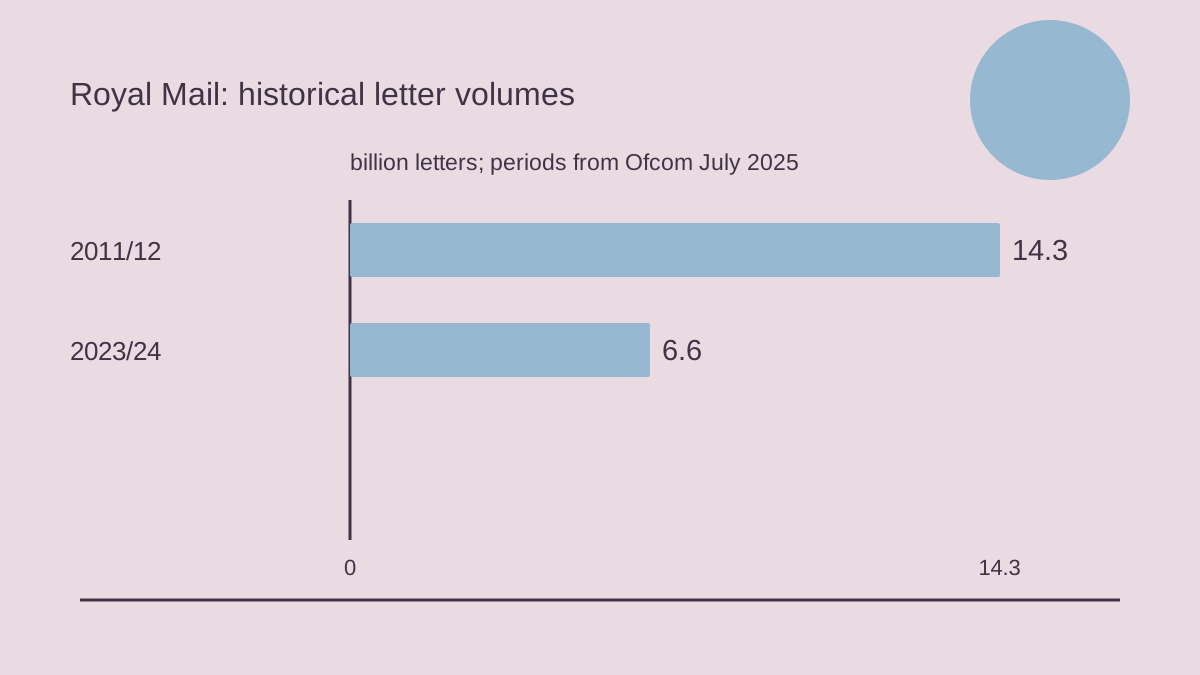
Those historical volumes describe a specific interval. They should not be presented as a measurement of the latest quarter or confused with a different comparison against the market’s peak. Their relevance is structural: a delivery organisation can lose a substantial amount of traffic while still needing to visit a widely dispersed set of addresses. The distance between houses does not shrink simply because each household receives fewer envelopes. The workload changes unevenly across sorting, transportation, administration and the final delivery round.
Consider an illustrative route that still has to pass every eligible street, but carries fewer letters per stop. Some sorting effort may decline with the number of pieces. Travel time, vehicle availability and the need to cover staff absence may decline much less. This is an explanation of the cost mechanism, not an estimate of Royal Mail’s actual route economics. It shows why managers need to identify which costs respond to volume and which depend on maintaining a network. Cutting every function by the same proportion would ignore that distinction.
Support functions can help solve this problem when they provide useful route planning, reliable maintenance information or clear workload forecasts. They can also add friction when several teams request similar information without improving a decision. The relevant measure is the effect of the work, rather than its distance from the delivery office. A central team may look like overhead in one accounting view while preventing operational disruption in another. Equally, a long-established reporting process may consume time without changing anyone’s behaviour.
This makes a service map more informative than an organisation chart. The map would show what happens from acceptance of a letter to delivery, including exceptions, missed connections and complaints. Managers could then ask which support tasks keep that chain functioning and which merely record it after the event. A smaller headquarters can improve the service if it removes unnecessary handoffs. It can weaken the service if it leaves essential decisions without a clear owner.
A different delivery schedule needs a clear customer promise
The reform described by the regulator creates a need for careful communication. Frequency and delivery speed are related, but they are not interchangeable. A customer might hear that a service operates on fewer days and assume that every item must take longer. Another might see a time target and assume delivery opportunities are identical throughout the week. A useful explanation shows how collection time, service choice and working days interact, using examples that customers can understand without interpreting regulatory documents.
There is also a distinction between permission and implementation. A regulator can allow a different operating pattern, but the company still has to design routes, train employees and explain the change. It must ensure that its booking tools, collection information and customer-service responses describe the same service. If these channels disagree, an efficiency reform can create more contacts and complaints, transferring work back into the support organisation that was intended to become simpler.
For a small business, dependable expectations may be more useful than an optimistic promise. A firm sending an invoice, replacement part documentation or a time-sensitive notice needs to know how the service fits its own process. It may be able to change a dispatch day when information is clear. It cannot easily adapt to unexplained variation after an item has entered the network. That is why service communication should be evaluated as part of operations, rather than treated as a final publicity step.
The same principle applies internally. Delivery offices need instructions that resolve practical questions instead of leaving them to interpret several overlapping messages. If staff must seek clarification repeatedly, central simplification has not necessarily simplified frontline work. A useful assessment would ask how often an exception can be resolved locally, how long a response takes when escalation is necessary and whether the answer is consistent across locations. These are proposed management questions, not assertions about current performance.
Publishing a clear customer promise also makes improvement easier to judge. When the promise is stable and measurable, users can distinguish a delayed item from a misunderstanding about the service. The company can classify complaints more accurately and identify the stages causing failure. When descriptions are vague, disappointment becomes difficult to interpret: the customer may have expected the wrong service, the service may have failed, or both may have occurred. A restructuring should reduce that ambiguity.
Reliability requires attention to the longest delays
The backstop in Ofcom’s reform is useful because an average or headline success rate does not describe every customer’s experience. Two networks can report similar on-time percentages while producing very different problems for the minority whose mail is late. One might resolve almost all delays quickly. Another might leave a smaller group of items unaccounted for over a much longer period. The public consequence depends on the severity and distribution of the failures, not only their frequency.
An analytical assessment should therefore examine both routine performance and the tail of the delay distribution. It should ask how late items are, whether the same places experience repeated problems and how quickly the organisation identifies a disruption. The answer may reveal a need for better information, additional operational resilience or clearer responsibility. None of those needs can be inferred from a headcount total alone. A support team that shortens the time between detection and correction may contribute directly to reliability.
It would also be misleading to describe a changed target as an improvement in actual delivery. A target defines the required or expected standard. Performance measures whether the organisation meets it. If the definition changes, comparisons need to preserve the underlying delivery data and explain the new denominator. Otherwise, a better compliance figure may reflect a different benchmark rather than a faster or more consistent service. Readers need both the rule and the observed result to assess progress.
Complaints add another perspective, but they require similar care. A reduction in complaint numbers could indicate fewer failures, a change in how people contact the company or a less accessible complaint process. More complaints might reveal deterioration, or it might follow clearer reporting options. A credible account would combine complaints with delivery measures and resolution times. It would explain changes in collection methods and avoid assuming that a single indicator captures the entire customer experience.
Local variation matters as well. A national network can perform adequately on average while a particular office, route or customer group experiences recurring trouble. The point is not to prescribe public reporting for every individual round. It is to ensure that management sees concentrations of failure and has a way to act on them. Removing a layer of administration is valuable when it speeds that response. It is costly when it makes local problems less visible.
Removing duplication without removing responsibility
Organisational simplification is often expressed as fewer teams, fewer layers or fewer reports. These can be useful results, but the decisive question is who now makes each necessary decision. A process can contain fewer formal steps while leaving employees uncertain about authority. That uncertainty can create informal steps: additional emails, parallel spreadsheets or repeated requests for approval. The organisation appears smaller while the practical work becomes harder to navigate.
A sensible transition would identify responsibilities before moving them. For each activity, managers could specify whether it stops, becomes automated, moves to another team or remains with fewer resources. They would also describe how the decision affects service continuity. This does not require every internal detail to be public. It does require the company to know whether savings come from genuinely unnecessary activity or from accepting a different level of operational risk.
Timing deserves equal attention. Experienced employees often hold knowledge that is not captured in a procedure: the reason a supplier arrangement exists, the history of a recurring route problem or the practical limits of a system. A transition can lose that knowledge before a replacement process is working. Retaining a document is not the same as retaining the ability to interpret it. Handover arrangements should therefore test whether the receiving team can perform the task, rather than merely confirm that files have been transferred.
Technology can help, but a new system does not automatically eliminate administrative work. It may reduce manual entry while creating a need to check exceptions, maintain data quality or train users. Any proposed automation should be assessed through the complete workflow. If the central team saves time by shifting correction tasks to delivery offices, the overall benefit may be smaller than it appears. If reliable information reaches the right person earlier, the same technology may improve both cost and service.
Employee consultation is relevant to this operational assessment because people performing the work can identify dependencies that are difficult to see from a structural diagram. Their involvement does not guarantee agreement or remove the need for difficult choices. It can improve the evidence behind those choices. The most useful discussion connects particular tasks to particular service consequences, rather than assuming that all support work is wasteful or that every existing role must remain unchanged.
What a credible progress report would demonstrate
The first requirement is a stable baseline. A report should identify the period against which cost, staffing and service outcomes are compared. It should distinguish planned changes from completed changes and explain whether the boundaries of a measure have moved. This matters when several reforms operate at once. A different delivery schedule, new systems and a support review may all affect the same result. Attributing every improvement to one announcement would overstate the evidence.
The second requirement is a balanced set of indicators. Financial savings matter to the sustainability of a network, but they should be read alongside service reliability, severe delays, complaint resolution and the practical workload of remaining staff. These measures need not all move in the same direction immediately. A temporary transition cost might support a lasting improvement. Equally, an early cost reduction might precede a later rise in disruption. Reporting should make those tradeoffs visible rather than select only favourable measures.
The third requirement is a clear account of corrective action. A useful progress report explains what happens when an assumption fails. If a transferred function develops a backlog, who has authority to adjust resources? If a service measure deteriorates, which team investigates and by when? Accountability becomes concrete when there is a response mechanism. A promise to monitor performance is much less informative without a description of how monitoring changes a decision.
- Compare service results against a consistent baseline.
- Separate planned staffing changes from completed changes.
- Track severe delays alongside headline delivery rates.
- Explain who corrects problems during the transition.
Finally, public claims should stay within the evidence available at the announcement date. The proposed staffing reduction is a future organisational plan. The regulator’s 2025 reform describes a separate set of service rules and historical data. Neither establishes that the present review has already improved deliveries. The reasonable conclusion is conditional: simplification can help a postal network when it removes friction, protects necessary expertise and makes service failures easier to correct. Its success will be demonstrated by the deliveries customers receive, not by the size of the announcement.