
A packaging supplier can encounter two different problems at once: customers order less, and the currency in which its business is reported changes value. Those pressures meet in the same earnings statement, but they do not necessarily require the same response. Cutting production costs may help with an underused machine. It does not automatically resolve an exposure created by the currency of a receivable. Adding customers may improve the order book while leaving the timing of payments unchanged.
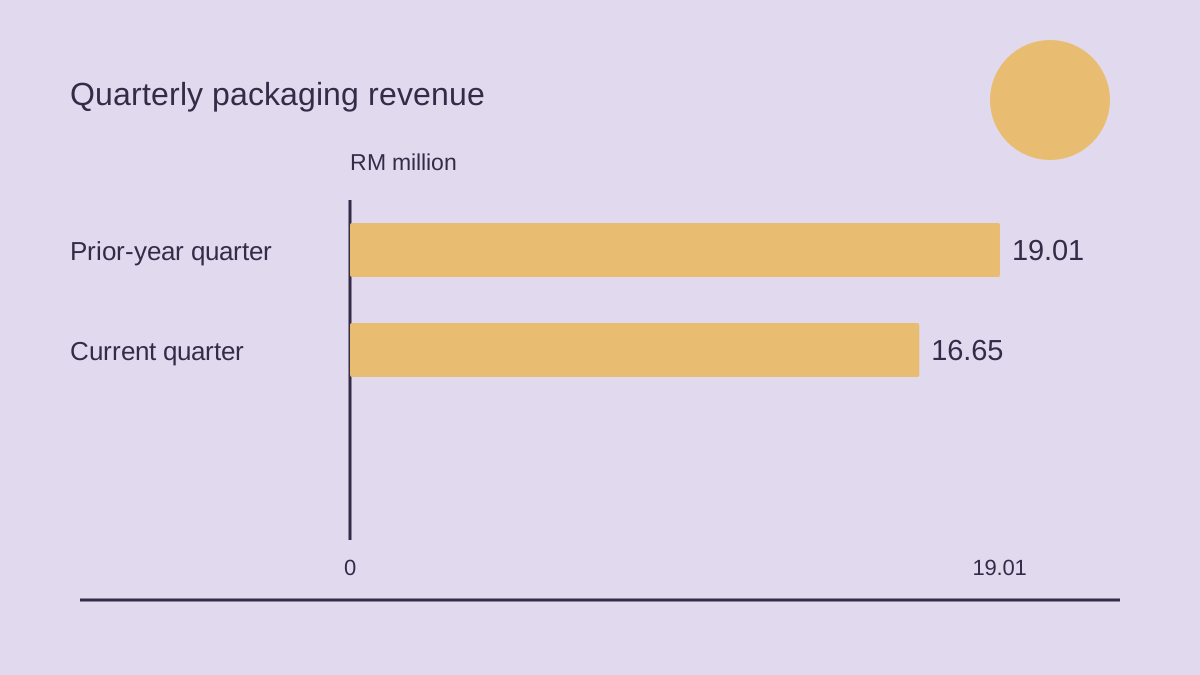
The starting point is HPP Holdings Bhd’s quarter reported on 17 October 2024. The Edge Malaysia reported revenue of RM16.65 million and net profit of RM1.04 million, against RM19.01 million and RM2.29 million a year earlier. It attributed weaker earnings to reduced sales and foreign-exchange losses associated with a stronger ringgit. The reporting period ended on 31 August 2024, although HPP labels it the first quarter of financial year 2025. Those dates describe different things; they are not contradictory.
For a packaging business in Malaysia, that combination raises a practical management question: which part of the pressure belongs to demand, which belongs to execution, and which belongs to currency? The following discussion is an original operating framework, rather than a description of HPP’s undisclosed contracts, production records or treasury arrangements. It uses the reported quarter to frame questions that a supplier would need to answer with its own records.
Begin with the order, not the total
Revenue is an outcome assembled from many orders. Two periods can contain a similar number of deliveries but produce different sales because their sizes, specifications and prices differ. Equally, a revenue decline can reflect fewer orders without implying that every remaining order is less profitable. A useful investigation starts by separating these possibilities before choosing an intervention.
The order record should connect the customer, product family, quantity, agreed price, delivery requirement and currency. Comparing those fields over time makes it possible to distinguish a volume change from a change in the mix of work. Without that separation, a sales team may be asked to chase additional business when the more immediate issue is that complicated orders are consuming too much production time.
This is not an argument for collecting every available detail. It is an argument for identifying the smallest reliable set of records that explains the movement. A consistent definition matters more than an impressive dashboard. If a repeat order is classified differently in successive periods, management can mistake a reporting change for a commercial trend.
Measure the work that an order creates
Packaging is purchased as a product, but manufacturing that product creates several kinds of work. Preparing a design, setting up equipment, checking colour, handling material, inspecting output and arranging delivery do not all vary directly with the number of finished units. An order that appears attractive on selling price alone may impose a disproportionate burden on the plant.
A practical cost review therefore follows the order through its actual stages. It asks which activities recur on every run and which can be reused when the same customer returns. A familiar specification with stable volumes can allow preparation to be spread over more units. A constantly changing specification can generate additional work even when the invoice looks similar.
The management response depends on that distinction. It may be appropriate to change the quotation process, introduce clearer approval deadlines or consolidate runs. Simply asking every department to spend less can obscure the commercial decision that created the cost. The objective is to make the relationship between the customer’s request and the supplier’s workload visible.
Use contribution before judging an idle machine
An underused production asset presents an uncomfortable choice. Extra work may improve the use of available time, but filling the schedule is not the same as improving the business. If a quotation fails to cover the costs caused by the additional order, higher output can deepen the problem rather than solve it.
The relevant distinction is between costs that arise because a particular order is accepted and costs that remain even if it is declined. That distinction supports a disciplined assessment of contribution. It should not become an excuse to ignore the longer-term need for a sustainable price. A business cannot permanently fund its equipment, maintenance and support functions from work that contributes too little.
For that reason, an exceptional quotation needs an owner and a review point. Management should know why the price differs, how long it applies and which capacity it occupies. Otherwise, a short-term decision made to keep a machine busy can quietly become the normal commercial arrangement, with no explicit decision to accept its consequences.
Keep the currency question separate
A currency exposure is created by the relationship between a commitment, its denomination and the time at which it is settled or measured. It cannot be understood solely by looking at the country in which a customer operates. An overseas order invoiced in the supplier’s reporting currency creates a different exposure from an order denominated in another currency.
The first task is to map commitments rather than assume that every export has the same risk. Receivables, payables and anticipated purchases may move in different directions. Their payment dates may also differ. An apparent offset between two amounts can disappear if one is settled well before the other.
None of these observations establishes how HPP manages currency. Its particular arrangements would require evidence beyond the short earnings report. The broader lesson is about diagnosis: management should identify the exposure before deciding what tools or commercial terms could address it. A production improvement and a currency measure answer different questions, even when both affect the final earnings number.
Bring sales and finance into the same conversation
Commercial terms can influence the size and duration of a currency exposure. The currency specified in a quotation, the validity period of that quotation and the agreed payment date all matter. Sales and finance therefore need to examine the same order before it becomes a commitment, rather than discussing its consequences only after the invoice has been issued.
This does not mean that every customer should be offered identical terms. A supplier may choose to accommodate a commercially important requirement. The decision becomes stronger when the accommodation is explicit and when its cost can be considered alongside price, volume and service obligations. An unrecorded concession is much harder to evaluate.
A useful review asks whether the people preparing quotations can see the assumptions on which their prices depend. If those assumptions change, the business needs a clear route for reconsidering the quotation. That route should be quick enough for commercial work but consistent enough to prevent different customers receiving incompatible commitments by accident.
Treat diversification as a capability question
HPP’s stated interest in broadening its customer base presents another management problem: entering a new customer segment requires more than finding a buyer. A supplier needs to establish whether its existing capabilities match the requested work and whether the new relationship improves the balance of its business. The announcement of an intention does not answer those questions.
The screening process can begin with familiar operational requirements. Are tolerances compatible with current equipment? Can inspection requirements be met consistently? Will delivery expectations fit the production schedule? Does the work need a certification or approval that has not yet been obtained? These are questions to investigate, not assumptions about any particular HPP customer.
A new segment can also create a different pattern of order sizes and preparation. It may diversify demand while increasing the number of short runs. That trade-off needs to be assessed before capacity is promised. Diversification is valuable when the business can serve the new work reliably and understand its economics, rather than merely attach another industry name to its sales presentation.
Make product development pass an operating test
A different packaging material or format can open a commercial opportunity, but the opportunity should be evaluated as a product system. Design, forming, drying where relevant, inspection, packing and transport may introduce requirements that differ from existing work. A familiar customer does not remove the need to test those requirements.
The original earnings coverage records HPP’s expectation of potential growth in moulded-pulp packaging. That is an expression of commercial interest, not evidence of a completed demand recovery. A decision framework should distinguish customer enquiries, qualified specifications, repeatable production and confirmed orders. Each stage provides a different level of confidence.
For a supplier assessing such an opportunity, a small but well-defined trial can answer questions that a broad market forecast cannot. The trial needs a specified acceptance standard, a record of the material consumed and a realistic account of the work required. Its purpose is to establish whether a promising idea can become a product that the business can repeatedly supply.
Connect quality with the cost of repetition
Quality is often described as a property of the finished package. From an operating perspective, it is also a measure of whether the business can repeat the agreed result without extra work. An inspection that catches a defect is useful, but preventing the defect from recurring addresses a different and potentially more durable problem.
A quality review should therefore connect the point at which an issue was found with the point at which it originated. A design approval, a material variation, a setup error and a handling problem call for different responses. Aggregating them into one rejection figure can help show scale while concealing the action that would prevent a repeat.
The same principle applies to customer complaints. A supplier needs to determine whether the specification was met, whether the expectation was clear and whether the delivered package performed in its intended use. The review becomes commercially useful when its findings feed back into the next quotation and production instruction, rather than remain in a separate quality file.
Do not let inventory hide a weak decision
Inventory can support reliable delivery, but it can also hold the consequences of a decision that has not been revisited. Material purchased for a forecast may remain unused when the customer changes its plans. Finished packaging prepared ahead of demand can become difficult to redeploy if it is specific to one product or brand.
A clear inventory policy connects each holding to a reason: a confirmed order, an agreed service arrangement, a known replenishment requirement or another documented purpose. The review should distinguish usable general material from stock whose value depends on a particular customer returning. Those categories do not have the same operational flexibility.
This is a general management consideration, not a claim about HPP’s stock position. It matters in a demand slowdown because purchasing, production and sales can each make individually understandable decisions that collectively tie up resources. Bringing the decisions together helps the company see whether its service promise still justifies the material and work committed to it.
Create a short, decision-oriented review
A management review becomes more effective when each indicator leads to a decision rather than merely describes the period. There is little value in reproducing a large set of numbers if nobody knows which action would follow from a change. The review can be compact while still addressing the business from several angles.
- Compare order volume, selling price and product mix separately.
- Identify preparation, rework and delivery demands attached to the order.
- Map the currency and settlement date of the relevant commitments.
- Check which stock holdings depend on unconfirmed future demand.
- Distinguish product enquiries and trials from qualified repeat orders.
- Assign an owner and review date to each commercial exception.
These questions can be answered with different levels of detail as the business develops. The essential feature is continuity: the same definitions should be used at successive reviews so that an improvement is not confused with a change in measurement. A useful process makes it easier to see what happened and who can act on it.
Separate the reported result from the operating explanation
A quarterly result establishes an outcome for a defined period. It does not, by itself, reveal the profitability of each product, the performance of each production line or the terms of individual customers. Those explanations require more detailed evidence. Reading a result carefully means respecting that boundary rather than filling the gaps with a plausible narrative.
For this reason, the operating questions in this analysis should not be read as allegations that HPP followed an ineffective policy. They describe the information that would be needed to assess possible responses. The same evidence discipline applies to an improvement: a future increase in revenue would not alone demonstrate that every product initiative or efficiency measure had succeeded.
The connection between a result and a decision should be established through records that show the mechanism. That approach may be less immediate than assigning a single explanation to a headline, but it is more useful for managing a business. It gives management a basis for deciding which action addresses the pressure and which action merely accompanies it.
A better question than whether sales recover
The reported quarter can be used to ask a more precise question than whether the next period will be stronger. What would make the work accepted by the company more predictable, better understood and consistently deliverable? That question directs attention to the relationship between the commercial promise and the operating system that must fulfil it.
The answer need not be one large transformation. It may begin with a better quotation record, a clearer production approval, a review of settlement terms or a more disciplined product trial. The value of each change depends on the problem it addresses and the evidence used to assess it. None should be presented as a guaranteed remedy for the reported earnings decline.
HPP’s disclosure provides a dated example of demand and currency pressure meeting in one result. The management lesson is to separate the mechanisms before combining the response. A business that can explain the work behind an order, the commitments behind an exposure and the evidence behind a new product is better equipped to make the next decision on its own terms.