
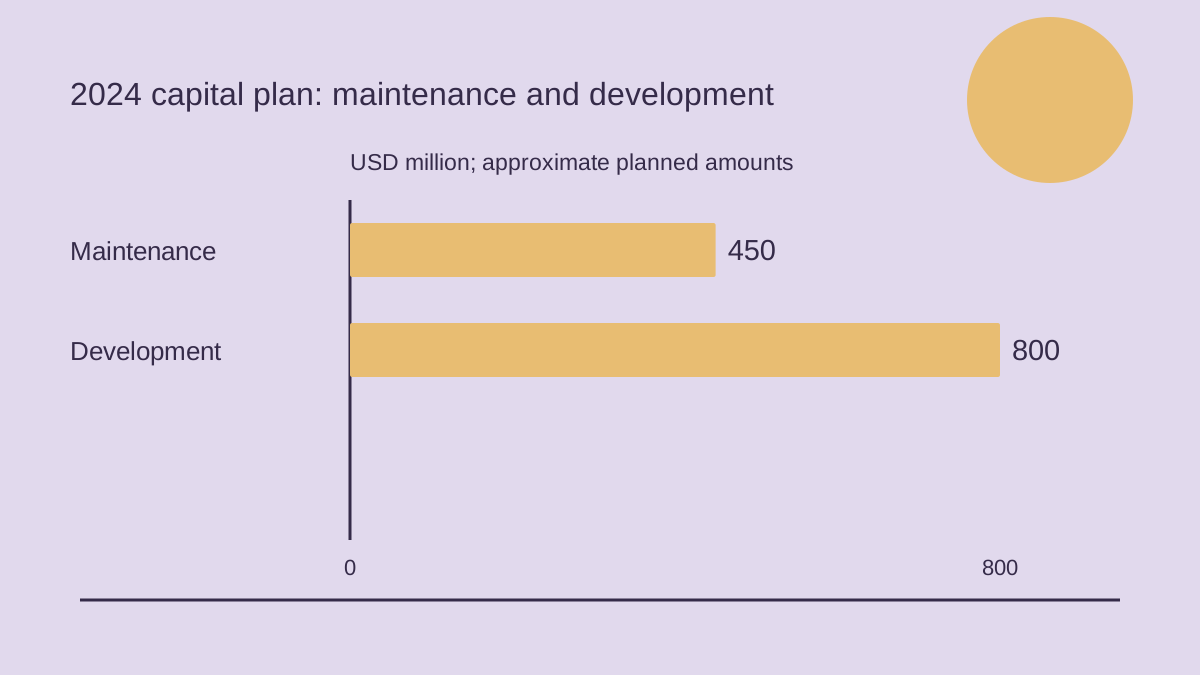
MMK's proposed capital allocation puts a practical management question into two categories: expenditure to keep existing capacity usable and expenditure intended to develop the business. In Russia, MMK was planning roughly $1.25 billion of capital expenditure for 2024, including about $450 million for maintaining existing capacity, deputy investor-relations director Ilya Nechaev said, according to Interfax on 14 March. The remaining amount was described as development. This is an attributed plan, rather than evidence that the money had been spent or that individual investments had delivered their intended results.
The analytical question is how to compare the two purposes without allowing either label to substitute for an investment case. The framework below is proposed here for interpreting a capital programme. It does not describe MMK's internal approval procedures, identify its individual projects or establish that its allocation is optimal. The distinction between a stated budget and a verified operating result remains essential throughout.
The allocation reveals priorities, not a return
Subtracting the approximate maintenance amount from the approximate total leaves about $800 million for development. Maintenance represents roughly 36% of that total and development roughly 64%. These are calculations from rounded planning figures, not a more precise company disclosure. They identify the balance between two stated purposes; they do not measure additional production, sales, avoided downtime or cash generation.
A larger development share can be interpreted in several ways. It might represent a substantial opportunity, an expensive transformation or a programme whose benefits arrive well after payment. The figures alone cannot distinguish those possibilities. Similarly, a smaller maintenance share does not establish that assets are underfunded: the relevant question is what obligations, conditions and replacement needs sit behind that share.
The useful first step is therefore to ask what evidence would make each category credible. Maintenance needs a description of the operating condition being protected and the consequence of postponement. Development needs a description of the new commercial or operating capability and the conditions necessary to use it. Both categories need an execution path, but they answer different questions about why spending is worthwhile.
Maintenance needs a credible alternative to spending now
The proposed maintenance test starts with the counterfactual. If a project is delayed, what specifically changes? A general statement that equipment is important does not answer whether intervention is necessary this year. A stronger case identifies the affected process, the evidence of deterioration, the available temporary response and the period during which that response can reasonably operate.
Consider a hypothetical component replacement. The relevant comparison is not simply a new component against an old one. It is replacement during a planned interruption against continued operation with inspection, restricted use or an earlier emergency intervention. None of those alternatives should be assumed to be available or safe without the necessary technical evidence. The example illustrates the question; it is not a description of MMK equipment.
This approach makes the case more specific without requiring an invented certainty about future failure. Evidence may support a range of possible outcomes rather than a single forecast. A decision document should show which uncertainty matters, how it could be reduced and which delay would make the uncertainty harder to manage. Calling expenditure maintenance does not remove the obligation to explain its timing.
Development needs a route from capability to use
The proposed development test starts at the other end of the chain: what changes for the business once the asset is usable? A physical capability is an intermediate result. Its commercial value depends on a route to use, whether that means customer acceptance, integration into another process, a different operating specification or removal of a constraint elsewhere. The budget label does not establish that route.
A hypothetical new process could be technically ready while a downstream operation is unable to absorb its output. In that situation, installation may be complete but the intended business benefit remains conditional. The useful question is who owns the unresolved handoff and what evidence would establish that it is ready. This separates physical completion from the ability to obtain the proposed benefit.
Development proposals should therefore connect the asset to a measurable change in use. They should also identify dependencies that lie beyond the project manager's control. This is not a demand to guarantee demand or eliminate every uncertainty. It is a demand to make those conditions visible before irreversible commitments accumulate. A credible investment case explains both the opportunity and the circumstances in which the opportunity would remain unavailable.
Compare evidence without forcing identical benefits
Maintenance and development should compete for scarce resources, but a comparison becomes misleading if both must claim the same kind of benefit. Maintenance may protect continuity while development may create a new capability. Turning both into an unsupported promise of additional sales conceals the distinction. Equally, declaring maintenance automatically essential can prevent scrutiny of scope, alternatives and timing.
A proposed common comparison would ask about consequence, evidence, dependency and reversibility. What happens if the decision is postponed? Which observations support that consequence? What else must occur for spending to achieve its purpose? How much freedom remains after the next commitment? These questions apply to both categories while allowing the answers to differ.
The outcome need not be a universal ranking in which every project receives a supposedly comparable number. Some proposals may be sufficiently evidenced for approval, others may require a limited preparatory stage, and others may need to be deferred. A shared discipline is more useful than false numerical precision. Where technical or legal obligations apply, their actual requirements should be established separately rather than inferred from a budget category.
The calendar can change the real cost of a decision
Capital expenditure is often presented as an annual amount, but implementation occurs through particular windows. A proposed review should connect payment, delivery, interruption, installation and commissioning dates. An annual envelope can conceal an overloaded period in which several projects require the same specialists or the same production interruption. The amount available does not establish the capacity to execute all commitments simultaneously.
For a hypothetical maintenance intervention, missing an agreed operating window might change the available alternatives. For a hypothetical development project, an early delivery could be of little use if complementary equipment arrives later. These are possible scheduling problems, not reported events at MMK. Their purpose is to show why comparing only annual spending can overlook the sequence on which benefit depends.
The response is to assess critical handoffs alongside expenditure. A project can have enough money and still lack a workable sequence. Conversely, changing a sequence may preserve much of a project's purpose without changing its entire scope. A useful decision identifies the next date that matters, the condition required by that date and the consequence of missing it.
Commitments and payments are separate exposures
A proposed capital dashboard should distinguish money already paid from obligations already entered into. A payment total can understate the practical freedom to change direction if contracts, custom specifications or dependent works have already restricted the available choices. Yet not every unpaid amount is equally binding. The actual terms and execution state determine what can still be changed.
Before each major commitment, management could ask whether the next stage preserves options or closes them. Ordering a standard item, specifying a custom system and starting dependent construction may have different consequences for reversibility. The article does not assign any of these arrangements to MMK. They illustrate why an approval process needs to examine the nature of a commitment, not merely its scheduled cash date.
This distinction also improves a postponement decision. Deferring a payment is not necessarily the same as deferring the project, and stopping work is not necessarily the same as removing an obligation. A decision should identify which action is actually available and what remains after it. Otherwise, an apparent budget saving may simply move an exposure into another period without resolving it.
Keep the comparison basis consistent
The allocation is stated in dollars, but interpreting any capital programme requires care about what its amounts include. A proposed comparison should establish the currency basis, the reporting period, the scope of works and the treatment of related expenditure. Two equally labelled budgets can cover different items. Without matching their boundaries, a change in the displayed amount may not mean a change in the underlying programme.
This is particularly relevant when comparing a plan with a later reported result. A plan may describe authorisation, expected expenditure or a strategic envelope; a later statement may describe actual cash payments or another accounting measure. They should not be treated as identical without evidence that their definitions agree. This article makes no such reconciliation for MMK and does not imply an exchange-rate assumption for its projects.
The discipline is straightforward: state the basis before calculating the difference. If an important definition remains unknown, preserve that uncertainty rather than converting it into an apparent conclusion. A precise calculation cannot repair a mismatched comparison. The best use of the approximate allocation is to organise questions about purpose and execution, rather than construct an unsupported historical performance score.
Use checkpoints that can change a decision
A checkpoint is useful only if its result can affect the next action. Recording that a meeting occurred or that a document was circulated does not establish whether the investment case remains valid. The proposed framework would identify an observation, an owner and a decision attached to each important handoff. The observation should concern the unresolved condition, rather than merely confirm activity.
- For maintenance, specify the condition being protected and the evidence needed to assess postponement.
- For development, specify the intended capability and the evidence that another process or customer can use it.
- For execution, specify the shared resources and the operating window required for the next stage.
- For commitments, specify what becomes difficult to reverse and what uncertainty remains at that point.
- For review, specify what would trigger a narrower scope, a different sequence or a pause.
These questions make approval conditional on something observable. They do not imply that all projects should follow an identical timetable. A maintenance case may depend on an inspection result, while a development case may depend on successful integration. The shared requirement is that management should know which evidence changes the decision and should avoid moving the checkpoint beyond the point at which meaningful choices disappear.
Mixed-purpose projects need an explicit benefit map
A project can plausibly serve both maintenance and development. Replacing a constrained asset might protect continuity while also enabling a different operating specification. Forcing it into one category can obscure either purpose; allowing it to claim both benefits without separation can exaggerate the case. The proposed response is to map each benefit to its own condition and to identify the scope needed for each.
In a hypothetical replacement project, the basic intervention might protect existing service, while additional scope provides a possible new capability. A useful comparison would distinguish the minimum intervention from that additional scope and examine the dependency for the new capability. It would not automatically assign all spending to maintenance or all benefits to development. Those classifications require the actual project evidence.
The same benefit should not be counted twice simply because two teams describe it differently. If one claimed outcome depends on another, that relationship belongs in the decision. A benefit map can reveal where the proposal is a single integrated case and where its parts could be sequenced separately. This improves the quality of questions without asserting that MMK's disclosed allocation contains any particular mixed-purpose project.
Make disagreement part of the decision record
A proposed capital review should also preserve disagreement about the evidence. An operating team may favour earlier intervention because it sees an uncertain condition every day. A project team may favour a development commitment because a delivery opportunity appears temporary. A finance team may focus on the timing of obligations. These are hypothetical perspectives, not statements from MMK. None should become decisive merely because its owner has the strongest voice in the meeting.
The decision record could separate what participants agree on from what remains disputed. Agreement on the condition of an asset does not necessarily imply agreement on when replacement is required. Agreement on the usefulness of a new capability does not necessarily imply agreement that all complementary processes will be ready. Identifying the exact point of disagreement helps determine whether additional observation, a different scope or a staged commitment would resolve it.
Responsibility should follow the condition being tested. A project manager can report completion of installation, but cannot automatically speak for a receiving operation's readiness or a customer's acceptance. The relevant owner should confirm that handoff. This proposed discipline avoids treating a single person's assurance as a substitute for several distinct conditions. It also makes unresolved dependencies visible when responsibility crosses organisational boundaries.
Finally, the review should retain the reason for accepting uncertainty. A decision may reasonably proceed before every question has a definitive answer, provided the remaining uncertainty is described and the next opportunity to reassess it is clear. That is different from forgetting the question. If later evidence challenges the original assumption, the record should show what would have changed the choice at the time. The objective is an accountable decision process, rather than an appearance of certainty that the available evidence cannot support.
Review the investment case after commissioning
A proposed review should continue beyond physical completion. For maintenance, it would examine whether the specified operating condition was protected and whether the assumptions behind timing were reasonable. For development, it would examine whether the capability became usable under the conditions originally identified. Finishing installation answers an execution question, but does not automatically answer either question about purpose.
The review should also distinguish a weak original case from a change in circumstances. If a dependency was never examined, that is different from a clearly documented dependency changing after approval. Keeping the original evidence and decision basis makes that distinction possible. The purpose is to improve subsequent choices rather than create a retrospective narrative in which every outcome appears inevitable.
MMK's stated split thus provides a starting point for analysing capital discipline, not a verdict on investment quality. Maintenance and development deserve different explanations of value, a common scrutiny of commitments and explicit tests of completion. Until project evidence and realised outcomes are available, the defensible conclusion is limited: the allocation identifies two purposes, while the quality of execution and the benefits of spending remain questions to be demonstrated.