
Two encouraging reports, two different populations
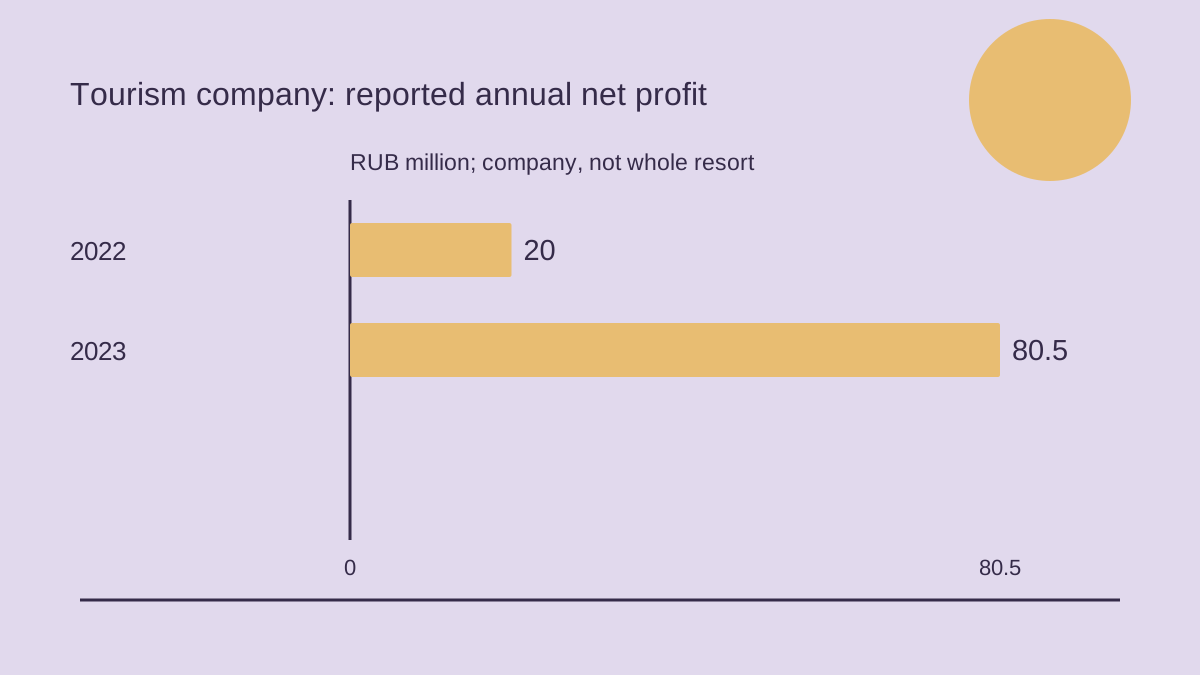
On 8 April 2024, Vedomosti South reported that the limited liability company Centre of Wine Tourism Abrau-Durso earned 80.5 million roubles in 2023, against 20 million in 2022, on revenue of 1.1 billion against 956 million. It cited SPARK data; the underlying statements have not been independently inspected for this analysis. A 20 March resort announcement separately reported more than 600,000 visitors to the resort territory and more than 200,000 tunnel excursionists during 2023.
The figures describe different objects: a legal entity’s reported financial results, a destination’s audience and participation in one experience. Putting them next to each other is useful for defining questions. Dividing them immediately would conceal the very information needed to answer those questions. This analysis proposes a measurement framework; it does not claim that the operator uses that framework or that the available announcements establish the profitability of individual activities.
Define the boundary before choosing a denominator
A destination can be an intelligible place to a visitor without being an intelligible accounting unit. The visitor may remember a single trip even when purchases belong to several businesses. Equally, one company’s revenue can include transactions that do not correspond to a counted arrival. These are possible relationships, not findings about this company. They explain why a destination label is insufficient evidence that a revenue total and an attendance total refer to the same population.
A proposed reconciliation would begin with the legal entity whose accounts supply the financial numerator. It would list the activities included in that entity’s revenue, the locations and reporting period covered, and any transactions outside the visitor population being measured. The attendance definition would be documented separately. Only after those definitions are established should the analyst decide whether the two populations can be matched. A mismatch is a reason to change the question or obtain additional information, rather than to produce a more precise-looking ratio.
For example, imagine a destination that counts entrances to public space while its operator sells several experiences. Someone could enter without buying, buy several experiences during one visit, or return on a different day. None of those possibilities establishes what actually happened at Abrau-Durso. The example shows why an arrival, a person, a customer and a transaction should be separate labels until the counting rules demonstrate an equivalence.
Reported profit growth does not identify the mechanism
A higher reported annual profit is a financial outcome. It is not a decomposition of that outcome. A business could earn more because of a different sales mix, different prices, a change in expenses or other items included in the reporting measure. The published totals do not allocate the change among those possibilities. Listing a plausible mechanism should therefore introduce a question for further evidence, not a statement that the mechanism explains the result.
A useful proposed review would distinguish an observation from an explanation in every working note. “The reported total increased” belongs in the observation column. “A particular experience became more profitable” requires evidence about that experience’s revenue and appropriately defined costs. “More people visited” requires a consistent attendance measure across periods. “Those additional people caused the profit increase” requires evidence connecting the additional activity to the financial outcome and addressing other changes during the same period.
This separation also prevents a newly opened facility from becoming an automatic explanation for an annual result. Opening is an event; contribution to annual earnings depends on its operating period, transactions, costs and accounting treatment. Even if the event and the higher profit appear in the same report, their coexistence does not establish the contribution. The appropriate next step is a reconciliation, not a causal headline assembled from neighbouring facts.
Attendance and participation need their own definitions
The resort’s announcement describes territory visitors and tunnel excursionists separately. Both published quantities are lower bounds. A ratio between two lower bounds is not a measured conversion rate: the actual numerator and denominator remain unknown. Nor does the announcement establish that excursionists are a consistently defined subset of unique territory visitors. The vocabulary of a public announcement should not silently acquire the precision of a linked customer dataset.
A proposed attendance dictionary would record what constitutes a counted event, how repeat attendance is treated, which locations are included and whether participation is paid, free or mixed. It would also distinguish a full-year count from a seasonal count. Those definitions are questions for the operator’s measurement process; they are not claims that a particular method is already in use. If some definitions remain unavailable, the published totals can still be quoted accurately without using them to calculate customer behaviour.
- Keep legal-entity financial totals separate from destination attendance.
- Describe the published counts as reported lower bounds.
- Require matching populations before calculating conversion or revenue per visitor.
- Keep proposed explanations distinct from verified observations.
Repeat visits change the unit of observation
A person can contribute more than one attendance event without becoming more than one person. That elementary distinction becomes economically significant when an analyst asks what brings people back. An event count can describe activity at a place; a count of distinct people can describe reach. Neither is inherently superior. Each answers a different question, and the choice must remain visible when comparing periods or programmes.
A proposed repeat-visit analysis would specify a consistent observation window and distinguish people who return within it from people first observed within it. It would acknowledge where identification is incomplete rather than silently treating every unlinked arrival as a new person. The purpose would be to investigate relationships between experiences, subsequent visits and purchases, not to declare an actual retention rate from the resort announcement.
Consider a hypothetical programme attracting the same group several times. Attendance could increase while audience reach remains stable. That would not automatically be a disappointing result: repeat participation could be relevant to a service. But its commercial contribution would still require matching transactions and costs. The same headline count cannot establish reach, loyalty and profitability at once.
Purchases are not interchangeable with participation
Participation may be organised in ways that do not correspond one for one to purchases. A single transaction could cover a group, while one participant could acquire several services. A package might include an experience whose separate price is not observed. These are hypothetical arrangements that illustrate the importance of the unit being counted, rather than descriptions of the operator’s offers.
A proposed commercial record would preserve the relationship between a transaction and the experiences it includes. It would distinguish the amount charged from any analytical allocation of that amount among components. An allocation rule can support a comparison, but it should not masquerade as an observed stand-alone sale. Changing the rule can change a component’s apparent performance even when the underlying customer payment is unchanged.
For this reason, a review should name the question before selecting a measure. If the question concerns payment activity, transactions may be relevant. If it concerns use of a service, participation events may be relevant. If it concerns audience reach, people may be relevant. A reconciliation between those records would be useful evidence; an assumption that all three are identical would discard the information the review needs.
Channels need comparable accounting
A service can reach a customer through different channels, but a channel label alone does not reveal its contribution. The relationship between the reported amount, the final customer payment and the cost of obtaining the booking depends on how the arrangement is recorded. No specific arrangement at Abrau-Durso is established here. The proposed principle is to compare channels on a stated, consistent basis.
A review could separate customer payment, amounts attributed to the operator and identifiable channel expenses, provided the necessary records exist. It should explain whether a comparison concerns gross demand, recognised revenue or contribution after selected costs. Those measures should not be mixed within one ranking. Otherwise an apparently stronger channel could merely be reported on a different basis.
Attribution requires another explicit choice. The channel processing a booking may differ from the contact that first introduced the service. A proposed investigation should retain that distinction rather than award all influence to the last observable action. If the earlier contact cannot be measured reliably, the limitation belongs beside the finding. Unavailable attribution is not evidence that an unobserved channel had no effect.
Seasonality requires matching periods
An annual financial total and a full-year attendance statement can share a calendar without sharing the same distribution of activity within it. A proposed seasonal review would therefore retain the timing of demand and service availability. It would not infer that an annual change occurred evenly across months, or that each facility contributed for the entire reporting period.
Comparable periods should be defined before interpreting a trend. Differences in operating days, programme availability or the population observed can complicate a comparison even when both columns carry the same month name. These are potential issues to examine, not assertions about the resort’s actual operating calendar. If a comparison excludes part of the business to improve comparability, that exclusion should be disclosed rather than allowing a narrower measure to inherit an annual total’s meaning.
A seasonal view could be useful for decisions about service capacity, but the relevant question would be whether demand and the resources serving it coincide. A busy interval does not establish year-round utilisation; a quiet interval does not establish unused capacity that can be removed without consequences. The review needs the service’s operating requirements alongside the demand pattern, and should resist converting a single annual audience figure into an occupancy measure.
Shared costs make the question decisive
A destination may support experiences through shared resources. To examine any such arrangement, an analyst would need to identify which costs can be associated directly with an activity and which require an allocation rule. This is a proposed analytical distinction, not evidence about the operator’s cost structure. The public figures do not provide a service-level cost map.
An allocation can make a fully distributed view possible, but it is not the same as measuring what would change if an activity changed. A service’s assigned share of a common cost might remain in the organisation if the service were removed. Conversely, expansion could require an additional shared resource that is absent from the current average. The appropriate measure depends on the decision being examined.
A proposed review would present the allocation basis, explain its purpose and test whether a different reasonable basis changes the interpretation. It should avoid treating every allocated expense as immediately avoidable, or every unallocated expense as irrelevant. Where the evidence only supports a business-wide result, retaining that level of description is more informative than manufacturing a precise profit figure for each experience. Precision cannot compensate for an unsupported cost boundary.
Average outcomes do not answer incremental questions
An average can describe the observed relationship between totals, once their boundaries are compatible. It cannot by itself answer what would happen if the business attracted another visit or offered another session. That second question concerns changes in activity and the resources needed to support them. Confusing the two can produce an apparently simple decision rule with no evidence about the decision’s actual consequences.
A proposed incremental review would specify the change being considered and its time horizon. It would ask which transactions could be additional, which could replace existing activity and which costs would change. It would also distinguish a temporary arrangement from a continuing one. These questions do not identify an actual opportunity or establish that the operator has spare capacity; they describe the evidence required before reaching such conclusions.
A hypothetical new session could attract people who would otherwise attend a different session. In that case, its own attendance is not automatically additional destination demand. Another hypothetical session could require resources beyond those captured in an existing average. Both examples show why a decision should be tested against a stated alternative. A larger activity count is an observation; additional business contribution is a separate proposition to demonstrate.
A reconciliation should preserve an unexplained remainder
A useful reconciliation is not obliged to explain every difference immediately. It should make the explained and unexplained portions distinguishable. If some attendance cannot be connected to a transaction population, that portion should remain visible. If some reported revenue cannot be matched to the experiences under review, it should not be forced into an allocation merely to make a table balance.
A proposed working record would identify the source and reporting period of each measure, its unit, the transformation applied and the evidence supporting the connection. Any estimate should be labelled separately from an observed total. A later improvement in coverage could then be distinguished from an actual change in activity. Otherwise a better measurement process could appear to be business growth, or a narrower process could appear to be decline.
The same discipline applies when financial data are reported through an editorial source. Attribution preserves what is known about the origin of the number; it does not replace inspection of the underlying statement. This analysis keeps that distinction explicit. An unresolved boundary does not invalidate the quoted report, but it limits what can reasonably be built from it. Leaving a question open is preferable to resolving it through an undocumented assumption.
The proposed scorecard begins with definitions
A compact scorecard could organise the investigation without collapsing everything into a single performance number. Its first layer would describe the scope of the business-wide financial measure. Its second would describe destination attendance. A third would describe participation and payment relationships for the experiences being studied. Each layer would keep its own population and period until a documented connection allowed a cross-layer calculation.
The scorecard should also record the question each measure is intended to answer. Reach, activity, payment and contribution are different questions. A rise in one measure does not require the others to move by the same proportion. Nor should a favourable measure be selected after the result is known and presented as if it had always been the objective. A proposed review would state the comparison and its limitations before interpretation.
Responsibility for the definitions matters as well. Someone needs to maintain the meaning of a measure when a programme, booking arrangement or counting process changes. That is a suggested governance requirement, not a finding about current practice. The aim is to make a later reader able to reproduce the reasoning, identify missing evidence and understand why a conclusion applies to one population rather than another.
What the available reports establish
The available reporting supports a carefully attributed description of the company’s financial results and the resort’s stated audience. It does not supply the matching records needed to establish revenue per visitor, a paid conversion rate or profitability by experience. Keeping those limits explicit leaves the positive reported outcomes visible while preventing them from acquiring meanings the sources do not demonstrate.
The next useful evidence would depend on the intended question. A question about financial change would call for the underlying accounting scope and a reconciliation of relevant components. A question about audience behaviour would call for consistent attendance and participation definitions. A question about expansion would call for evidence about additional demand, substitution and changing resource requirements. Collecting information without selecting the question first could produce more numbers without resolving the boundary problem.
The original lesson from this comparison is methodological: a destination’s audience and a company’s earnings can both be relevant while remaining different measures. Their relationship needs evidence, not merely arithmetic. As of the article’s historical date, the quoted announcements should be read within their stated scope. The proposed framework provides questions for further investigation; it supplies no undocumented operating result and makes no recommendation to buy, invest in or consume a particular product.