
SamMobile reported on March 5, 2025 that Samsung had announced an expansion of the One UI 7 beta programme beyond the Galaxy S24. The company's primary announcement described applications through Samsung Members and qualified availability by device model and market. An announced opportunity to participate does not establish how many owners joined, used a build or submitted feedback.
The original analysis below examines how to interpret voluntary software feedback. Its numerical examples are invented and describe no actual Samsung participation, defect frequency or product performance. They separate eligibility, participation, observation and reporting, because those boundaries determine what a feedback count can mean. The analysis does not recommend installing a beta or buying a device. Its subject is the evidence available to a reader who encounters a claim based on test participants.
Eligibility is a boundary around possible participation
An eligibility statement describes who could enter a programme under its stated conditions. It does not describe who actually entered. A list of supported models or markets therefore identifies an opportunity boundary, rather than a participant census. Expanding that boundary can make participation possible for additional owners, but the announcement alone contains no count of their subsequent actions. A report should retain that distinction instead of treating a wider invitation as a measured increase in feedback.
The subject being counted also needs attention. A device model is a category, an individual device is an object and an owner is a person or other holder. Those units are not interchangeable. One owner could have more than one device, while many owners could share a model category. A programme described as covering more models need not be described as covering a known additional number of owners unless that information has independently been supplied.
For an editorial explanation, the first question is therefore what the announcement makes eligible and when. The second is whether any evidence of actual participation follows. These questions can sit beside each other without diminishing the announcement. They prevent an expected expansion from becoming a completed observation through a change in wording. The historical publication date also matters: a statement about planned availability describes what was announced then, rather than a current participation instruction.
Volunteers do not automatically represent every owner
A voluntary programme involves a decision to participate. Without evidence about how that decision relates to the wider owner population, a reader cannot assume that participants are a representative cross-section of all owners. They might resemble that population in some respects and differ in others. The announcement does not establish either outcome. Recognising this boundary avoids assigning a known distribution to a group whose selection process has not been measured.
This does not make volunteer feedback useless. A participant can describe an observed issue, a confusing interaction or a particular use case in detail. Such a report can provide evidence about that observation. A different question asks how frequently the same experience occurs among all owners. Moving from the first question to the second requires information about coverage and selection that a detailed individual description does not contain by itself.
The distinction is between learning that something was reported and estimating a population frequency. A collection of reports can support the former without supporting the latter. A large collection does not automatically remove this limitation if the additional reports arise through the same unmeasured selection process. Counting more observations increases the recorded volume; it does not, on its own, establish a bridge from volunteers to every owner outside the programme.
An invented participation funnel keeps the units visible
Consider a hypothetical programme with 1,000 eligible owners, 100 participating owners and 20 distinct participants who submit feedback. Suppose those 20 people send 60 messages in total. The numbers are chosen solely for explanation. Twenty reporters are 20% of the participating group and 2% of the eligible group. Sixty messages are a message count, not 60 different people and not an observed count of affected devices.
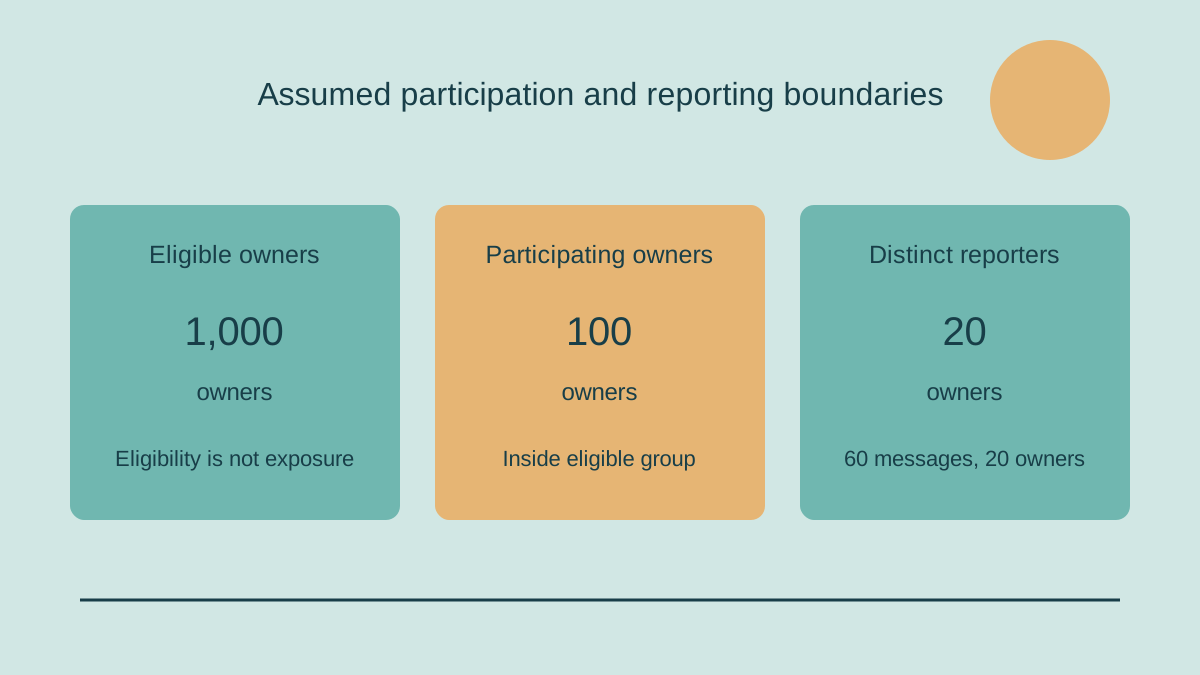
Neither percentage is a population defect rate. The example has specified reporters, rather than verified defects, and has supplied no information about the experiences of people who did not report. A message could concern a suggestion, a question or an observation requiring further examination. Even if the hypothetical messages all described issues, their authors would still be a voluntarily selected reporting group. Changing the label beside the percentage would not supply the missing population evidence.
The arithmetic can nevertheless answer a narrow descriptive question. Under the stated conditions, one in five participants sent at least one message. That sentence preserves the group, the action and the observation boundary. Saying instead that one in five owners experienced a defect would change both the population and the outcome. The calculation is simple; the meaning depends on keeping the original nouns attached to it.
A message is not a unique person or a unique issue
The invented 60 messages could include follow-up details from the same 20 reporters. If each reporter sent three messages, the total would still be 60. It would not establish that the programme had reached 60 distinct reporting owners. The difference matters when a headline describes feedback volume as though it were coverage. A count of interactions measures interactions unless another rule identifies distinct people or devices.
Messages and issues also have different boundaries. Several messages could describe one observation, and one message could mention several observations. The example does not specify how reports are classified or whether any issue is reproduced. It therefore cannot yield a verified issue count. A reader should not infer a classification system from a total that was collected for another purpose. The counting rule needs to be stated before that total can support the proposed comparison.
A clear report could present message volume and distinct reporting participants separately, provided both were actually available. It could then explain whether repeat submissions are included. These are suggested descriptive fields, not a claim about Samsung's actual reporting workflow. Their value is conceptual: they keep repeated interaction from being mistaken for wider participation and keep wider participation from being mistaken for a technical judgement about the software.
No report is not the same as no observed issue
In the hypothetical programme, 80 participating owners have submitted no message. That fact does not explain their experience. They might have used the software without encountering the subject under discussion, might not have used the relevant feature, or might not have supplied a report. These are alternative possibilities, not measured explanations. The model has deliberately left them unknown. Treating silence as a confirmed absence of issues would add information that the example never provided.
The 900 eligible owners who did not participate belong to a different boundary again. The programme's feedback does not describe their experience with the tested build merely because they were eligible. Eligibility establishes a possible path into the programme, not evidence of exposure. A comparison should therefore avoid combining non-participants with silent participants into one observed group. Both lack a report in the example, but their relationship to the test differs.
This is a distinction between missing information and an observed zero. A zero can be reported for a specifically measured outcome within a defined observation window. Missing information means that the corresponding outcome has not been supplied. A blank field should not become a zero simply because a chart or paragraph needs a complete-looking result. The same restraint applies whether the feedback is favourable, unfavourable or absent.
Coverage needs more than a list of device names
A device category can be part of an observation boundary, but it is not the entire boundary. A report about a software experience can also depend on the build being discussed, the period of use and the circumstances in which the interaction occurred. This analysis establishes no actual feature differences between models or markets. It asks only that the reader retain the recorded conditions instead of assuming that a model name supplies all of them.
A hypothetical report from one build cannot automatically describe a later build. Likewise, an observation made before a particular action was tried cannot establish its outcome afterward. A concise feedback summary can identify the software version and time window if that information is available. These fields distinguish an observed experience from a statement about every future version. They preserve the temporal scope of evidence without requiring a technical explanation of the software's implementation.
Coverage can remain incomplete even when the programme includes many device categories. If no observation has been supplied for a category, its presence on an eligibility list does not fill that gap. Conversely, a detailed observation from one category need not be dismissed merely because other categories are missing. It can be retained with its own boundary. The appropriate scope of a conclusion follows the scope of the observation, rather than the length of the invitation list.
A changing mix can change an aggregate without changing each group
Consider a second invented illustration with two abstract groups, called the first group and the second group. In one period, 80 participants belong to the first and 20 to the second. Suppose the explicitly defined reporting shares are 10% and 30%, respectively. That produces eight reporters from the first group and six from the second, or 14 among 100 participants. The example describes reporting actions, not defects or product reliability.
In another hypothetical period, reverse the group sizes while keeping those reporting shares unchanged: 20 participants in the first group and 80 in the second. The counts become two plus 24, or 26 reporters among 100 participants. The aggregate reporting share rises from 14% to 26%, although neither group's assumed share changed. The difference follows from the mixture of participants, not from an improvement or deterioration in either group's software experience.
This example does not identify actual device groups or predict how volunteers behave. It shows why an aggregate comparison needs the composition of the group being compared. A statement that feedback became more frequent could describe the pooled count, while leaving its cause unresolved. Keeping the group mix visible prevents that descriptive change from becoming an unsupported conclusion about a new build's quality.
Finding an issue and measuring its prevalence are separate tasks
A report can identify a question worth examining even when it cannot establish prevalence. For example, a hypothetical volunteer may describe a sequence that produced an unexpected result. The description can be treated as a reported observation and investigated within its stated conditions. No frequency estimate is needed to recognise the observation as relevant to further inquiry. Its evidential value does not depend on pretending that the reporter stands for every owner.
A prevalence statement asks for a defined outcome in a defined population over a defined period. The participation funnel alone does not supply those elements. Nor does a report count establish that every message meets a common technical definition. A summary can therefore retain useful findings while declining to convert them into a population percentage. That is a precise separation of questions, rather than a verdict that the programme succeeded or failed.
The same reasoning applies to praise. Favourable messages can describe favourable reported experiences among their authors. They do not automatically measure satisfaction among all owners. Applying the boundary consistently to positive and negative feedback keeps the interpretation from depending on the desired conclusion. The key is the evidence category and counting rule, not whether the messages support an attractive headline.
A short checklist for interpreting feedback
The following checklist is an original reading aid for the hypothetical examples. It is not a description of the company's testing methodology, a claim about its actual results or an instruction to participate. It helps a reader locate the boundary between an announced programme, a recorded action and an inferred population outcome before comparing totals.
- Identify whether the count concerns eligible owners, participants, observed users, reporters or messages.
- Keep a voluntary reporting group separate from the wider population it has not been shown to represent.
- State the action being measured before describing a percentage.
- Distinguish repeat submissions, distinct reporters and classified issues.
- Retain the build, observation period and participant mix where those data are available.
- Keep unreported outcomes unknown, and label invented illustrations as conditional examples.
An expanded beta invitation can widen the opportunity to gather observations. The meaning of the resulting evidence still depends on who participated, what they experienced and what they reported. Those questions require records beyond an announcement or a message total. Preserving the boundaries allows feedback to inform an analysis without turning volunteer participation into a census, silence into a measured zero or a reporting percentage into a product reliability verdict.