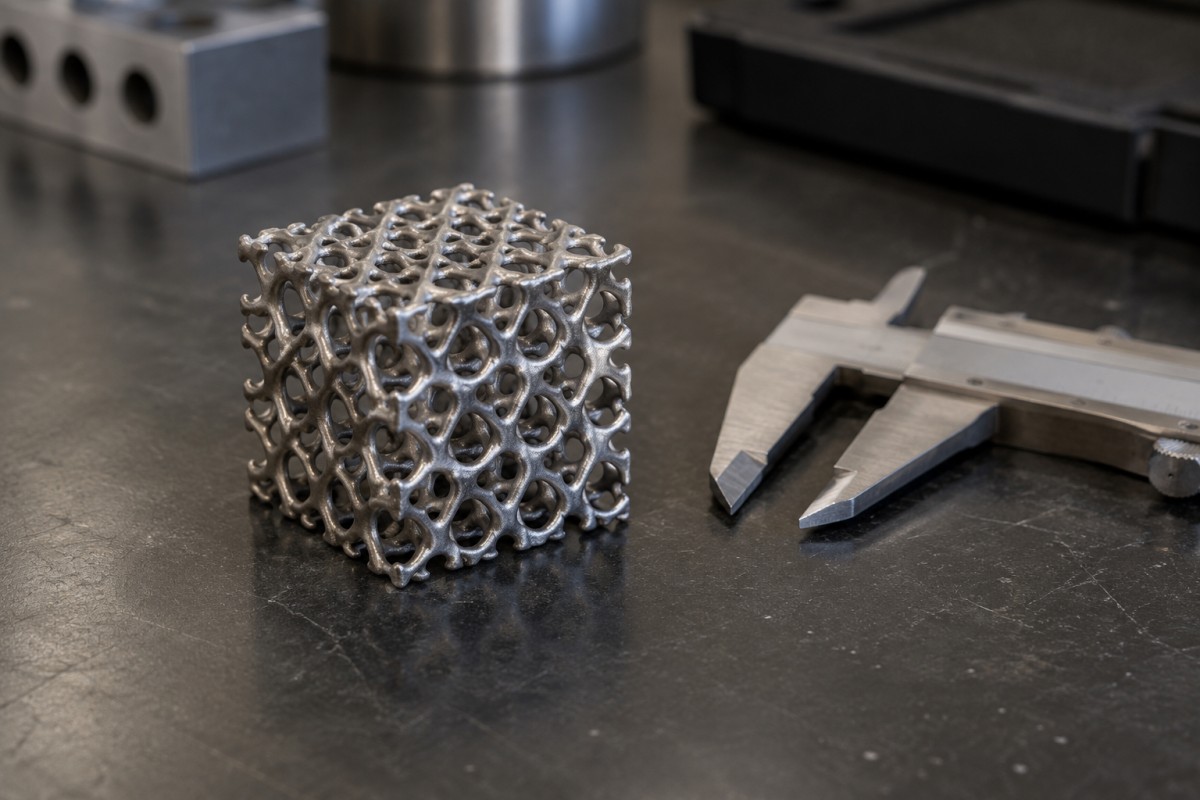
Australian Manufacturing reported on September 3, 2026 that researchers at RMIT University in Australia demonstrated a floating titanium lattice with foam-filled hollow struts. The university’s primary announcement identifies polyurethane foam and describes further scaling and long-term testing as next steps. The reported result concerns a hybrid structure, rather than a new floating property of bulk titanium.
The original commercial analysis below examines how to compare a product whose performance depends on an architecture. It does not reproduce the study’s technical methods, assess marine suitability or recommend a design. Its numerical illustrations are invented, with dimensionless units used solely to explain comparison boundaries. The question is what a buyer, researcher or editor should identify before treating a material headline as a description of a complete product.
The material name is one part of the object
A material name identifies a constituent or a class of constituents. A complete object also has geometry, dimensions, connections and other components. If its reported behaviour depends on several of those elements, the comparison should retain them. Naming the metal alone can be convenient in a headline, but a product description needs to explain what was actually observed. Otherwise the reader may attribute an assembly result to a constituent that was not tested independently.
This is a familiar commercial distinction even outside research materials. A supplier can sell a raw input, a manufactured component or a complete assembly. Each offer answers a different purchasing question. A demonstration of an assembly does not establish that a raw input can deliver the same result without the other elements. Conversely, acknowledging those elements does not diminish the demonstration. It identifies the object to which the reported finding belongs.
For a comparison brief, the first line could therefore name the tested object in full before listing its constituents. The next lines could distinguish what belongs to the demonstrated architecture from what belongs to a future product proposal. This is an editorial way to organise a discussion, not evidence that an actual commercial offer exists for the research. A precise object description prevents a short material label from becoming an unexplained product promise.
Geometry and filling should remain visible in the comparison
A complete architecture can contain several design choices. Comparing two versions may change one choice while holding others fixed, or may change several at once. Those are different experiments and different commercial comparisons. A report should explain which elements changed rather than letting a constituent name imply that it was the only difference. Without that explanation, the reader cannot know whether the comparison isolates a material, a geometry or an entire assembly.
A constructed comparison might examine assembly A with one geometry and assembly B with another, each using a named constituent. If their observed results differ, the account can describe that difference for the two assemblies. It cannot attribute the difference exclusively to the constituent while ignoring the changed geometry. The example does not describe the university’s experiment. It illustrates the general distinction between comparing objects and identifying the cause of their differences.
The same logic applies to an added internal component. If one version includes it and the other does not, the comparison concerns different compositions. A buyer may find that comparison useful, provided its scope is visible. A researcher may ask a more specific question about the contribution of the added component. The product brief should preserve the chosen question rather than claiming that one demonstration answers every possible comparison.
A volume definition belongs beside a density figure
The RMIT announcement distinguishes a conventional overall volume from the parts of an open structure that exclude water. That is an attributed explanation of the research’s measurement boundary. This article does not turn it into an engineering calculation or a general assurance about a proposed product. Its commercial implication is that a density figure should retain the volume definition used to calculate it.
The arithmetic principle can be illustrated without using any research measurements. Imagine an object with a mass of 2 units, an overall comparison volume of 10 units and a second, explicitly defined volume of 4 units. Dividing mass by the first gives 0.2; dividing it by the second gives 0.5. Both calculations use the same mass. Their different results arise from different denominators, so they must keep different labels. These numbers have no specified physical material or flotation meaning.
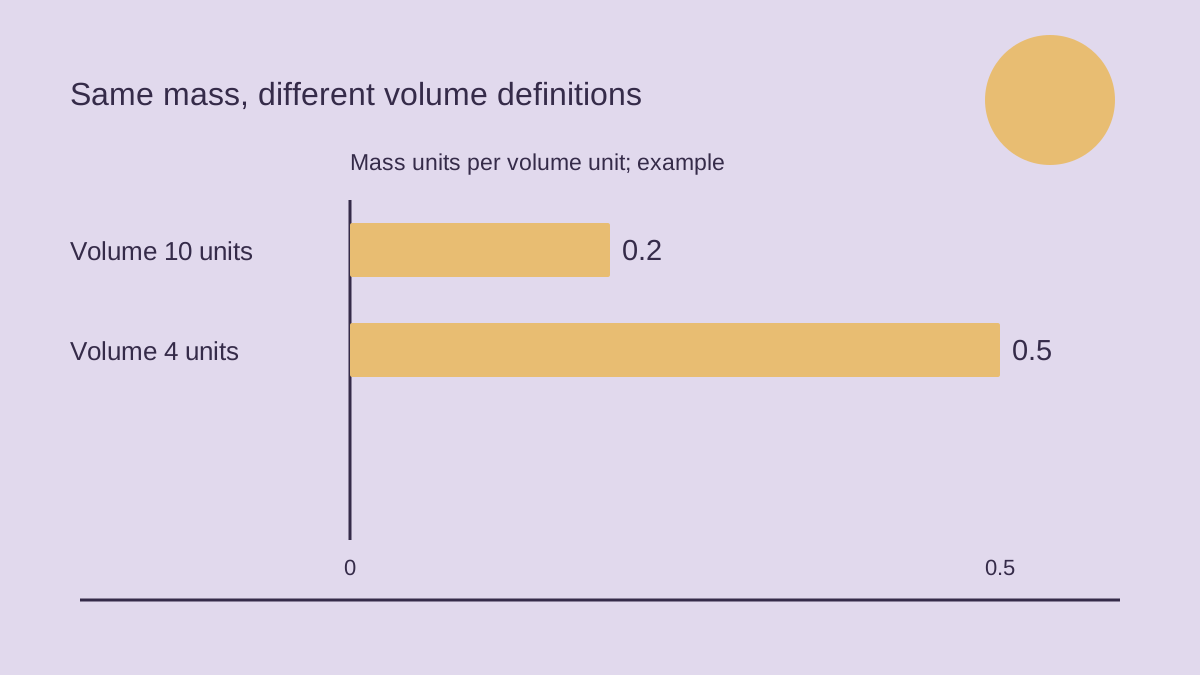
The example explains why a reader needs more than the word density. It does not establish that either invented figure predicts an actual object’s behaviour. A technical interpretation would need appropriate definitions, conditions and evidence. In a commercial account, the immediate requirement is to avoid comparing differently defined ratios as though they were one metric. Naming the denominator makes the numbers interpretable before any further conclusion is attempted.
A fixed mass and a fixed envelope answer different questions
Comparisons often hold one property constant to examine another. Two objects can have the same mass while occupying different overall volumes. They can also fit inside the same overall envelope while having different masses. Both comparisons can be legitimate, but their conclusions have different boundaries. A report should name the property held constant instead of presenting a result as a universal ranking of materials or products.
Consider two invented product options with masses of 3 and 4 units that both fit within one stated comparison envelope. That account answers a mass question under an envelope constraint. Now imagine two different options, both of mass 3, with comparison volumes of 8 and 12. That account answers another question. Neither example supplies a strength, cost or suitability result. It simply shows why the constant in a comparison matters to the claim.
A purchasing discussion can therefore state the intended constraint before asking which option performs better. A comparison with the wrong constraint may be technically interesting but commercially inconclusive for that decision. The article does not identify a particular customer’s requirements. It proposes a way to keep requirements visible so that a later product discussion does not mistake a narrowly framed demonstration for an answer to every use case.
Test conditions are part of the finding
An observed result belongs to a tested object and a set of conditions. A description that removes those conditions can expand the claim beyond its evidence. A report should therefore identify the setting, duration and relevant comparison basis when those details are available. If they are unavailable, the limitation should remain explicit. The absence of a detail does not justify inventing it from a broad account of the research.
The distinction is important for a demonstration and for a proposed application. A demonstration can establish that a specified observation occurred in a particular setting. It does not automatically cover every environment, scale or period associated with a future product. A commercial analysis can recognise the significance of the demonstration while leaving those further questions open. This is a description of evidence, not an assessment that any particular use is safe or unsafe.
A useful comparison brief could place the observed setting beside the proposed setting and identify the differences that have not yet been examined. It should not estimate the effect of those differences without evidence. The result is a bounded statement of what is known and what further information would be needed. That gives a development discussion a concrete agenda without converting unanswered questions into either promises or a premature rejection.
A damage observation is not a general durability guarantee
A report about behaviour after a particular change in an object can be informative. Its scope depends on what change was observed, how the object was examined and what result was recorded. The word damage alone does not describe all of those elements. A product comparison should retain the observation’s boundaries rather than treating one reported demonstration as a guarantee covering any future event or duration.
For an invented reporting exercise, one sample could retain an identified function after a specified alteration while another loses it. That would describe two outcomes in the chosen exercise. It would not establish performance after every alteration or prove a complete lifetime result. The example gives no instructions for damaging or testing an object. Its purpose is to show how a report can state a result accurately without stretching the scope of its comparison.
A later commercial claim about durability would require evidence appropriate to that claim. It might concern a different object, a longer period or a wider set of observations, but those details should come from actual records. The article makes no such durability claim for the reported lattice. It keeps a research demonstration and a commercial guarantee as different objects, each with its own requirements for evidence and explanation.
The assembly boundary matters to a quoted cost
A raw material price, a component price and an assembly price are different quantities. If a performance account concerns an assembly, comparing only the raw constituent price may leave out parts of the object being evaluated. A useful cost discussion would identify what the quoted amount covers and what remains outside it. This article has no verified prices or production costs for the research, and does not estimate them.
A constructed offer might include a manufactured part but exclude another component or a later assembly step. A second offer might include both. Their headline amounts could be accurate while remaining incomparable until their scopes are explained. This is a general purchasing distinction, not a description of an actual supplier’s terms. The reader needs to know whether the price refers to the object whose performance is being discussed.
The same boundary applies to a claim that one option requires fewer additional elements. Such a claim should identify the complete comparison object rather than assume an unchanged surrounding system. If the evidence covers only a demonstration sample, the commercial account should say so. A cost question can be identified without filling it with guessed savings, projected margins or an invented manufacturing route.
A demonstration sample and a repeatable product are different stages
A successful sample establishes a result for that sample under its observed conditions. A repeatable product claim asks whether defined objects can be produced with consistent characteristics. The questions are connected, but the first does not supply the answer to the second. A report can describe the research while leaving repeatability, production scope and commercial availability unestablished where it lacks evidence.
A development discussion could identify what must remain recognisable across later samples: the object definition, comparison basis and recorded result. This is a conceptual description of a reporting task, rather than a manufacturing specification. It does not prescribe dimensions, tolerances, materials processing or testing. Those technical details would need appropriate sources and qualified assessment, and are outside the article’s commercial comparison question.
The reported next steps matter because they indicate that further work remains, rather than certify a finished product. An editor should avoid changing that development stage through an enthusiastic headline. A buyer can still find the demonstration relevant to a future conversation. Its relevance comes from a clearly described possibility and a clearly described evidence boundary, rather than from an unsupported assumption that an order-ready product has already been established.
Compare the function before ranking the object
A complete product may be asked to fulfil more than one function. A comparison focused on one observed property does not automatically rank the entire product for all of them. The intended function should therefore be named before the account uses words such as better or stronger in a commercial sense. The article does not identify a complete set of functions for a marine product or assert that the research has met one.
An invented purchasing question might prioritise one constraint, while another prioritises a different one. A narrow demonstration could be relevant to the first without answering the second. This is why a comparison brief should distinguish the observed property from the decision the reader wants to make. It prevents a technically specific observation from becoming a broad commercial ranking through a change in vocabulary.
A useful development account could retain several unresolved questions alongside the demonstrated one. It need not force them into a single score. Such a score would require a stated weighting and evidence for each entry, neither of which can be inferred from a research announcement. Keeping separate questions visible gives later evidence a place to enter the discussion without retroactively changing what the original demonstration established.
Questions for a hybrid-material product comparison
The following editorial checklist could help organise a later discussion of a product based on a hybrid architecture. It does not claim that a supplier already offers the research as a finished product, or that the listed questions have verified answers. Its purpose is to keep the complete object and the scope of the evidence visible before a constituent name becomes shorthand for a commercial promise.
- Does the claim concern a constituent, a component or the complete demonstrated assembly?
- Which geometry and additional components belong to that assembly?
- Which volume definition supports any stated density?
- What property is held constant in the comparison?
- Which object, setting and observation period support the reported finding?
- Does a quoted price cover the same object whose performance is being compared?
The September report identifies an interesting hybrid demonstration and a reason to examine its product implications. The strongest commercial interpretation keeps the architecture intact: the named metal, the added component, the geometry and the comparison boundary belong together. That permits the reported result to inform a future development conversation without implying a new bulk-metal property, a finished marine product or a universal performance ranking. A complete product claim can develop through further evidence while the original demonstration remains accurately described on its own terms.