In its May 22, 2025 report, Interfax attributed plans for a September opening of the Artem logistics centre in Russia to FinInvest chief executive Alexander Kakhidze. A rolling-stock repair depot was also planned. He described distant repair journeys as a constraint. These were plans and an attributed explanation, rather than measured operational results.
The original analysis below examines the question raised by repair geography: when would a shorter journey actually shorten the elapsed time associated with a repair? It does not describe the proposed depot’s technical capabilities, infer completed construction or give instructions for railway work. Its time accounts and numerical examples are constructed illustrations. They are intended to separate a change in location from the evidence needed to explain a change in elapsed time.
Distance and elapsed time describe different things
A repair location has a geographic relationship to the asset’s starting point. That relationship can be expressed as distance, but distance does not alone determine when an asset reaches a workshop. A journey also occupies a sequence of available movements, waiting periods and transfers. A nearby destination might be reached promptly or only after a long wait. A distant destination could have a different arrangement. Neither outcome should be assumed from a map.
For reporting purposes, a location comparison should therefore retain two separate questions: how far is the movement, and how long does the episode take? The first requires a clearly defined route or geographic measure. The second requires timestamps whose meanings are explicit. A straight-line distance and a recorded journey duration can each be valid descriptions, but they cannot be substituted for one another. A journalist or manager should avoid presenting one as proof of the other.
This distinction does not weaken the case for examining a closer repair location. It gives that case an identifiable measurement task. If the practical concern is time spent away from an intended use, then an appropriate account needs to show where that time begins, which intervals it contains and where it ends. The geographic change becomes one explanatory element in that account. It does not automatically explain every hour recorded after the repair episode begins.
Choose the start before calculating a duration
A repair episode can begin at different recorded milestones. A fault may be reported before a movement is requested. The request may be accepted before the asset departs. Workshop arrival occurs later again. If one comparison begins at the request and another at departure, an apparent improvement could simply exclude an interval that was previously counted. The report should state the start event and preserve its meaning across the compared episodes.
A similar choice exists at the other end. Completion of workshop activity, release from the workshop and arrival back at an identified location are different moments. A record extending to a later assignment adds another interval whose length can depend on circumstances beyond repair. There is no single universally correct endpoint for every question. The useful endpoint is the one that answers the stated question, accompanied by a clear explanation of what remains outside it.
An account can show more than one duration without losing clarity. Request to arrival may describe the outward movement arrangement; arrival to release may describe a workshop episode; release to return may describe the inward journey. A broader total can join them if the boundaries fit. The labels matter because a reader needs to understand whether an apparent change concerns movement, waiting, workshop time or a combination. A single unexplained turnaround figure conceals that distinction.
Divide the episode into intervals that fit together
An elapsed-time account should use adjacent intervals rather than overlapping descriptions. For an editorial illustration, the sequence might be request to departure, departure to workshop arrival, arrival to workshop release, and release to return. These are analytical labels, not a prescribed operating process. They permit a reviewer to locate a change without counting the same hour twice. If the real records contain a different sequence, the account should follow those records instead.
Workshop arrival to release can itself contain waiting and work. Whether those parts can be distinguished depends on the available evidence. An arrival timestamp and a release timestamp support an elapsed interval; they do not establish how many hours were spent actively repairing. Calling the whole interval repair labour would introduce a different measurement without supporting records. The same caution applies to a travel interval that might contain stationary waiting as well as movement.
A useful table could therefore show both the interval and the evidence supporting it. A timestamped movement record supports one boundary; a workshop record supports another. Where only dates are available, the account should retain that lower resolution. It should not turn an approximate date into a precise hour merely to make the table complete. Uncertainty about a boundary belongs beside the duration that depends on it.
A constructed time account shows why one saving is insufficient
Consider two entirely hypothetical episodes, each measured from an accepted request to return at the same named location. In the first, the outward arrangement and journey take 18 hours, the workshop interval takes 30 hours and the inward arrangement and journey take 12 hours. The total is 60 hours. These numbers are invented for explanation. They are not records from the proposed terminal, a railway benchmark or a forecast of any depot’s performance.
In the second episode, the outward interval takes 6 hours, the workshop interval 42 hours and the inward interval 4 hours. The total is 52 hours. Travel-related intervals together fall from 30 to 10 hours, a difference of 20. The overall episode becomes 8 hours shorter because the workshop interval is 12 hours longer. The arithmetic shows that a large improvement in one part can coexist with a smaller improvement in the total.
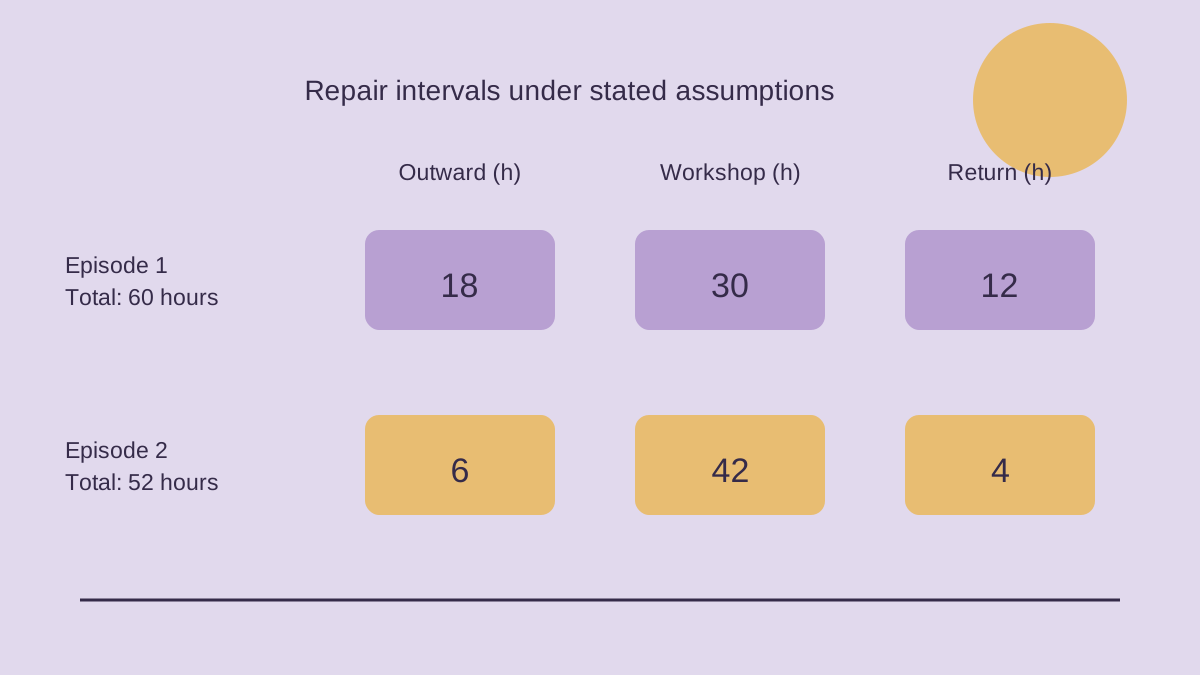
The example does not explain why the workshop intervals differ. They could reflect different work, waiting or record definitions; no cause is supplied. Its purpose is to prevent a report from equating a shorter outward and inward journey with an identical reduction in total time. A real comparison would need comparable episodes and records before making a causal claim. The total and its parts should be visible together, even when the resulting explanation is less dramatic than the geographic change.
Comparability requires more than two totals
Two recorded durations can be accurate while still answering different questions. Their tasks, observation periods, starting conditions and endpoints may differ. A reviewer should identify which differences matter to the comparison rather than treating every episode as an interchangeable unit. This is a requirement for interpreting records, not a technical classification of repair work. The article makes no claim about which repairs any particular workshop can perform.
One useful approach would be to compare defined categories and retain unmatched episodes separately. If one period contains many short episodes and another contains fewer but longer ones, the overall average may change with the composition. That movement is real as an aggregate description, but it does not isolate a location effect. Showing the categories beneath the total helps the reader see whether the two sets represent a similar mix.
The calendar boundary matters as well. A seasonal period, a short start-up interval and a full year are different observation windows. A new location’s early records might contain only a limited set of episodes. A report could describe those records honestly without presenting them as a settled annual result. Consistent windows and explicit limits make a comparison more useful than an ambitious projection whose assumptions disappear from the published account.
Open episodes must remain visible
A report compiled on a particular date can contain completed episodes and episodes still in progress. If it averages only completed cases, it may omit the longest ongoing ones. This does not make a completed-case average meaningless, but it changes what the average describes. It is an average for the episodes that have finished by the cutoff, rather than a complete account of every episode that began in the period.
Imagine a constructed group of five episodes begun in one observation window. Four have ended after 10, 12, 14 and 16 hours. Their completed-case average is 13 hours. The fifth is still open after 40 hours. Reporting only the average would hide a material feature of this invented group. Reporting four completed episodes, one ongoing episode and its elapsed time gives a fuller description without guessing when the unresolved case will end.
The appropriate treatment is to keep the cutoff visible and refrain from assigning an invented finishing time. A later report may update the unresolved episode when a real endpoint is recorded. Until then, its duration is incomplete. This distinction is especially useful when comparing periods of different maturity: a recent period has had less time for its long episodes to finish. The reporting method should explain that timing effect rather than turning it into an apparent performance gain.
Nearby workshop space and available workshop time are separate
A location can be close while an appointment or necessary resource remains unavailable. Conversely, a more distant location may have an earlier opening in its schedule. An assessment of elapsed time therefore needs evidence about the actual interval between arrival and release, rather than assuming that geographic proximity guarantees immediate attention. This is an analytical point about time records. It does not establish the staffing, equipment or workload of the planned facility.
There can also be a difference between the availability of a place and the availability of a service for a particular episode. A general announcement of a repair depot does not enumerate every activity it will provide or every asset it will accept. Those details would need their own verified source. A report can examine the importance of the distinction without filling the gap with a list of imagined capabilities.
A careful follow-up question would ask which reported episodes entered the comparison and which were outside its stated scope. Excluded cases should remain identifiable as exclusions, rather than disappearing from the denominator. That allows a reader to distinguish a promising result within a limited category from a claim about all repair journeys. A narrow but accurately described result can be useful; a broad claim requires evidence covering the broader population.
A time account does not automatically become a money account
Hours and money are different units. A shorter episode may be relevant to an organisation’s plans, but its monetary effect cannot be calculated by attaching an unexplained rate to every saved hour. Some costs may be fixed, some may depend on actual purchases and others may reflect opportunity rather than a cash payment. The article does not estimate savings, profit or additional freight revenue for the proposed project.
A meaningful monetary comparison would require a stated cost boundary and evidence about the categories that changed. Journey purchases, workshop charges and internal allocations could each have different treatments. Whether a particular cost enters the comparison depends on the question being asked. An account of recorded spending should remain separate from a constructed estimate of the value of time. Combining them without explanation would make the result harder to assess.
The same discipline applies to an opportunity claim. An earlier return does not prove that another useful assignment existed at that exact moment. That would require evidence about the intended work and its timing. The analysis can identify the missing connection without recreating a dispatch process or prescribing railway operations. It is enough to distinguish an observed shorter episode from the additional claim that the recovered time produced a measured economic result.
A repair location and annual terminal capacity are different scales
A terminal is described through several kinds of resources and activities. An episode involving one asset occupies a smaller observational unit than a terminal’s annual handling account. A change in one episode may matter, but multiplying a selected time saving across an imagined fleet would not establish annual throughput. Such a projection needs a defined population, comparable episodes, observation coverage and a demonstrated link to the activity being counted.
This is why an attributed explanation about distant repairs should remain an explanation to investigate. It can identify a plausible question without proving how much handling a project will add. A journalist can report the plan and then ask what evidence would distinguish an improvement in repair-related travel from a measured change in terminal activity. Both topics are legitimate, but the evidence for one does not automatically answer the other.
An annual capacity statement also cannot reveal the workshop interval for a particular episode. Moving from the large account back to individual time records requires separate evidence. Keeping the scales distinct avoids both exaggeration and dismissal. A smaller, well-documented time result may have value even when a terminal-wide effect has not been established. Its usefulness comes from the clarity of its scope, not from attaching the largest available headline to it.
Questions for a repair-journey comparison
The following editorial checklist brings the account back to the question raised by location. It could help a reader assess a later report about actual elapsed time. It does not assert that the proposed project already maintains these records or that every question has a known answer. Each item concerns the description of evidence, rather than a technical decision about moving or repairing rolling stock.
- Which recorded event starts each episode, and which event ends it?
- Are distance and elapsed time reported as separate measures?
- Do the intervals join without overlap or an unexplained gap?
- Are workshop waiting and active work distinguished only where records support the distinction?
- Which cases are comparable, excluded or still unresolved at the cutoff?
- Does any monetary or annual handling claim have evidence beyond the episode’s duration?
The May report establishes a planned project and an attributed reason for examining repair geography. It does not establish that the facility opened, that a particular journey became shorter or that terminal throughput improved. A subsequent account would become more informative by showing the time boundaries, the parts of the episode and the cases left open. That evidence would allow a shorter repair journey to be discussed as a specific observed change, while any wider operational or economic conclusion retained its own requirement for proof.