An equipment supplier’s order book is a promise of work, rather than a complete explanation of how that work will become revenue or cash. The distinction becomes especially useful when the supplier combines customised projects with materials and services used after installation. EPB’s food-automation business offers a case for examining that combination: what must be delivered, which resources delivery needs, and what can lead to a later order from the same customer.
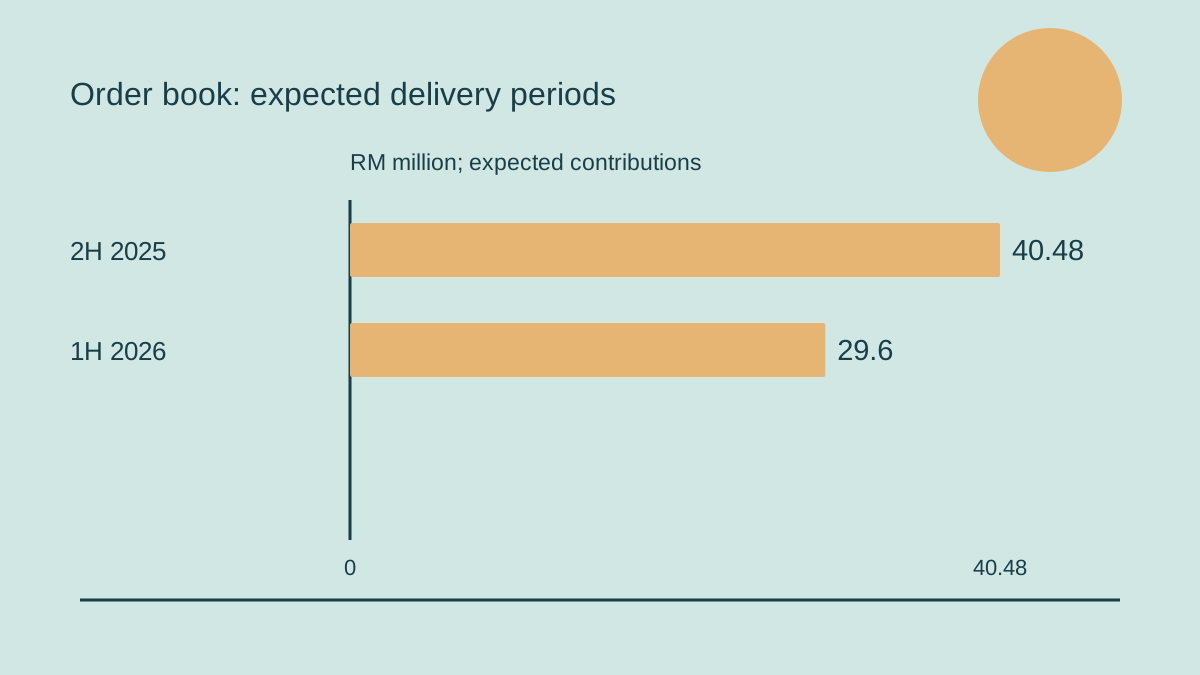
In a The Edge Malaysia interview published online on 26 November 2025, managing director Yeoh Chee Min described EPB’s machinery, packaging consumables and after-warranty services. Reported orders of RM70.08 million were scheduled as RM40.48 million for the second half of 2025 and RM29.6 million for the first half of 2026. The discussion below uses those attributed facts as a starting point for an independent delivery framework. It does not reconstruct private contracts or claim that scheduled work had already been completed.
Start with the unit of work being promised
A project supplier needs a more specific description of an order than its headline value. The work might involve equipment, integration, commissioning support or several connected tasks. An operating review would need to establish the scope promised to the customer and the conditions for completing it. This is a proposed investigation, not a statement that EPB’s published order book uses a particular contractual structure.
The scope should also distinguish what the supplier does from what the customer or another contractor must provide. A line may be physically ready while installation depends on site access, utilities or adjacent equipment. If those dependencies are omitted from the plan, a timetable can appear achievable even though a necessary input is outside the supplier’s control.
A useful project record would therefore identify the promised result, the inputs required from each party and the evidence that the result has been delivered. It would keep unresolved decisions visible. The point is not to make the order seem less valuable. It is to explain what the value represents and what has to happen before the business can regard the associated work as finished.
Keep the order schedule separate from reported revenue
The two scheduled amounts describe how the reported order book was allocated between periods. They are components of that total, not additional orders to add to it. Nor should a reader automatically add a period’s scheduled work to its reported revenue. That would mix a forward-looking workload measure with an accounting result without knowing how the underlying contracts connect them.
The IFRS Foundation’s explanation of IFRS 15 links revenue recognition to satisfying obligations by transferring promised goods or services. Recognition can occur at a point in time or over time, depending on the obligation. This principle does not establish EPB’s treatment of a particular contract; the interview does not disclose that policy or contract assessment.
For a business review, the practical question is how each scheduled project moves through its actual delivery and reporting stages. A change in the schedule could affect when work is expected, while the accounting result depends on the relevant contract and performance. The review needs that connection before interpreting the order book as a precise earnings forecast or an amount already earned.
Cash collection has its own timetable
A customer can pay at a different time from the delivery or recognition of the related work. A useful cash plan would therefore identify the payment conditions separately from the production schedule. The source gives no project-level advance payments, credit periods or acceptance-linked collections. This analysis does not assign any such terms to the company.
As a general project-management problem, expenditure can occur before collection. Materials, supplier services and staff time may be needed while equipment is being prepared. A planner should understand which payments are committed, which depend on milestones and which can change if the project changes. Those distinctions help explain the resources required to execute orders rather than only the size of those orders.
The resulting plan should connect delivery milestones with expected receipts and payments without treating them as identical events. It should also show what happens if a milestone moves. This is not an estimate of EPB’s cash position or financing need. It is a method for identifying the information that would be necessary to judge whether a particular project schedule is supported by a workable cash schedule.
Integration makes interfaces part of the product
When several machines or processes need to work together, the connection between them becomes part of the operating result. A machine can perform its own task correctly while the line as a whole still has a mismatch in throughput, hand-off or control. A project review should therefore define success for the system, not only for each item supplied.
For example, a proposed acceptance plan could distinguish an individual equipment test from a test of the connected process using the intended product. The second test would ask whether the interfaces work under the agreed conditions. This is an illustrative approach, not evidence of the acceptance procedure used by EPB or a claim about a failed installation.
The commercial implication is that coordination has value but also needs resources. Design decisions, changes and responsibilities must be clear enough for the parties to resolve a mismatch. A supplier’s ability to integrate a line cannot be assessed solely from the number of machines delivered. Useful evidence would concern the agreed operating result and the process for resolving exceptions before final completion.
Customisation needs a disciplined change process
A customer’s requirements can become more precise as design and testing progress. A management review should distinguish clarification within the agreed scope from a change that adds work. Otherwise, a project can keep its original headline value while the effort required to deliver it changes. The interview does not reveal project-level changes, so no such deterioration is asserted here.
A practical change record would state the request, its effect on equipment or software, the resources required and the effect on the schedule. It would also identify who approves the commercial consequence. Keeping those elements together helps prevent an engineering adjustment from appearing harmless in one team’s records while creating an unresolved delivery or payment issue elsewhere.
The purpose is to preserve a common understanding of the promised result. A change may improve the customer’s eventual outcome and be commercially reasonable. Its value still needs to be considered alongside the added effort and altered dependencies. A well explained order book would make material changes visible rather than leaving readers to assume that every original project remains unchanged.
Consumables offer repeat opportunities, not automatic repeat revenue
Materials used during a customer’s operations can create a different commercial rhythm from an equipment project. A customer may need replenishment after installation, while a machinery purchase may be much less frequent. That possibility helps explain why the combination merits analysis. It does not establish a guaranteed purchasing commitment or a disclosed recurring-revenue share.
A review of repeat demand would need to connect the customer’s operating activity with the relevant material and purchasing terms. It should distinguish a first shipment, replenishment, a standing agreement and a new order won in competition. Each can require different inventory and service commitments. Treating all of them as the same kind of recurring sale would conceal those differences.
The supplier also needs to consider the resources involved in reliable replenishment. A repeat product can still require stock, lead-time planning and a clear specification. The management question is whether the relationship makes future demand more understandable and whether serving it contributes value after the associated costs. The company interview does not disclose enough information to calculate that contribution.
After-warranty service should be assessed on its own terms
An installed machine can create later needs for maintenance, repair or replacement parts. Those needs connect a supplier with a customer beyond the original project. Yet an installed base is not the same as a contracted service revenue stream. A useful review would ask which services are agreed, which are purchased when needed and which depend on the customer choosing the supplier again.
Service also needs an operating model. A response promise may require skilled staff, parts availability and a method for diagnosing problems. The distance to the customer and the ability to resolve an issue remotely may affect the resources needed. These are practical considerations for evaluating an offering, not published measurements of EPB’s service performance.
For the customer, the relevant evidence is whether support meets the agreed need. For the supplier, the evidence includes the cost and reliability of fulfilling that promise. Neither side can be evaluated simply by noting that service is offered. A later assessment would need actual service commitments and results, while the historical interview establishes only the presence of the offering.
Cross-border delivery requires a view of local dependencies
EPB’s reported markets include Malaysia, the Philippines and Indonesia. Geographic reach gives context for a project business, but it does not supply a country-by-country delivery plan. The analysis does not infer identical contract terms, requirements or customer behaviour across those markets.
A cross-border project review could identify which activities must take place at the customer’s site and which can be completed before shipment. It would need the relevant logistics, access arrangements and responsibilities for local work. A delay in one dependency can affect a later milestone even when the supplier’s own manufacturing work is on schedule.
This is why geographic diversification and execution resilience are separate questions. Serving several markets can broaden the commercial opportunity, while each project still needs a workable delivery route. A useful report would explain material dependencies rather than treat a broad map of customers as proof that all orders can be executed on the same timetable.
Expansion should connect with the work the business can deliver
An equipment supplier evaluating additional capacity needs to connect its production resources with the projects it expects to undertake. More floor space alone does not establish more completed customer systems. Design, fabrication, integration and site work can place demands on different teams. The source does not provide a complete resource plan, so this analysis does not identify a specific bottleneck inside EPB.
A practical resource review would allocate work by stage and identify shared constraints. It would ask whether several projects need the same specialist at the same time and whether a later site task depends on that person finishing an earlier one. Such a schedule is more informative than dividing the order book evenly by the number of employees.
The same review should preserve the difference between a planned facility and a completed operating contribution. A proposal can describe a future opportunity without proving its timing or result. Keeping that status clear lets a reader compare the original plan with later evidence. It avoids presenting an expected benefit as if it had already appeared in the historical period under discussion.
Measure replenishment and completion together
An order book changes as work is added, completed, revised or removed. A useful movement schedule would explain those categories separately. A stable closing total could result from steady execution and replenishment, or from a different combination of movements. The closing number alone does not distinguish them. No detailed reconciliation is supplied in the interview.
For management purposes, completion should be examined alongside the quality of newly added work. The question is not only whether orders are replaced, but whether the new projects fit available resources and commercial requirements. A larger pipeline that cannot be scheduled coherently would not, by itself, establish a stronger operating outlook.
Repeat materials and service orders should also remain distinguishable from major equipment projects in that discussion. Their timing and resource demands may differ. The combined business can be assessed more clearly when each activity has a defined measure, rather than when several unlike forms of work are gathered into a single growth narrative.
A checklist for an order book that can be explained
The case suggests a practical set of questions for reading an integrated equipment business. This is an analytical framework, not a description of EPB’s internal controls or a recommendation concerning its securities. It identifies the evidence needed to connect announced work with delivery, reporting and later customer relationships.
- Define the promised result and the responsibilities of each party.
- Separate scheduled orders from recognised revenue and cash collection.
- Connect project stages with the resources and external inputs they require.
- Record changes in scope, timing and commercial terms together.
- Distinguish initial materials sales from repeat purchasing commitments.
- Assess service promises against the resources needed to fulfil them.
- Explain additions, completions and other movements in the order book.
- Preserve future plans as plans until operating evidence becomes available.
The value of the November account lies in the questions it makes possible. The combination of projects, consumables and service offers several ways to maintain a customer relationship. Whether those opportunities produce reliable revenue and cash depends on their actual execution and terms. A clear explanation follows that route rather than treating the order book as its own proof of the final result.