
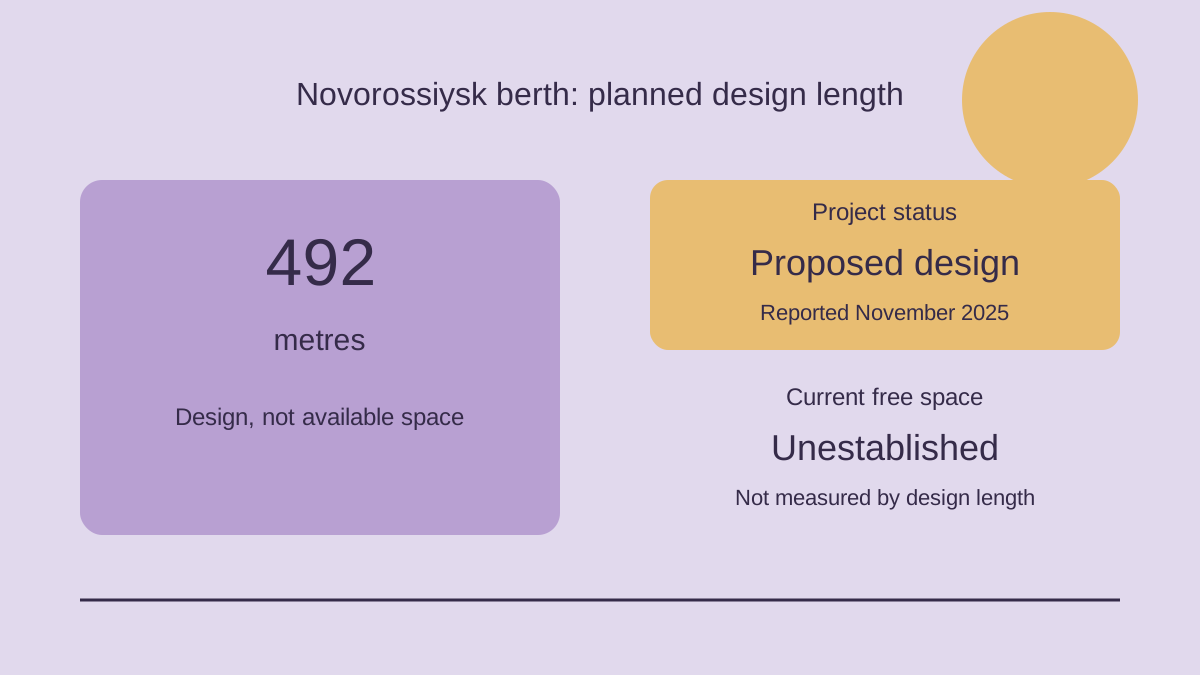
Interfax reported on November 19, 2025 that a company presentation for a planned fertilizer terminal in Novorossiysk, Russia, included a 492-metre berth in its design specifications. This is an attributed statement about a proposed design, rather than an observation of an operating berth's free space.
The original analysis below examines a narrower measurement question: why total free length and the largest continuous free segment are different quantities. Its examples use invented, dimensionless length units on an abstract line. They describe no actual vessel, port layout, reservation or engineering clearance. They do not calculate how many ships the reported berth could accommodate. The purpose is to explain the information lost when separated spaces are added into one total.
A length total omits the arrangement of its parts
A sum answers how much length is included in a set of segments. It does not identify where those segments lie or whether they touch. If a request requires one continuous segment, arrangement becomes part of the allocation question. Two spaces with the same total can offer different possibilities because one has a sufficiently long uninterrupted section and the other does not. The total remains correct in both cases; it answers a less detailed question.
This distinction can be expressed without making a claim about any real berth. An abstract line can contain available and unavailable sections. The available sections have a combined length, while each individual section has its own length and position. Adding their lengths discards position. That loss of information is harmless when the question asks only for a total, but consequential when a proposed allocation cannot be divided across separate sections.
For a commercial explanation, the first step is therefore to name the quantity being reported. Total designed length, total currently free length and largest currently free continuous segment are three different objects. The source supplies the first as a planned specification. The examples below construct the other two solely to explain their relationship. None of the constructed availability states is inferred from the proposed terminal or assigned to its reported design.
An invented twelve-unit line shows the difference
Consider an abstract line twelve units long. Six units are free at one end, two intervening units are unavailable, and four units are free at the other end. The total free length is six plus four, or ten units. The largest continuous free segment is six. An indivisible allocation requiring eight continuous units cannot fit under the model's rules, even though the free total exceeds the requested length.
Now arrange the same twelve-unit line differently: ten continuous units are free, and the two unavailable units are at one end. Total free length is still ten. The largest free segment is now ten, so the same eight-unit request can fit within the invented one-dimensional model. No additional length has been created. Only the arrangement of the unavailable section has changed, and that change alters the modelled allocation possibilities.
These examples assume that any position within a free segment is otherwise usable and that no spacing or other conditions apply. Those assumptions belong only to the abstract model. A real port would require evidence beyond a line-length calculation before any conclusion about vessel accommodation. Keeping the units dimensionless helps preserve that boundary: the example demonstrates continuity, rather than translating the reported 492 metres into a proposed operating plan.
The largest segment answers a particular request
In the first invented arrangement, a six-unit continuous request can fit, while an eight-unit one cannot. Both conclusions depend on the specific request and the stated rules. Describing the fragmented line as simply unavailable would therefore be too broad. It contains available space, but not the continuous space required by the larger request. A useful availability statement needs to retain what kind of allocation is being considered.
The largest segment is sufficient to answer whether one indivisible request fits in this simplified line model. It is not sufficient to describe every possible combination of requests. The full list of free segments can matter when several allocations must coexist. Replacing the total with one largest-segment number would therefore improve one comparison while discarding other information. The appropriate description depends on the question, rather than on a single universally superior capacity measure.
A compact record could preserve both the sum and the individual segment lengths. A separate line could state the request's length and whether it is divisible. These are suggested fields for explaining the model, not a claim about actual port booking records. They make the counting rule visible and allow the reader to see why a total that looks sufficient can still fail the continuity requirement.
One eight-unit request differs from two four-unit requests
Return to the arrangement with free segments of six and four units. One indivisible eight-unit request cannot fit. Two independent four-unit requests can: one can occupy four units within the six-unit segment, and the other can occupy the four-unit segment. Their requested lengths sum to eight, just as the single request does. The different result follows from the number and divisibility of the requests, not from a change in total demand.
This does not mean that an indivisible object can be split merely because doing so would improve the arithmetic. The two-request example explicitly changes the object being allocated. A report should not treat that change as a solution to the original request unless the original conditions actually permit division. The abstract comparison is useful precisely because it shows how the same total demand can conceal different allocation requirements.
For the same reason, a count of requests does not replace their lengths. Two requests might need two short segments or two much longer ones. Their number alone cannot determine whether they fit. An allocation explanation therefore needs both the requested units and the structure of each request. Keeping those elements together prevents a total length from being interpreted as an unlimited ability to accept any combination of objects.
Placement choices can change what remains
The model can also demonstrate a placement effect. Start again with free segments of six and four units, and consider two indivisible requests of four and six units. If the four-unit request is placed at an end of the six-unit segment first, that segment leaves two free units. The other four-unit segment remains free. There are six free units in total afterward, but no continuous six-unit section remains for the second request.
If the four-unit request is instead placed in the four-unit segment, the six-unit segment stays intact. The six-unit request can then fit. Both placements use four units initially and leave six units free. Their remaining arrangements differ. This is a constructed example, not evidence that an actual port uses either placement rule. It identifies information that a total alone would not preserve when describing the state after an allocation.
An explicit first-fitting-segment rule can also make request order matter in the toy model. If the six-unit segment is considered first, placing the four-unit request there prevents the later six-unit request from fitting. Processing the six-unit request first occupies that segment and leaves the four-unit segment for the four-unit request. The example specifies the rule as well as the order; it does not claim that every allocation method has the same outcome.
Separated segments cannot be merged by arithmetic
Adding six and four produces ten, but addition does not remove the unavailable gap between the segments. A continuous ten-unit section exists only if the relevant arrangement actually contains one. In the abstract model, relocating or removing the unavailable section would be a change to the state, not a different way of writing the same state. A report should distinguish that proposed change from the availability already observed.
The distinction becomes especially important when a text describes potential rather than current use. A possible rearrangement can be presented as a scenario with its own assumptions. It cannot be counted as existing free continuity merely because the total length would remain constant. The model establishes no real ability or permission to move an occupied allocation. That question would require additional evidence outside the simple spatial calculation.
Likewise, a planned design specification does not establish a present availability map. Designed length can provide context for a future facility, but the operating state would need an observation of its own. Preserving this distinction keeps the historical announcement intact while preventing an original illustration from becoming an invented description of what the announced terminal already offers.
Time adds another boundary to free space
All earlier examples describe one availability state at one observation point. A request for an interval of time introduces another condition: the required continuous segment must be free throughout the interval specified by the model. A free section observed now does not by itself establish its future availability. This is a statement about the model's observation boundary, rather than a reconstruction of an actual berth schedule.
Consider an invented ten-unit continuous section free during a first period but unavailable during a second. A request spanning both periods cannot be supported by the first-period observation alone. The spatial length is sufficient in the first state, but the time condition is not established across the entire request. Adding free lengths from different periods would not create simultaneous continuous space. Each observation needs to remain attached to its own period.
This does not require turning the article into a detailed scheduling model. A concise explanation can simply say when the reported availability applies and whether future states are observed or assumed. Its purpose is to prevent a snapshot from becoming a promise. The spatial fragmentation question remains distinct from the temporal question, although both can matter to the same hypothetical allocation.
Unknown availability should not become a complete map
A designed-length number supplies no list of current free segments. If that list is missing, the largest free segment is unknown. It is not automatically equal to the total designed length, and it is not automatically zero. The first assumption would treat the whole line as available; the second would treat it as wholly unavailable. Neither state follows from the absence of an availability observation.
The same distinction applies to reservations in a hypothetical record. A section described as reserved and a section described as currently occupied can have different relationships to an observation time. The model would need an explicit rule to decide which is unavailable for the proposed request. This article supplies no actual booking status or contractual rule. It asks only that any assumed status be identified before calculating the relevant free segments.
Uncertainty can therefore remain a useful part of a clear report. A reader can learn the planned total while understanding that current allocation possibilities have not been established. This is a complete description of the available evidence, rather than a defective calculation waiting for an invented input. The original source and the abstract model can both be retained without pretending that they contain the same kind of information.
A short checklist for a length-based claim
The following questions are an original reading aid for the invented examples. They do not describe a port's engineering standards, booking method or operating instructions. They identify what a length-based statement would need to say before its total can answer a particular allocation question.
- Is the number a designed total, a free total or the largest free continuous segment?
- Which observation time or assumed period does the availability describe?
- Does the request need one indivisible segment or several independent segments?
- Are the individual free intervals known, including the gaps between them?
- Does a placement example state its rule and the resulting remaining arrangement?
- Are proposed rearrangements and missing availability data kept separate from observed states?
A length total can accurately describe scale while remaining insufficient for a continuity question. The invented examples show that equal free totals can support different requests and leave different remaining states. Keeping segment arrangement, request structure and observation time visible preserves that distinction. It allows an analysis of a planned berth specification without inventing its operating availability or treating arithmetic on an abstract line as evidence about real vessel accommodation.