
Fanagoria, a producer in Russia, began wine exports to Mongolia, according to Interfax’s November 28, 2025 report, citing the company’s press service. The company said the wines had been delivered to the California restaurant chain in Ulaanbaatar. The shipment volume was not disclosed.
A first delivery makes a specific commercial relationship visible. It does not, by itself, show the buyer’s remaining inventory, subsequent orders or demand across an entire country. The original analysis below examines how those observations could be separated. Its quantities and schedules are invented teaching examples, expressed in abstract stock units. They describe neither this producer’s shipments nor this restaurant chain’s operations.
A delivered shipment and a recurring account answer different questions
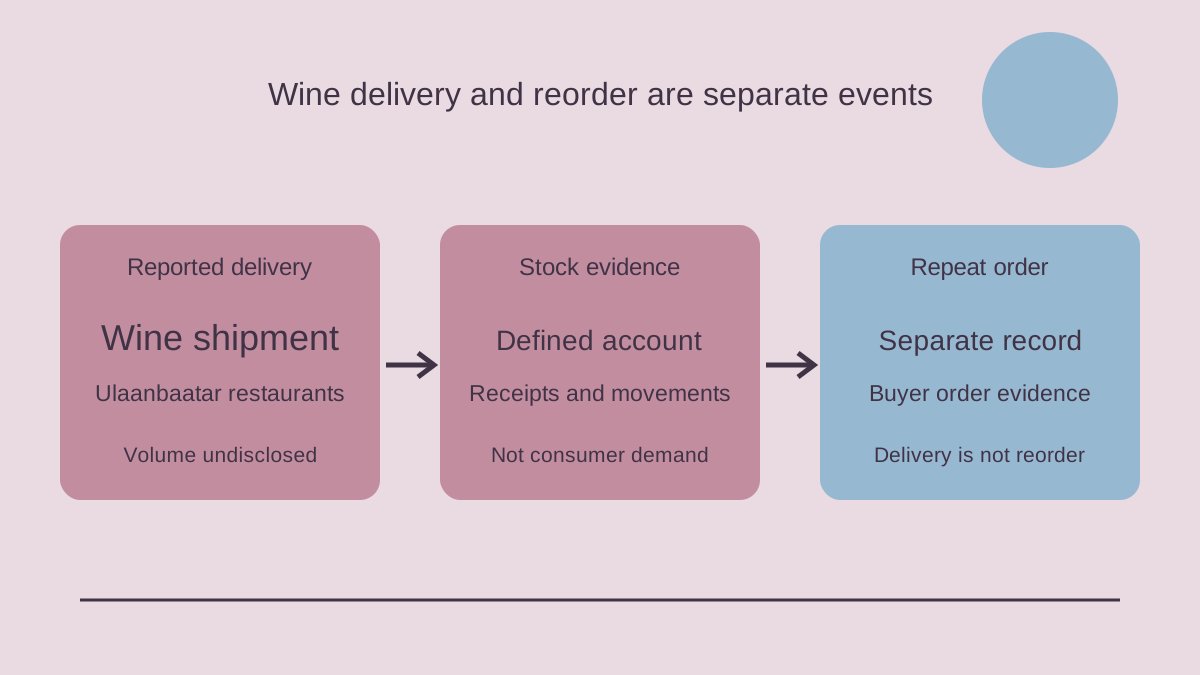
The first question is whether goods have reached a named receiving channel. The reported delivery addresses that question at the level described in the announcement. A second question is whether the buyer later places another order. A third is whether that order becomes another delivery. Each question needs an observation of its own. Treating the initial delivery as the answer to all three compresses a sequence into a single event and hides the evidence still missing.
Consider an editor writing a short update several weeks later. If the only available material remains the original announcement, the defensible update is that no further delivery information has been established by that material. It would be misleading to turn the passage of time into confirmation of continuing orders. Equally, a lack of published follow-up would not establish that the relationship ended. Public silence leaves the later stages unresolved; it is not a sales result with either a positive or negative sign.
That distinction matters because a recurring account is observed over a period, whereas a first shipment has a particular place in a sequence. An account might receive goods once and retain them, receive a later replenishment, change the items it orders, or wait before deciding. Those are possibilities for an analytical model, not reported developments here. A useful account of market entry therefore identifies the stage actually supported before discussing what further records could make the next stage visible.
Define the receiving channel before expanding the claim
A restaurant chain is a named commercial channel. The word “chain” alone does not supply an outlet count, the distribution of goods between outlets or the size of a national market. A delivery to that channel could be described accurately without any of those additional quantities. An analyst should resist filling the gaps with an imagined network map. The most precise geographical statement may remain a named buyer in a named city, even when the announcement describes entry into a country.
For an original record design, the unit of observation could be one buyer account rather than one restaurant location. The account would then have a single identifier, and any later location-level observations would be attached separately if available. This prevents an accidental change of denominator. Ten receiving locations, for example, would not automatically mean ten independent purchasing decisions. Conversely, one central purchasing decision would not reveal how much each location received. These are alternative record structures, not facts about the announced buyer.
The same restraint applies when comparing channels. A hypothetical restaurant account, a wholesale account and a retail account might each record a delivery, but their later observations could differ. Combining their shipments into a national demand measure would require a defined scope and compatible units. Without that groundwork, a larger-looking total might simply collect unlike records. Keeping the initial channel explicit preserves the meaning of the first event and makes any later expansion of coverage visible to the reader.
Reconcile stock with an explicitly invented example
Suppose an invented buyer account receives 120 abstract units at the beginning of an observation period and has no opening stock. During the period, its records show 70 units leaving the measured stock account and 10 units transferred into a separately tracked holding account. The closing balance in the original account is therefore 40 units: zero opening units plus 120 received, minus 70 outbound units, minus 10 transferred units. The arithmetic defines a stock account, not consumer purchases.
The holding account matters. If the analyst measures stock across both accounts together, the 10-unit transfer stays inside that larger scope. Total stock remaining across the two accounts would then be 50 units, assuming no other movements. If the analyst measures only the first account, the balance is 40. Both numbers can be correct because they describe different boundaries. Switching between them without explanation would make an internal transfer appear to remove goods from the entire buyer’s stock.
The 70 outbound units also need a definition. In this example they are simply recorded departures from the measured account. The example does not say whether they were sold, issued internally or moved through another process. Naming them “consumer demand” would add information the arithmetic does not contain. Stock reconciliation can show that the entries fit the closing balance; it cannot decide what an unspecified movement meant. That interpretation requires an accompanying movement description rather than a more confident adjective.
Separate an order date from a receipt date
Now extend the same invented example. After the closing balance has been recorded, the buyer places an order for 60 abstract units. An order record adds a new observation, but it does not add 60 units to physical stock. If the goods arrive in the following period, their receipt belongs to that later period. Keeping two dates prevents an order placed near a reporting boundary from being presented as goods already received before the boundary.
If the next period opens with 40 units in the original stock account and then records receipt of all 60 ordered units, the account has 100 units available before any further movements. If only 45 units arrive during that period, the corresponding quantity is 85. The outstanding 15 units remain an order-related quantity, not stock on hand. These invented alternatives demonstrate why an order total and a receipt total should be displayed separately even when both refer to the same intended replenishment.
A later cancellation would be another event in the order record, not a revision of the earlier delivery into something that never happened. Likewise, a later receipt would not change the historical date on which the first order was placed. Preserving the sequence allows the reader to follow what was known at each stage. It also makes a modest follow-up statement possible: an additional order has been recorded, while its fulfilment remains a separate observation awaiting the relevant evidence.
A reorder can coexist with substantial remaining stock
The invented 60-unit order does not prove that the previous 120 units were exhausted. The example already contains a remaining balance. There is no contradiction: a buyer can place an order before an earlier balance reaches zero. An analyst therefore cannot infer complete depletion solely from the appearance of a subsequent order. To discuss depletion, the record would need a closing-stock observation covering the same inventory boundary and a definition of the movements that reduced it.
Nor does a reorder automatically reveal the buyer’s reason. An original scenario could specify an intended inventory level, an upcoming observation period or a different selection of items, but none of those explanations follows from an order quantity alone. They would need to be explicitly stated within the scenario or supported by a separate real record. Leaving the reason open is more informative than attaching a convenient narrative that appears to explain every gap in the sequence.
For reporting purposes, the strongest improvement may be a simple separation of columns: closing stock, new order quantity, receipt quantity and the dates attached to each. A row could then show both remaining stock and a new order without implying an inconsistency. This proposed layout is an analytical aid, not a claim about any company’s systems. It makes the information that supports the replenishment observation easy to distinguish from the information that would support an explanation of the buyer’s motives.
Choose the observation period before calculating a rate
A movement count becomes a rate only after a period has been attached to it. Seventy outbound units over ten days and seventy outbound units over thirty days produce different daily averages. In the invented example, neither duration has been supplied, so a daily movement rate cannot yet be calculated. Adding a guessed duration would create a plausible-looking number without a defined basis. The interval is part of the evidence, not decorative context that can be reconstructed after the calculation.
Even with a duration, the resulting average would describe that chosen account over that chosen interval. It would not establish a constant future pace. A hypothetical ten-day observation containing one large movement is different from ten similar daily movements, although the average could be the same. If timing within the interval matters to the question, dated movements provide more information than the aggregate. The appropriate level of detail follows from what the analyst is trying to explain, rather than from a desire to produce more digits.
Comparing the first and second replenishment intervals also requires consistent endpoints. One calculation might run from order to order, another from receipt to receipt, and a third from receipt to a stock count. Their lengths are not interchangeable. Naming the endpoints makes a comparison understandable and avoids attributing a shorter interval to stronger demand when the comparison actually changed its starting event. Any real explanation would still need the relevant observations; this example merely specifies how the comparison could be constructed.
Keep item changes visible when following repeat business
A repeat order at the account level may not repeat the same items. An invented buyer could order one item initially and a different item later. That would support an observation of continuing account activity, while leaving repeat demand for the first item unresolved. Grouping both orders under one buyer identifier is useful for one question; retaining their item identifiers is necessary for another. Neither grouping is universally superior. Each should be labelled according to the claim it can support.
Quantities require the same discipline. If an original teaching example uses abstract units, it must keep those units consistent throughout its arithmetic. A real comparison involving different pack sizes would need an explicitly chosen common basis before the totals could be compared. This article does not supply such pack data for the reported shipment. It is therefore more accurate to retain the announcement’s undisclosed volume than to construct a conversion from assumptions about how a particular product might have been packed.
A record of continuing account activity can remain useful even when item-level detail is unavailable. The author can state the narrow observation and explain what is unknown, instead of discarding the observation or upgrading it into a broader claim. That approach allows a later item-specific report to add information without forcing a correction to an earlier overstatement. The practical goal is a history that becomes more detailed over time while keeping each historical statement proportionate to its evidence.
Build a follow-up that adds one verifiable stage
A concise follow-up template could begin with the previous observation, then identify the new one and its date. For example, an explicitly hypothetical update might say that a first receipt was recorded in one period and a later order in another. It would then distinguish whether that later order had also been received. This structure gives the reader a sequence rather than a repeated market-entry headline. It also keeps a new order from silently becoming a completed shipment in the wording.
The supporting record would be described at an appropriate level: who reported the event, which account it concerns, what kind of event it is and which quantity, if any, was disclosed. Missing values could remain marked as unavailable. A blank quantity is not zero, and an unavailable receipt date is not the order date. These small distinctions prevent a table or summary from generating assertions that were absent from the underlying material. They also show precisely what a future update would need to add.
- Account identifier: the invented buyer receives one stable identifier across the sequence. A location mentioned later is recorded as additional detail, rather than silently replacing the buyer account. This keeps a comparison about the same subject even when the available description becomes more detailed.
- Event type: an order, a receipt, an outbound movement and a transfer receive distinct labels. They cannot be counted as interchangeable deliveries. If the type of a movement remains unknown, the record preserves that uncertainty instead of selecting the label that makes the strongest story.
- Event date: the record uses the date attached to the observed event and identifies a separate publication date where relevant. A later announcement need not mean the physical movement occurred on the announcement date. The example supplies no missing historical date for the reported shipment.
- Quantity and unit: each amount keeps its stated unit and account boundary. An unavailable amount remains unavailable; it does not become a zero. A total across two stock accounts includes their internal transfer only as an internal movement, so the transfer does not reduce combined stock.
- Observation interval: a comparison states its beginning and end before calculating a rate. If one interval runs between orders and another between receipts, they are displayed as different measures. Readers can then see whether a shorter interval concerns buying decisions or recorded physical arrivals.
- Reporting basis: each real observation identifies who supplied the information, while each invented example is marked as invented. An explanatory calculation does not become independent confirmation of the event used to introduce it. Keeping those roles visible allows later evidence to add another stage without rewriting the first.
For this announcement, the supported starting point remains the company-reported delivery to the named restaurant chain, with its volume undisclosed. Subsequent orders, stock balances and broader demand are separate questions. The invented ledger shows how those questions could be followed without answering them prematurely. A first shipment is a meaningful beginning to a channel history; the next chapter becomes informative when it contributes its own dated observation, preserves the units and identifies the stage that observation actually establishes.