
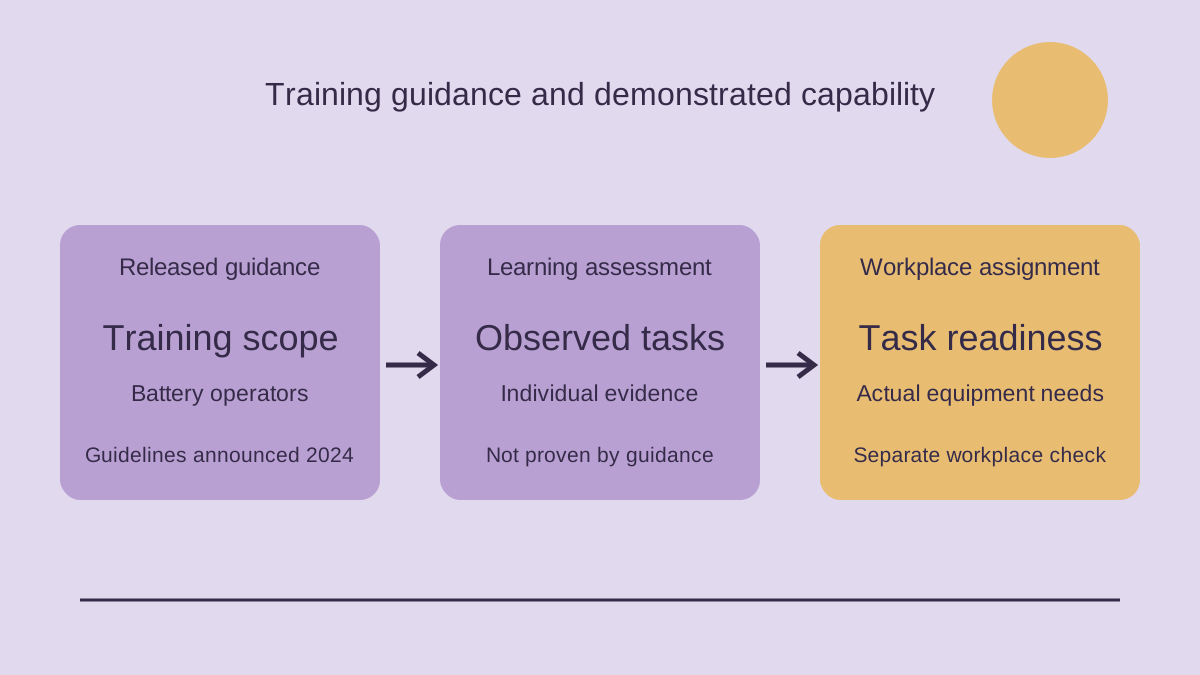
The energy and labour departments in the United States have released apprenticeship guidelines for battery machine operators, according to Manufacturing Dive’s April 9, 2024 report. The Department of Energy’s March 26 announcement confirms the release. An announcement of training guidance establishes neither an individual learner’s result nor readiness for a particular workplace assignment.
The practical question is how a common training framework acquires a common record of evidence. A training provider can describe what was offered; a learner can describe participation; an employer may need to understand an assessed result. These are connected accounts, but they are not interchangeable. The original analysis below examines the connections without interpreting legal certification requirements or prescribing battery production, machine operation or technical assessment procedures.
Participation, observation and assessment are different records
Participation records can answer whether someone attended an identified activity. An observation record can describe a particular task that was seen in a stated context. An assessment record can describe a decision made by reference to identified criteria and evidence. Each record can be useful, but one does not automatically prove the others. A person’s presence in a learning activity is not, by itself, an observation of every task associated with the wider programme.
The distinction matters when a training initiative is discussed through a single completion figure. Completion may refer to an activity, a module, an assessment or an entire programme. Without the object being named, the same number can acquire different meanings as it moves between a training provider and an employer. A clearer statement keeps the object visible and avoids allowing a participation count to become an implied count of assessed outcomes.
This does not establish that any programme in the announcement currently has unclear records. It identifies the information needed to interpret a future result. A shared framework can provide a reason to align the vocabulary, while the actual programme remains responsible for explaining its own records. The editor’s role is to distinguish the kinds of evidence being discussed, rather than invent their content or infer an individual’s capability from the existence of published guidance.
A task reference should survive the handoff
A record becomes easier to understand when it identifies the task that the evidence concerns. The task reference should remain recognisable when the discussion moves from a learning activity to an assessment account. Otherwise, a broad module name may hide whether two records concern the same task or different parts of it. This is an information question, not an attempt to define the actual battery-operator curriculum or select the technical tasks it should contain.
The reference should also preserve the scope of the observation. Evidence about one task should not silently expand into a claim about an entire occupation. A record can be valuable within a limited scope, provided that scope is visible. A receiving organisation can then ask which further information it needs for its own question. The existence of a common framework does not remove the need to identify what an individual record actually describes.
For a training partnership, this creates a practical point of connection between providers and employers. They can discuss whether a task reference has the same meaning in both accounts without assuming that the teaching activity and the workplace assignment are identical. The answer would depend on the actual programme and employer context. The article does not supply that answer; it explains why a useful handoff should preserve the reference rather than replace it with a general statement that training occurred.
Evidence needs a context, not just a positive label
An observation is evidence of something seen under particular circumstances. An assessment account should make those circumstances understandable at the level relevant to the decision. A task description, an observation date and an identified evidence reference can help connect the result to its scope. These are proposed information categories. They are not a list of mandatory fields from the announced guidelines, which this analysis does not reproduce or interpret as a legal standard.
A positive label without context can be difficult to use. A receiving reader may not know whether it describes a practice exercise, an observed task or a final decision. Conversely, a detailed observation without an assessment account may leave the reader uncertain about what conclusion was drawn. The record should preserve the relationship between evidence and decision, rather than require the recipient to reconstruct a result from an isolated description of an activity.
The relevant level of context depends on the question. A programme summary need not contain every individual observation, but it should explain what its categories count. An individual record may need a more precise task reference. Keeping these levels distinct allows a concise public account and a specific assessment account to coexist. It also prevents a programme-wide statement about the training framework from being treated as if it were evidence about every participant.
Criteria and evidence should remain distinguishable
Criteria describe what an assessment decision refers to. Evidence describes the material or observation considered in reaching it. A record that connects the two can explain why a decision has a particular scope. It should not merge the criteria with the evidence, because saying that a criterion exists does not show that it was observed in a particular case. This is a logical distinction and does not specify any technical threshold for battery manufacturing work.
A criteria reference can also have a version. If the reference changes, an older result should remain attached to the version under which it was described. That does not automatically invalidate the older result or establish what a new assessment should require. It keeps the record interpretable. A receiver can ask how the earlier result relates to the question now being considered, without assuming that a change in the framework silently rewrites a previous observation.
The person or role responsible for the assessment account should be identifiable within the actual programme’s arrangements. Identifiability is different from a claim of legal authority. The article does not appoint an assessor or state who is entitled to certify a worker. It asks how a receiving reader would know which decision the record describes and where a question about its evidence should be directed. That boundary keeps the original analysis within the explanation of records.
A hypothetical cohort with twelve participants
Consider an entirely invented report about twelve participants in one identified learning activity. These people, counts and results are fictional for analysis and are not data from the announced initiative. Suppose nine have an observation record for the task under discussion. Of those nine, seven have a recorded assessment decision and two await that decision. The remaining three have no observation recorded for that task. The example does not assume that all seven decisions are positive.
Three different counts now exist: twelve participants, nine observed cases and seven recorded decisions. Calling all twelve assessed would add evidence that the example does not contain. Calling the three without an observation unsuccessful would also add a conclusion. Their record is incomplete for the stated task, and the example provides no reason for that state. The distinction allows an account to preserve what is known without turning an absence of evidence into an invented judgement about a learner.
- Identify the activity counted in the twelve-person participation figure.
- Keep the nine task observations attached to that specific task reference.
- Count seven recorded decisions without assuming that they all have the same result.
- Describe two observed cases with a decision still open.
- Describe three cases with no observation recorded for the task.
- State which question each count can answer before combining the categories.
If the two open decisions are later recorded, the decision count becomes nine while participation remains twelve. That change does not, by itself, add observations for the remaining three or establish the outcomes of the nine decisions. The invented sequence shows why a later update needs a stated object. A report can become more complete at one boundary without becoming complete at every boundary in the training and assessment account.
An open record is a question, not an explanation
An open state can be useful when it describes exactly what information is missing. A task observation awaiting a decision is different from a task with no observation recorded. The next question differs accordingly. One asks about the assessment account; the other asks about the observation record. Collapsing both into a single pending category may be convenient, but it removes information that would help someone understand the status of the evidence.
The record should not assign a reason that has not been established. An absent observation could have several explanations in a real programme, and the article knows none of them for the invented cohort. It therefore leaves the reason open. The same discipline applies to a delayed assessment decision: its state does not prove a learner’s performance or a provider’s failure. Description should precede explanation, and explanation should be tied to actual information.
A concise next-action reference can keep the question identifiable. It can say which record needs clarification and which programme contact should explain it, if that contact has been provided. It should not manufacture a completion deadline or an assurance that the issue will be resolved. This proposed structure is an analytical tool for discussing the handoff of evidence, not a claim that the announced programmes already use a particular follow-up process.
A receiving employer asks a different question
An employer receiving a training record may need to understand how the described result relates to a particular workplace question. That is a different question from whether the learner attended an activity. The record can support the conversation by identifying its task, scope and assessment decision. It does not automatically answer every question about the employer’s own assignment. The actual relationship needs an explanation from the responsible organisations, rather than an assumption made by the editor.
This matters because portability of information is not the same thing as automatic acceptance of a conclusion. A common vocabulary can make a record easier to read across organisations while leaving the receiving decision distinct. The article does not claim that a training record provides permission to operate equipment, satisfies a legal requirement or guarantees employment. It examines the narrower information relationship between a described learning result and a receiving organisation’s question.
That relationship can preserve the learner’s result without inflating it. A bounded assessment can remain meaningful even when the receiving employer needs further information. The useful question is what the result covers and what the current assignment asks, not whether the framework’s name sounds sufficiently authoritative. Explaining both scopes would make the conversation more precise while avoiding a fictional account of an employer’s recruitment or workplace authorisation process.
A programme total should keep its denominator
A programme summary should explain which group a result count refers to. In the invented cohort, seven decisions out of nine observed cases is a different statement from seven decisions among twelve participants. Neither ratio is a universal success rate, particularly because the decision outcomes have not been specified. The denominator and the counted state are both necessary to understand the number. Omitting either would allow the result to acquire a meaning unsupported by the example.
A later observation period needs the same care. A new group of participants should not be merged casually with an earlier group if the report intends to compare their progress. A count can include several groups, but the report should identify what the combined figure measures. The analysis does not supply actual completion rates or compare programmes. It explains the information needed before a future comparison would be interpretable.
This gives an editor a concrete way to report progress without manufacturing a success story. Participation, observation and decision counts can each be stated accurately with their scope and period. The reader can then see which stage the report describes and which questions remain open. A common training initiative is a reason to seek this clarity; its announcement is not a substitute for the evidence needed to describe the results of a particular cohort.
Shared guidance becomes useful through bounded evidence
The attraction of a common training framework is the possibility of a more coherent conversation between learners, providers and employers. That possibility is a legitimate subject for analysis. It does not establish that the guidance has already improved learning, reduced staffing gaps or made a particular task safer. Such claims would require evidence about actual programmes and outcomes. The discussion therefore retains the difference between an announced framework and a demonstrated effect.
The practical follow-up questions are about the record: what participation means, which task was observed, what evidence a decision refers to and which scope the decision covers. Those questions let organisations discuss the framework’s use without pretending that every activity has one interchangeable completion label. They also leave room for a limited result that is useful precisely because its boundaries are clear.
For the April report, the strongest conclusion is that shared guidance creates a reason to seek shared explanations of evidence. The twelve-person example illustrates the need to distinguish participation, observation and assessment decisions; it does not forecast a programme’s performance. A record that preserves those distinctions would allow the training story to develop through actual results while keeping an individual learner’s evidence attached to the task and decision it genuinely describes.