
The investment raises an operating question
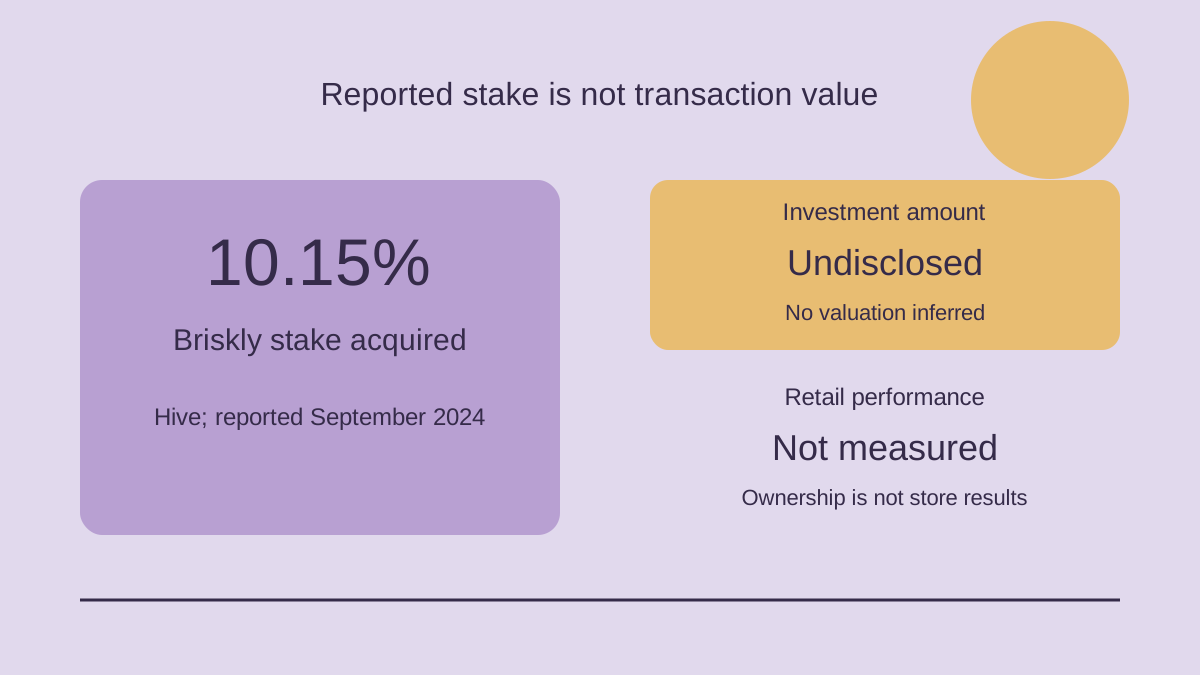
Hive, the venture fund created by VimpelCom, acquired 10.15% of Briskly, according to Interfax’s 11 September 2024 report. The investment amount was not disclosed. Briskly develops autonomous retail software and refrigeration equipment in Russia. That combination raises a practical question: who owns an exception when a purchase needs attention?
A retail format can remove the seller from the immediate interaction without removing the work surrounding a sale. A product still has a physical location, a transaction still needs an identifiable state, and somebody must decide what happens when those records disagree. The useful operating question is therefore where responsibility sits after the routine interaction has been automated. It is not answered by the presence or absence of a person beside the equipment.
This analysis considers a possible way to organise that responsibility. It does not describe Briskly’s internal systems, contracts or store results. The worked example below is hypothetical, and the proposed records are design choices for discussion. Keeping that boundary explicit matters because an investment announcement establishes an ownership event, while the everyday operating quality of a retail site requires different evidence gathered over a defined period of activity.
Define where a transaction starts and ends
An operating review needs a transaction boundary before it needs a success percentage. An attempted purchase, a completed payment and a reconciled stock movement answer different questions. Calling all three a sale can conceal the point where work remains unfinished. A review can begin by identifying the event that opens the case, the evidence needed to move it forward and the state that closes it for the purpose being measured.
Those boundaries should also distinguish a customer interaction from a support case. One interaction might create a support case, but repeated messages about that case need not represent several separate purchases. Conversely, a single equipment incident could affect several interactions. Without these distinctions, a report can count the same problem repeatedly or overlook its wider reach. The identification scheme is useful because it allows each measure to retain the event it actually describes.
Closure is likewise a defined state rather than a comforting word. A case may be closed for communication while an accounting or stock question remains open. A practical review would name the perspective under which closure is recorded and retain any unresolved linked task. That approach avoids pretending that one department’s finished work proves that every consequence has been settled. It also makes later reconciliation possible without reconstructing the history from an unstructured message trail.
Build evidence around a sequence
An exception becomes easier to review when its evidence has an ordered sequence. A record can distinguish the time of the customer interaction, the time at which the issue was noticed and the time at which responsibility was accepted. These are proposed reporting fields, not claims about any vendor’s implementation. Their purpose is to separate the occurrence of an event from the delay in observing it or arranging a response to it.
The same discipline applies to a changing state. A reviewer should be able to tell which observation supported a decision at that moment, rather than assuming that later information was available earlier. A payment record updated after a stock check should not silently rewrite what the operator knew during the check. Preserving the sequence makes an operational explanation more credible because it retains the limits of the evidence available when action was chosen.
More records do not automatically mean better evidence. A small set of relevant identifiers and state changes can be more useful than a large collection of unconnected screenshots. The test is whether another responsible person can understand the event, see the outstanding question and identify the next decision. A record that cannot support that handover may create storage without reducing the work required to investigate the exception or explain the eventual outcome.
Separate the stock question from the payment question
A stock discrepancy and an unresolved payment should not be collapsed into the same label simply because they arose during one interaction. The stock question concerns the physical and recorded position of a product. The payment question concerns the transaction’s recorded state. They may be linked, but the evidence that answers one may not answer the other. A useful case structure allows the relationship to be recorded while preserving the separate question in each branch.
That distinction also changes what a handover needs. The person reviewing transaction evidence may need a different observation from the person checking the product position. Asking both to act on a vague description of a failed purchase leaves the required evidence unclear. An explicit case can state which question is open, what has already been observed and which further observation would allow a decision. The point is coordination, rather than an assumption that one person must perform every task.
Once the separate questions have answers, the combined outcome can be reviewed. A report should not infer a physical movement solely from a payment status, or treat a physical count as a complete transaction history. Those shortcuts remove the distinction that made investigation possible. Retaining the branch results also helps explain why some cases took longer: the remaining work may have depended on a physical observation rather than on another message or another review of the same record.
Know which work requires a physical observation
A possible operating design can classify tasks by whether the evidence can be reviewed remotely or requires somebody to observe the site. That classification should follow the question, rather than the job title of the person first receiving it. A remote reviewer might resolve a record inconsistency, while an unclear physical condition could require a visit. These are possibilities for a proposed workflow, not statements about Briskly’s service model or the arrangements at its customers’ premises.
The boundary matters when estimating support effort. A count of messages cannot reveal the work involved in travelling, locating the relevant product or obtaining a physical observation. Equally, counting every remotely reviewed case as a visit would exaggerate that burden. A useful report can distinguish the type of work actually performed and the point at which a physical task was requested. This lets the operator discuss effort without equating all exceptions with the same resource requirement.
A physical task should remain connected to the original case. Otherwise, the transaction team may record that it handed something over while the site task disappears into a separate list. Linking the records permits a reviewer to see whether the requested observation was supplied and whether it answered the original question. It also avoids assigning completion to a task merely because somebody scheduled it, acknowledged it or placed it in a queue for later attention.
A hypothetical cohort makes the distinction visible
Consider a deliberately hypothetical review of 100 attempted purchases at one self-service site. Suppose 92 follow the defined routine path, five leave a payment-state question and three leave a stock-record question. These categories are mutually exclusive only within this invented example. They are not measurements of Briskly, a customer or an industry benchmark. Their value is that the denominator and the classification rule are visible before anybody describes the overall result.
Under those assumptions, eight attempts need additional attention. That count does not establish eight lost sales, eight complaints or eight required visits. Each of those conclusions would need another observation and its own definition. If the five payment cases are resolved through record review, while the three stock cases remain open pending a physical observation, the example describes different work remaining within the same cohort. It does not establish a financial loss or a remedy for a customer.
Now suppose a subsequent review resolves two of the three stock cases and leaves one unresolved. The count of unresolved cases has changed; the original count of attempts has not. A transparent account would retain the initial cohort, identify the later review and record the remaining question. Replacing the original record with a new success total would make it difficult to see what the additional work achieved or how much time passed between the two observations.
- Define the event counted in the denominator.
- Keep the classification rule visible.
- Retain the original cohort after further review.
- Distinguish additional attention from a lost sale.
- Record which task still needs evidence.
- Date the observation that changes the case state.
Assign responsibility at the handover
An exception needs an owner even when several contributors are involved. In a proposed workflow, ownership means responsibility for knowing the next unresolved question and arranging the next step; it need not mean personally performing all technical or physical work. Without that distinction, a task can be passed among specialists while nobody remains responsible for connecting the results. A clear handover would identify the receiving owner, the outstanding question and the evidence already available.
Acceptance of a handover is different from sending a message. A report that records only the outgoing request cannot show whether somebody took responsibility or whether the task remained unassigned. A receiving acknowledgement can establish that boundary in the proposed process. The exact method is an implementation choice. The operating requirement is that a reviewer can distinguish a requested transfer from an accepted transfer and see who currently carries the next decision.
A return from specialist work should also specify what changed. A statement that the task is finished may be too broad to close the original case. The returned result can identify the observation supplied and the question it answers, leaving another branch open when necessary. This preserves accountability without forcing every contributor to make decisions beyond the evidence available to them. It also keeps the case owner’s work focused on coordination rather than on guessing what a short completion message meant.
Look for repeated work without assuming its cause
Repeated exceptions can justify a closer operating review, but repetition alone does not identify a cause. Similar descriptions might arise from different circumstances, while different descriptions might refer to the same underlying problem. A proposed review can group cases by the evidence available and the question left unresolved. That grouping is more useful than immediately assigning a technical explanation that has not been established through the records or a relevant observation.
The review should distinguish recurrence from reopening. A new interaction that creates a similar question is a new event; further work on an earlier unresolved case is not necessarily another failure of the same transaction. Mixing the two can make a process appear to generate more problems simply because investigation has become more thorough. Clear identifiers allow the operator to separate additional evidence about an existing case from a fresh event requiring a separate response.
Changes can then be assessed against the defined question. If a revised handover reduces unassigned tasks, that is evidence about assignment within the reviewed cohort. It does not by itself establish better physical stock accuracy or higher sales. A precise interpretation makes an improvement meaningful without stretching it into unrelated outcomes. It also leaves space for a later review to ask whether the change held under different operating conditions or merely shifted work into another queue.
Evaluate another site with the same boundaries
Before extending a proposed operating model to another location, the operator can ask whether the measures mean the same thing at both sites. Attempted purchases, unresolved cases and physical visits must retain comparable definitions. Otherwise, an apparent difference may reflect a different counting rule. The relevant comparison is between consistently defined observations, with the circumstances of each site stated separately, rather than between two isolated success percentages that conceal their denominators and reporting periods.
A new location could have different access arrangements, patterns of use or availability of physical support. These are possible conditions to investigate, not facts about a particular customer network. A useful expansion review identifies which assumptions remain applicable and which need to be tested locally. The purpose is to avoid copying a result without copying the conditions that made it interpretable. Similar equipment alone cannot supply the missing information about how tasks will be owned.
Expansion can therefore be discussed as a question of operating repeatability. Can the next location recognise the same case states, obtain the required observations and maintain responsibility through a handover? A positive answer would need evidence from that location’s defined process. It should not be inferred from the number of units installed or from an investment announcement. This keeps the decision tied to the work that must be repeated, rather than to a general impression that the retail format is scalable.
Read the investment and the operating result separately
The ownership event provides a dated business development, but it is not an operating audit. The useful reading of the announcement is to recognise the combination of software and physical equipment as a setting in which responsibility must cross several kinds of evidence. The proposed framework explains that question without claiming access to the company’s private procedures. It also avoids treating an undisclosed investment amount as a basis for estimating valuation, future revenue or a return to the investor.
A later account of retail performance would be more informative if it identified its transaction boundary, reporting period and unresolved work. Those details would allow readers to distinguish routine completion from additional attention and physical tasks from remote review. None needs to be invented to make the current announcement sound stronger. The investment can remain the factual starting point while operational analysis names the observations that would make a future claim about performance easier to assess.
Trading without a seller at the immediate point of purchase is still an organised process with decisions and exceptions. The central design question is whether those exceptions have a visible owner and a clear next step. A transparent record can make that work reviewable; a headline percentage cannot do so on its own. That distinction is the practical lens through which the investment can be considered, while the hypothetical example remains an illustration and the actual operating result remains a separate subject for evidence.