
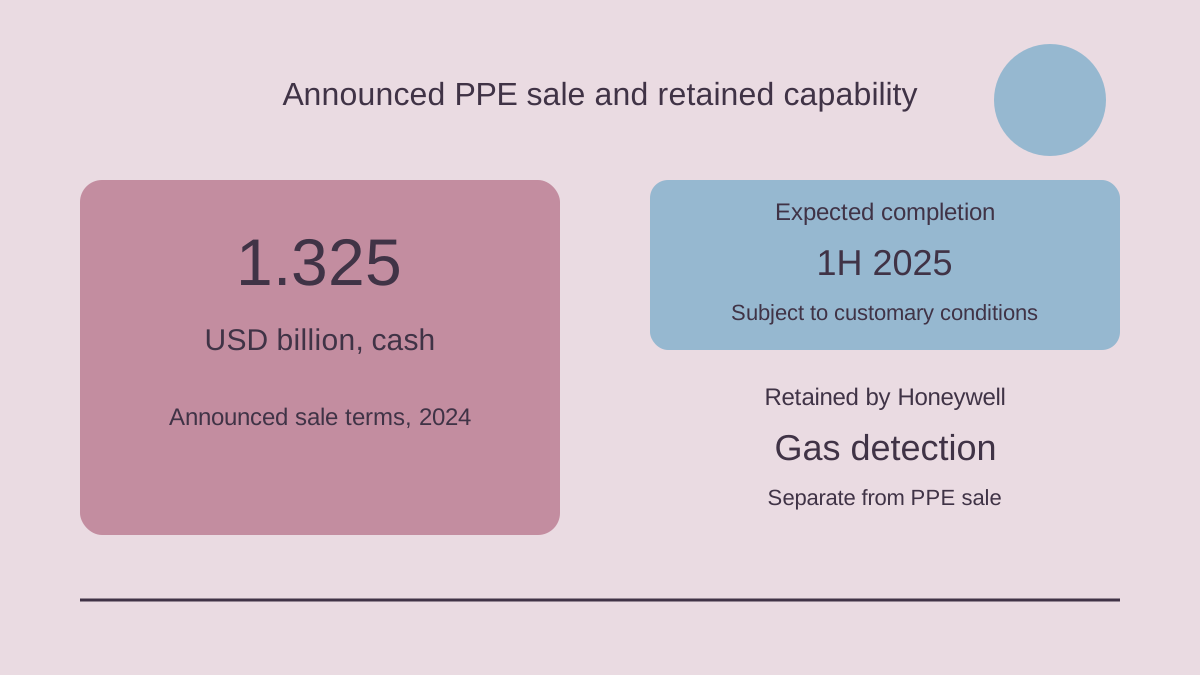
Honeywell's announced sale of its personal protective equipment business raises an organisational question: what must be transferred for a customer to experience continuity, rather than simply a change of owner? Manufacturing Dive reported on 4 December 2024 that the business was being sold to Protective Industrial Products. The seller's announcement specified $1.325 billion in cash, with completion expected in the first half of 2025, subject to customary conditions. It also said Honeywell would retain gas detection.
Those statements establish the announced transaction and an important boundary. They do not establish that the transaction had closed by the date of this article or that every customer-facing function had already been transferred. The analysis below proposes a way to examine service continuity during a business separation. It does not describe the parties' undisclosed transition arrangements, assess protective products or claim a particular integration result.
A business perimeter is more than a category name
Personal protective equipment is a useful description of the business being sold, but a category label cannot identify every product, service and responsibility crossing the boundary. The retention of gas detection makes that limitation visible. A reader should not turn the announcement into a claim that all worker-safety activities are transferring to the buyer. An accurate perimeter requires greater specificity than an umbrella description.
A proposed operating review would distinguish the ownership perimeter from the service perimeter. Ownership concerns what the transaction encompasses. Service concerns the functions needed to fulfil a particular customer request. A request might touch product information, order processing, distribution and support, each of which has its own responsible owner. The two perimeters may need to be reconciled, but this article does not assume their actual arrangement.
The practical question is whether each function can be assigned without leaving a gap or two conflicting answers. A customer who recognises a product name should not have to infer which organisation now owns the next action. This is a proposed standard for evaluating a transition, rather than evidence that a gap exists in the announced deal.
Product identity and organisational identity are different
A familiar brand can help a customer identify a product, while the organisation behind a particular service may change. Keeping those identities separate prevents a misleading shortcut: continuity of a name does not, by itself, prove continuity of the ordering or support process. Conversely, a change in corporate ownership does not establish that a product's specification has changed.
The buyer's announcement identifies a portfolio of brands within the proposed acquisition. That is a statement by a transaction participant. It should not be treated as independent proof that each brand's processes, records and service arrangements have already been integrated.
A proposed identity map would connect a customer-facing product reference to the relevant ordering, information and support responsibilities. It would also record which functions remain outside the transferred business. The aim is organisational clarity, not a recommendation to substitute products. Any question about product suitability, certification or use would require its own authoritative information; the sale announcement does not answer those questions.
Distribution creates a chain of responsibilities
For a business that works through distribution, service continuity cannot be established solely by an internal organisation chart. The customer may interact with a distributor, which in turn depends on another organisation for product information or fulfilment. A transition review should follow the request across that chain rather than stop at the boundary of the acquired company.
Consider a hypothetical customer asking a distributor about an existing order. The distributor may have the customer relationship but need an upstream response about availability or documentation. If the upstream responsibility changes, the distributor needs a usable route to the new owner of the action. The example illustrates a possible handoff; it is not a reported failure involving Honeywell or the buyer.
A proposed test would therefore ask who receives the request, who supplies the necessary answer and who communicates the result. These may be different roles. Assigning an owner to each role makes a handoff examinable. It also distinguishes an unanswered request from an answer that exists but cannot reach the customer through the usual channel.
Open requests need continuity of ownership
Requests already in progress deserve a separate examination from requests arriving after a transition. An existing enquiry may contain a history of commitments and unresolved questions. Starting a new record without that history can make the next team unable to understand what remains to be done. Keeping history does not mean that every prior commitment is automatically valid under every arrangement; its actual status must be established.
A proposed handoff record would identify the request, its current state, the next action and the responsible recipient. It would distinguish a record successfully moved from a request successfully resolved. Moving data is an administrative milestone. Completing the customer's outstanding action is a service milestone. Both matter, but neither substitutes for the other.
In a hypothetical transition, a team might report that every open case has been transferred while several recipients still lack access to the relevant information. The useful check is whether the recipient can act, not merely whether a file was sent. This is an example of the evidence needed for continuity, not a claim about the parties' systems or customer records.
Inventory visibility should not be confused with ownership
A product can appear in a catalogue without being available through the particular channel a customer uses. Similarly, physical stock can exist without the person handling an enquiry having a reliable view of it. A proposed separation review should therefore distinguish product identity, stock visibility and the responsibility for an order. A statement about one does not automatically establish the other two.
The important organisational question is where an availability answer comes from and who can rely on it. If different teams use different records, the review should identify which record governs the response and how discrepancies are resolved. This is a proposed information-control question. It does not assert that the seller or buyer uses a particular inventory system or has inconsistent records.
The same discipline applies to exceptions. A normal order may follow a familiar route, while a changed, incomplete or disputed order requires a different decision. Testing only routine cases can leave the difficult handoffs unexamined. A transition can be assessed more meaningfully by checking whether the exceptional request has a clear owner and a clear route back to the customer.
Customer communication should name the next action
A transaction announcement explains a corporate event, but customers may need a more specific answer: whom should they contact for a particular task? A proposed communication review would separate corporate messaging from actionable service information. Describing the strategic rationale does not tell a distributor how to route an unresolved enquiry. Reassurance has limited operational value if responsibility remains unclear.
Useful communication would identify the affected function, the relevant timing and the channel through which a customer can obtain a verified answer. It would avoid implying that every activity changes at once merely because an ownership event has a single date. The exact timetable and responsibilities would have to come from the parties' actual arrangements, which are not established by the material reviewed here.
Communication should also preserve the boundary around retained activities. Where a request concerns a function outside the transferred perimeter, the answer should not route it to the buyer simply because the product is broadly associated with safety. The proposed principle is to route by responsibility and product identity, rather than by a broad category or an assumption about the transaction.
Escalation is part of the service, not an afterthought
A customer-facing process needs a route for requests that cannot be resolved at the first contact. During a separation, the proposed escalation test is whether responsibility remains clear when the normal route fails. A general contact list may be insufficient if each recipient can redirect a request without accepting ownership of its next action.
Consider a hypothetical request that crosses both an acquired function and a retained function. A useful review would identify who coordinates the response and who confirms each part. Coordination does not mean that one person has authority to decide everything. It means the customer does not have to resolve the organisations' internal boundary before receiving a coherent response.
An escalation record should distinguish the unresolved issue from the action already taken. Forwarding an email is an action, but does not establish that the recipient accepted responsibility. A proposed checkpoint would verify that acceptance and the route for reporting the eventual answer. This makes continuity observable without making unsupported claims about the speed or quality of the parties' existing service.
Closing and operational readiness answer different questions
The announced timetable should remain a timetable, not be rewritten as a completed event. At the date used here, the reviewed statements described expected completion subject to conditions. No later closing announcement is used to retrospectively establish the situation in December. Maintaining that historical boundary is necessary for an accurate analysis of what was known at the time.
Even when a transaction has actually closed, closing and operational readiness are different concepts. Closing establishes a transaction milestone. Readiness concerns whether the relevant people, processes and information can perform the required functions. The evidence needed for the second question must be examined separately. This observation does not imply that a completed transaction is unready; it identifies the distinction between two claims.
A proposed review would avoid treating the completion of a corporate event as a universal service certificate. It would ask which functions require confirmation at that stage and which dependencies continue afterwards. That creates room to acknowledge progress without prematurely declaring that every customer-facing handoff has been proven.
Use a service scorecard with meaningful denominators
A proposed scorecard should define what is being counted before assigning a completion rate. A percentage of records moved, a percentage of requests assigned and a percentage of requests resolved measure different outcomes. They should not share a label that makes them appear interchangeable. A high result for one can coexist with unresolved work in another.
- Identify the product or service boundary to which a request belongs.
- Record whether the receiving owner has accepted the next action.
- Check whether the owner can access the information needed to act.
- Separate routine fulfilment from requests requiring an exception decision.
- Confirm that the result can reach the customer through the relevant channel.
These are proposed review questions, not performance measures reported by either party. A useful scorecard would also describe exclusions and unresolved cases. Otherwise, an apparent improvement might result from changing the population being counted rather than improving the process. The objective is to make the claim about continuity precise enough to be examined and challenged.
Test the handoff without inventing a problem
The absence of published detail about a transition is not evidence of failure. An analysis should avoid turning a question into an accusation merely because the reviewed announcement does not answer it. The proposed framework identifies what would establish continuity; it does not establish that continuity is absent. That distinction matters when organisational processes are not publicly disclosed.
Hypothetical examples can help specify a test, provided their status remains explicit. For instance, a request involving an old product reference could test whether the new contact route recognises the reference and accepts the appropriate action. A request involving a retained function could test whether the route leads to the correct organisation. Neither example implies that a real customer has encountered such a problem.
A meaningful test should also allow a positive result. If the receiving team can identify the request, access its history, accept responsibility and return an answer through the distributor, that would support the specific handoff tested. It would not prove every possible service case. The scope of the conclusion should match the scope of the evidence.
Temporary support needs a defined exit condition
A proposed transition review should distinguish the ability to operate with temporary assistance from the ability to operate independently. Both can be useful stages, but they are different claims. If an acquired function still depends on a retained team for information, a successful response may demonstrate a working temporary route rather than a completed transfer of capability. The review should preserve that distinction when reporting progress.
Consider a hypothetical support arrangement in which the receiving team can handle routine enquiries but asks a former shared team to interpret older records. The existence of that assistance is not itself a failure. The useful questions concern its scope, its responsible owner and the condition under which the receiving team can stop relying on it. This is an analytical example, not a statement that such an arrangement exists between the transaction parties.
The exit condition should concern ability to perform the function, rather than simply the passage of time. A calendar date can identify a planned change but cannot prove that the necessary information and responsibility are in place. A proposed review would test whether the recipient can resolve a defined set of requests without the temporary route, while preserving a clear exception path for requests outside that set.
It should also identify dependencies in both directions. Removing assistance could affect the receiving team, while continuing assistance could require resources from a retained function. A decision should recognise both sides rather than count only the resources transferred with the business. This observation does not establish the parties' actual costs, obligations or timetable; those would require the relevant arrangements.
Finally, progress should be recorded at the level actually tested. Independence for one function is not independence for every function, and a successful routine case is not evidence that all historical exceptions have been resolved. A useful review can acknowledge a completed handoff while listing the remaining dependencies. This produces a more informative account of readiness than a single label that treats temporary assistance, independent operation and unresolved exceptions as the same state. If the population of requests changes, the tested boundaries should be stated again so that the new conclusion remains comparable with the earlier result.
Review exceptions before declaring the transition complete
A proposed final review would focus on the unresolved boundary cases rather than simply repeat the corporate announcement. Which requests remain unassigned? Which product references cannot yet be reconciled? Which functions depend on an organisation outside the transferred perimeter? A list of exceptions can make the remaining work visible without denying the progress already achieved.
Responsibility for those exceptions should remain explicit. Some may require better information, others a decision about routing, and others coordination between functions. Treating them all as generic integration tasks can conceal the difference. A useful review attaches each exception to an owner and to the observation that would establish resolution. This is a proposed management discipline, not a description of the parties' integration plan.
The sale announcement therefore provides a starting point for questions about organisational continuity, not a verdict on its achievement. The transferred portfolio, retained activities and expected transaction timing establish boundaries for the analysis. Customer service must then be examined through specific responsibilities, usable information and completed handoffs. A change of ownership and uninterrupted service may be compatible, but compatibility alone is not the evidence that proves continuity.