A completed acquisition leaves an operating question
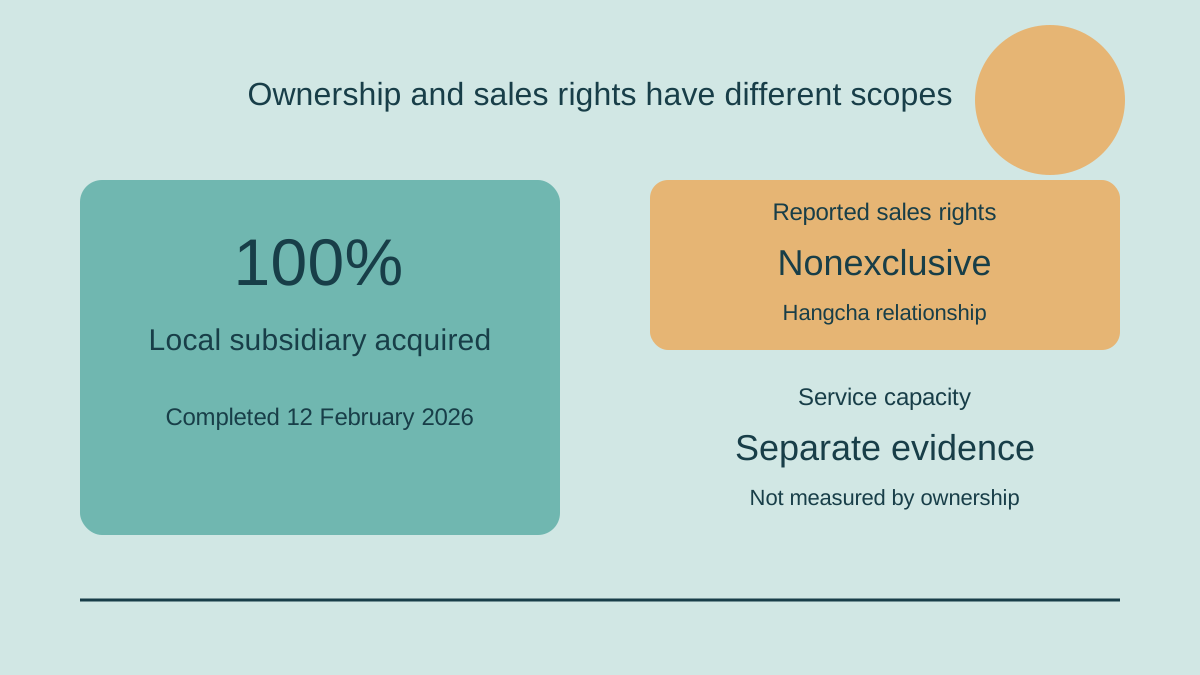
Interfax reported on 17 February 2026 that Insight Leasing acquired the entire local Jungheinrich subsidiary, with completion on 12 February and a rename to Forklift Technology. The report also attributes cooperation with Hangcha since 2023, without exclusive sales rights, to the acquired company’s reporting. A 13 February seller announcement confirms completion and the end of Jungheinrich’s activities in Russia.
Those statements describe a change in ownership and a reported distribution relationship. They do not provide an equipment operator with a complete answer about the next repair. This distinction matters because a warehouse buys several different things through what appears to be one supplier relationship: a machine, a route to compatible parts, access to technical knowledge, and sometimes an agreed service response. The name on an invoice can identify a contracting organisation while revealing little about the practical availability of those capabilities.
The useful analytical question is therefore narrower than whether an acquisition is good or bad. What evidence would let an operator understand the acquired distributor’s usefulness to its particular fleet? The framework below proposes that evidence. It does not describe undisclosed arrangements at the companies involved, predict a failure of support, or establish the legal effect of any private agreement. A completed transaction is the starting point for asking equipment-specific questions, rather than an operating assessment in itself.
Separate ownership from permissions and capacity
Ownership, permission and capacity belong in different columns of a supplier assessment. Ownership concerns control of a business. Permission concerns the scope of an arrangement with another organisation, such as a manufacturer. Capacity concerns what the supplier can actually accomplish with people, stock, tools and scheduled time. Even when all three support the same customer relationship, a statement about one does not establish the other two. A buyer can organise these questions without pretending to know the terms of a contract that has not been disclosed.
For equipment purchases, the practical distinction is between permission to offer a particular product and an exclusive position in that offer. Nonexclusive distribution can permit several sellers to compete. It does not, by itself, establish that a seller lacks technical skill, cannot obtain components, or delivers poor service. Conversely, an exclusive commercial position would not prove that a replacement component is on the shelf or that a technician can visit tomorrow. The operator needs answers at the level of the task, not just the label attached to the sales channel.
A useful enquiry would specify the equipment family, the requested activity and the evidence supporting the answer. Can the supplier identify the correct component for this serial number? Can it explain which diagnostic work it can perform? Which response is a firm commitment and which depends on another organisation? The distinction should remain visible in the reply. A broad assurance that a business continues operating may be relevant context, but it cannot replace a precise answer about a particular machine and a particular service need.
The installed fleet needs its own inventory
An assessment of new equipment sales and an assessment of an installed fleet are different exercises. A distributor may offer a current product range while a warehouse operates machines bought at different times, with different attachments, power systems and configurations. Grouping those machines under a familiar brand can hide the practical variation that determines a repair. The first step in an operating review is therefore a fleet record detailed enough to support an actual component enquiry, rather than a list of brand names and aggregate quantities.
Such a record could identify each machine by serial number, model designation, configuration, location and role in the warehouse. The role matters because two apparently similar machines may not be interchangeable in the available aisle width or lifting task. An attachment, battery arrangement or operating constraint can turn a visually similar substitute into an unsuitable one. This is a proposed way to structure an enquiry, not a claim that the acquired distributor has missing records or that any particular customer lacks the information.
The operator can then prioritise the record by operational consequence. A machine supporting an occasional activity may tolerate a longer interruption than one serving the only workable route between storage and dispatch. Priority does not automatically mean buying more machines or more parts. It means asking earlier, more precise questions about the machines whose interruption would be difficult to absorb. That approach makes the supplier discussion about the warehouse’s actual tasks and avoids treating the whole installed fleet as a single undifferentiated exposure.
A parts list is different from an available part
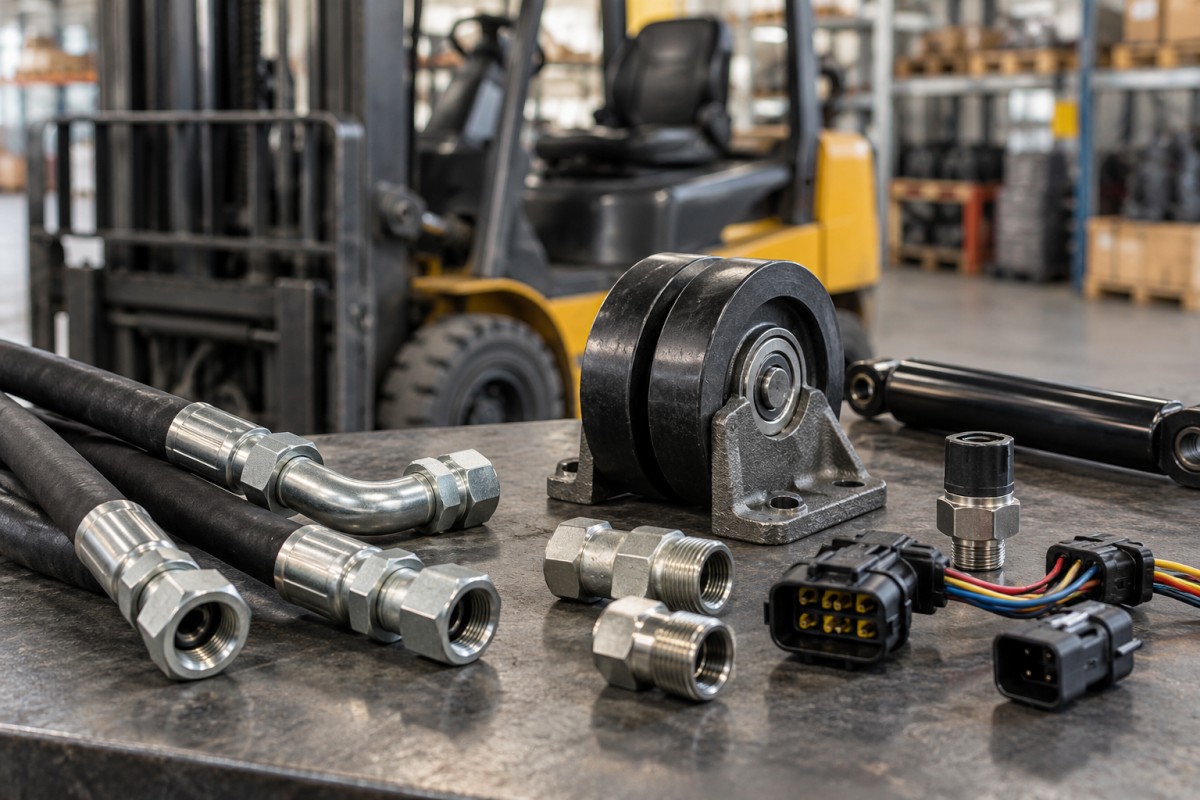
A catalogue listing answers an identification question. A stock statement answers an availability question. An order acknowledgement answers a procurement question. A completed installation answers an operating question. These are successive forms of evidence, and an operator should avoid treating them as interchangeable. The distinction becomes especially useful when a familiar distributor changes ownership, because continuity of a catalogue or customer account does not establish the location, timing and suitability of a component needed for a repair.
For a specific request, the operator could ask for the component identifier, the machine configuration used to select it, the location of any available stock and the conditions attached to the delivery estimate. If a proposed substitute is involved, the reply should explain how compatibility will be checked. Availability of a superficially similar component should not be presented as proof of suitability. This is an equipment-control question; it does not assume that substitution is taking place in the reported transaction or that an existing supply route has stopped functioning.
Timing also needs a defined endpoint. A statement that a component can be ordered this week is not the same as arrival at the warehouse this week. Arrival is not the same as an installed and checked machine. A useful supplier comparison puts those stages beside each other and marks dependencies rather than compressing them into a single promised date. This gives the operator a basis for planning temporary work arrangements while leaving uncertainty explicit wherever the supplier cannot yet provide a supported delivery commitment.
Service continuity should be tested with a defined request
A warehouse can ask about service continuity through a small, well-defined enquiry instead of relying on an abstract assurance. The enquiry might concern a recurring maintenance task, an unresolved diagnostic question or the identification of a component for a known configuration. Its value lies in the information it produces: whether the request reaches an accountable person, whether the equipment details are understood, and whether the response explains the next practical action. A reassuring tone is useful communication, but it is not the same as a completed technical answer.
Response measures require careful definitions. Time to acknowledge a message, time to diagnose a fault, time to obtain a component and time to return equipment to use describe different events. An operator comparing suppliers should not combine these into one number. A fast acknowledgement can coexist with a longer repair because the necessary component is not immediately available. Equally, a difficult diagnosis might be followed by a quick installation. Separating the stages helps identify the dependency that needs attention without inventing a cause from a headline measure.
The enquiry should also identify who can confirm completion. A supplier may report that work has been performed; the operator still needs a defined check that the machine can perform its intended task under the applicable operating conditions. This article does not prescribe a technical safety procedure. It proposes a commercial and operational boundary: an accepted response, an agreed repair plan and a returned machine should remain distinct entries in the record. That boundary makes supplier performance easier to discuss and prevents an administrative milestone from being mistaken for restored warehouse capacity.
A hypothetical fleet shows why averages can mislead
Consider a hypothetical warehouse with one hundred machines, of which ten serve a constrained picking area. These numbers are an illustration, not information about the acquired business or any actual customer. Suppose two of the specialised machines are unavailable while the other ninety machines remain usable. An aggregate count would describe a fleet that is mostly available. That description might still miss a serious interruption if the remaining machines cannot perform the specialised task or move through the required area.
The relevant question is what work remains possible. Can the specialised tasks be rescheduled? Can a suitable machine be moved from another area without creating a second interruption? Can the supplier explain a repair sequence that fits the warehouse’s operating priorities? None of these answers follows from the total fleet count. A useful operating view connects each unavailable machine to a task and a feasible alternative. That does not require assuming that the warehouse is operating at maximum utilisation or that every interruption immediately produces a measurable financial loss.
The same example clarifies how to compare service proposals. A supplier offering broad coverage may be valuable, but coverage of the specific constrained group deserves separate examination. The operator can ask whether the proposal includes the required configuration, components and practical response arrangements for those ten machines. This produces a more informative comparison than a general statement about the number of brands covered. The lesson is about matching evidence to operating consequence, not forecasting an interruption or recommending a particular commercial provider.
Warranty questions require the actual scope
Warranty language can carry several different meanings in a conversation. A product warranty, a supplier’s repair commitment and a separate service agreement may cover different activities and involve different counterparties. An ownership announcement does not reveal the full scope of those arrangements. The operator should therefore ask about the specific commitment relevant to the machine, purchase and requested work, rather than infer a universal answer from the distributor’s old name or its new one.
A practical information request could identify the applicable document, the party answering the request, the covered activity and the procedure for a particular case. Where another organisation must approve or supply something, that dependency should be stated. This is a proposal for obtaining information; it is not a legal conclusion about transfer, enforceability or customer rights. Nothing in the sources cited here establishes that a particular warranty has ended, remains unchanged, or can be used for every machine in a customer’s fleet.
The important operating consequence is to avoid a gap between what staff believe is covered and what the supplier has actually confirmed. A maintenance team might plan around an assumed response that procurement has never documented for that equipment. A short, machine-specific confirmation can expose the uncertainty before a repair request becomes urgent. If the answer remains conditional, the warehouse can record that condition and organise its next enquiry accordingly. Uncertainty is more useful when it is attached to a defined task than when it appears as a vague concern about the whole supplier relationship.
Competitive sales and service differentiation can coexist
The reported absence of exclusive sales rights is relevant to how a distributor can distinguish its offer, but it does not establish the outcome of competition. When several sellers can offer comparable equipment, the operator has reason to compare more than the initial quoted price. Correct configuration, clarity of delivery terms, access to appropriate parts and a well-defined service scope can affect how usable a proposal is. These are possible dimensions of comparison, rather than evidence that any named distributor has already achieved a particular advantage.
Care is needed when discussing service as a commercial strength. A supplier’s claim that it supports many machines is less informative than evidence matched to the operator’s fleet. A proposal can show which equipment it covers, what work is included, which dependencies remain outside the supplier’s direct control and how progress will be reported. The buyer can then compare equivalent tasks across offers. This avoids mistaking an attractive description of support for a demonstrated capability while allowing a supplier with a precise, credible response to explain its value.
Financing is another separate part of the offer. An arrangement that helps organise payments does not itself identify a compatible component, provide a diagnostic tool or create workshop capacity. If equipment, financing and service are presented together, the operator should still evaluate the practical content of each. This article does not assess financing terms or recommend a funding product. The operating point is simply that a convenient purchase structure and a usable maintenance arrangement answer different questions, even when the customer encounters them through the same commercial relationship.
Make the next review a record of evidence
The result of a supplier review should be a short record that another member of the warehouse team can use. It needs enough detail to explain what was asked, which machine or task the answer concerns, who supplied the answer and what remains conditional. It need not become an elaborate reporting system. The point is to preserve the distinction between a public acquisition announcement, a supplier assurance, a documented commitment and an observed completed action.
- Identify the installed machine and the task affected by an interruption.
- Separate component identification, stock availability, delivery and installation.
- State the service activity and the dependency on any other organisation.
- Keep acknowledgement, diagnosis and restored operation as separate milestones.
- Record the applicable scope rather than assuming a universal warranty answer.
- Review uncertain items when new evidence arrives, with the date of that evidence.
The transaction reported in February changes the context for those questions. It does not answer them all. A warehouse can respond constructively by making its next enquiry more specific: this configuration, this component, this activity and this point of completion. That approach recognises the confirmed change in ownership while assessing the equipment relationship through information that can actually support a decision about warehouse operations.