
A completed acquisition can place complementary capabilities under one owner while leaving an important customer question open: how will work move between those capabilities? Jabil’s purchase of Pharmaceutics International, known as Pii, provides a concrete occasion to examine that question. The transaction appears in Manufacturing Dive’s 16 April 2025 acquisition roundup, an editorial article by Kate Magill. The acquired business operates in the United States. This analysis considers the commercial organisation of a broader offer, rather than drug treatment, manufacturing instructions or regulatory approval. Its proposed framework distinguishes the acquisition of a capability from evidence that customers can use an integrated service.
Separate the acquired capability from the existing offer
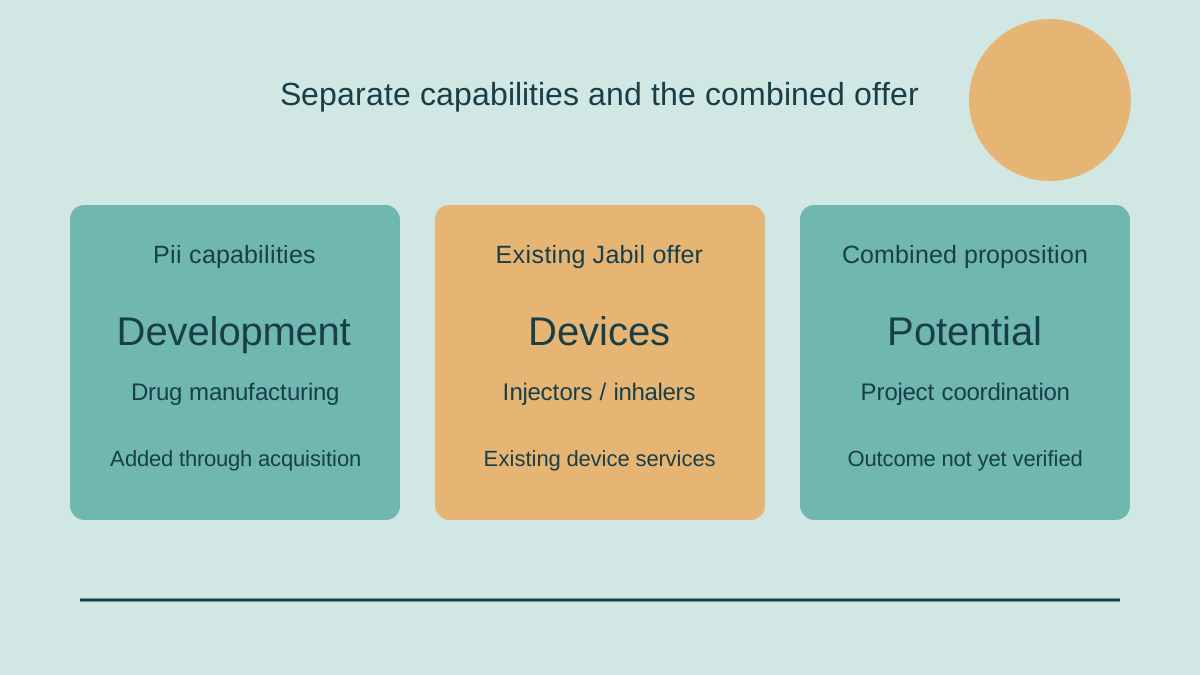
The editorial roundup reports the completed acquisition and an undisclosed deal value. Jabil’s issuer release distributed through Business Wire states that the transaction completed on 3 February 2025. It describes Pii’s pharmaceutical development and manufacturing capabilities, including aseptic filling, lyophilization and oral solid dose manufacturing. The release describes injectors, inhalers and on-body pumps as part of Jabil’s existing pharmaceutical offering. That distinction corrects the roundup’s description of those devices as acquired Pii production. The added drug capabilities and the existing device capabilities should retain their separate identities when explaining the combination.
The dated seller-side copy confirms publication of the release on 4 February. It reproduces the same company account, rather than independently verifying integration outcomes. The publication date of this analysis follows the April editorial source; the February dates describe the transaction and its announcement. Keeping those dates and roles distinct prevents a completed ownership change from being mistaken for a completed customer project. The companies describe potential benefits from combining their capabilities. That ambition is relevant, but the announcement does not supply a verified customer delivery result, a measured integration saving or a price from which to calculate an acquisition return.
A wider offer needs a defined customer scope
A proposed commercial scope should identify what the customer is buying and where each responsibility begins and ends. A catalogue can show a broad range of capabilities without establishing that every capability belongs in a particular project. The project needs its own specification of deliverables, dependencies and exclusions. This is especially important when one commercial conversation covers several stages of work. A customer can reasonably want fewer organisational interfaces while still needing a precise description of each interface. The analytical question is therefore how the broader offer becomes a specific commitment, rather than whether the combination sounds comprehensive when expressed in a short announcement.
Scope should also distinguish work already available from work that depends on further coordination. In a hypothetical proposal, an existing service might be offered immediately while a combined project requires additional agreement about responsibility or information. Presenting both as an undifferentiated package would conceal the unresolved dependency. A proposed scope document should identify the evidence supporting each commitment and the conditions that remain to be satisfied. This does not imply that Jabil has made an unclear proposal. The public release does not disclose its customer proposals. The framework identifies the evidence needed to evaluate any claim that the combined offer reduces the customer’s coordination burden.
Map the handoff before simplifying it
A handoff is the point at which one team supplies another with work, information or a decision that the receiving team needs. A useful proposed register should name the sender, receiver, expected content and condition for acceptance. It should also identify what happens when the receiving team finds the content incomplete. Without that definition, an apparently simple handoff can create repeated clarification and delay. This is an organisational analysis, not a description of a pharmaceutical production step. Its usefulness comes from making responsibility visible wherever the commercial promise depends on cooperation between teams with different capabilities and different sources of information.
Internalising a handoff through common ownership can change the people who coordinate it without eliminating the underlying need for information. The customer may see fewer supplier names while the work still crosses several internal boundaries. A proposed integration assessment should therefore compare the actual coordination required before and after the change. It should ask which decisions have become simpler, which information travels more reliably and which interfaces still require customer participation. The ownership change alone cannot answer those questions. A shared corporate name is a starting point for coordination; an observed improvement in the handoff is a separate result that should be demonstrated through the relevant project records.
Give decisions an owner
A broader offer needs clear decision authority alongside clear task ownership. A team can know what work it performs while remaining uncertain about who may accept a change in scope, resolve a conflict or approve a revised commercial commitment. A proposed responsibility table should distinguish those decisions from routine task execution. It should identify the decision maker, the information needed and the people whose agreement is required. Otherwise, an escalation can circulate among teams that each understand their own work but cannot settle the cross-team question. The framework is concerned with organisational clarity, rather than prescribing Jabil’s internal structure or implying that it lacks suitable decision arrangements.
The same discipline applies to the customer’s authority. A supplier cannot assume that one contact is authorised to decide every issue merely because the commercial offer is presented as integrated. The proposed project record should identify the customer decisions needed and the evidence of approval appropriate to the agreement. Where a decision depends on information outside the supplier’s control, that dependency should be explicit. This helps distinguish a delay caused by an incomplete supplier handoff from a delay awaiting a customer decision. Keeping those categories separate is useful both for delivery management and for evaluating whether integration changed the coordination effort required from the customer.
Keep information and versions connected to the commitment
A handoff becomes difficult to assess when different teams use different versions of the information that defines the work. A proposed document register should connect the current agreed version with its owner, its approval status and the decisions that changed it. This is a general project governance principle. It does not establish a particular documentation rule for a drug, device or regulatory submission. At the commercial level, its purpose is straightforward: the team receiving the work should know which agreed information forms the basis of its commitment and where to resolve a disagreement about that information.
Changes should also be connected to their consequences for other teams. A revision that appears local can alter the information another team needs, the timing of its work or the boundary of its responsibility. A proposed change record should therefore identify the affected handoffs and the people who confirm their updated assumptions. The appropriate measure of coordination is not simply the number of documents produced. It is whether the relevant decisions and their consequences can be traced without conflicting interpretations. The public acquisition announcement provides no such project records, so it cannot establish the quality of this coordination. It does, however, make the question relevant to the broader offer described by the company.
Define acceptance separately from activity
Completing an activity and having its output accepted are different observations. A team can record that it has finished its work while the next team or the customer still needs clarification about the agreed deliverable. A proposed handoff should therefore define acceptance at the appropriate commercial or project level. It should identify the evidence that the receiver needs and the route for resolving an unresolved issue. This is not a substitute for technical or regulatory judgement. It is a way of ensuring that the management record does not describe an interface as complete merely because the sending team has stopped working on it.
The distinction is also important when reporting progress. A count of completed activities may suggest that a project is advancing even while unresolved handoffs accumulate. A proposed review should show completed, accepted and open items separately, with the reason an item remains open. That structure allows management to address the actual dependency rather than add more activity around it. It also avoids treating a customer's question as evidence of failure without examining its scope. An open item can be legitimate while still requiring an owner and a decision. The benefit of integration would lie in handling such items clearly and efficiently, which requires evidence beyond the acquisition announcement.
Translate the operating scope into commercial terms
A broader service can simplify purchasing only if its commercial terms reflect the work being promised. A proposed offer should connect pricing, milestones and responsibility to the defined scope. If the scope contains dependencies or alternatives, the agreement should show how they affect the commitment. Otherwise, the customer may encounter a simpler headline price followed by a complex set of unresolved boundaries. This analysis does not estimate Jabil’s pricing or infer that the transaction changes customer charges. The deal value is undisclosed, and the release provides no customer contract from which to derive a commercial outcome.
A proposed comparison of integrated and separate offers should hold the customer task constant. It should consider the same deliverables, responsibilities and unresolved dependencies before comparing the visible prices. A cheaper proposal is not necessarily equivalent if it transfers more coordination work to the customer or excludes an important interface. Equally, a more expensive proposal is not justified merely by the breadth of the provider’s catalogue. The analytical task is to identify what is included and what must still be provided elsewhere. This makes the commercial comparison intelligible without assuming that common ownership guarantees either a lower total cost or a superior service for every project.
Look for evidence of a reduced coordination burden
A useful integration review could examine how often handoffs require clarification, how long an open decision remains unresolved and whether agreed information reaches the receiving team consistently. These are proposed observations, not published performance measures for Jabil or Pii. Their definitions should be fixed before a comparison is made. The review should also record the type and complexity of the work, because projects with different tasks may require different amounts of coordination. A shorter elapsed time on a simpler project would not, by itself, demonstrate an integration benefit. The evidence needs a comparable question and a stated boundary.
Customer effort deserves its own observation. An integrated supplier might reduce the number of external contacts while still requiring the customer to reconcile conflicting information or organise internal supplier teams. A proposed review should therefore distinguish fewer named suppliers from less coordination work. It could examine which decisions the customer still has to organise and whether those decisions have become clearer. Such evidence would support the commercial claim more directly than a count of capabilities or sites. It would also reveal where the broader offer needs further refinement. Nothing in the announcement establishes the outcome of such a review, so the analysis treats it as future evidence to obtain.
A proposed register for the combined offer
The following checklist brings the framework together at the level of a customer project. It describes a proposed analytical tool, rather than an existing Jabil procedure. The purpose is to connect the acquisition narrative with commitments that can be examined. Each entry should identify the relevant evidence and the person responsible for keeping it current. The register is useful when it exposes unresolved dependencies early enough to address them. It is less useful if it becomes a list of broad assurances that cannot be connected to a deliverable, a decision or a specific handoff between the people doing the work.
- Identify the customer deliverable and distinguish existing services from commitments that depend on further coordination.
- Name the sender and receiver for each relevant handoff, together with its content and acceptance condition.
- Assign decision authority for scope changes, unresolved interfaces and customer approvals.
- Connect the agreed information version and commercial milestones to the responsibility for each deliverable.
- Record comparable observations of coordination effort, retaining limitations and unresolved questions in the review.
The register should preserve uncertainty rather than hide it behind a completion label. If the evidence for a commitment is incomplete, the item should state what remains to be confirmed and who can resolve it. That clarity helps sales, delivery teams and the customer discuss the same project rather than different interpretations of the combined offer. It also creates a basis for checking whether a promised simplification actually occurred. The relevant result is not the existence of a large register. It is a clearer, more traceable connection between the commercial promise and the work needed to fulfil it.
Common ownership creates an opportunity to prove the offer
The Jabil and Pii transaction combines distinct capabilities according to the issuer’s account, and the corrected distinction between existing devices and acquired drug services matters to its interpretation. Completion of the deal establishes the ownership event. The potential for a broader customer offer remains a commercial proposition whose value should be demonstrated through defined projects. The proposed framework asks where responsibilities meet, what information crosses the interface and how acceptance and decisions are recorded. It avoids turning the company's expectation into a verified integration outcome. That boundary allows the announcement to inform analysis while keeping the conclusion proportionate to the evidence available in April 2025.
The transferable lesson for other capability acquisitions is to test the interfaces as carefully as the catalogue. Identify the customer task, define the scope and make handoffs and decisions traceable. Then examine whether the resulting arrangement reduces the coordination required to deliver that task. Complementary capabilities can create an opportunity, but a completed transaction does not measure the customer’s experience of using them together. Jabil’s announcement provides the starting point for this question. A convincing account of the broader offer should ultimately connect its promise to project evidence, with both the benefits observed and the limitations of the comparison stated clearly.