
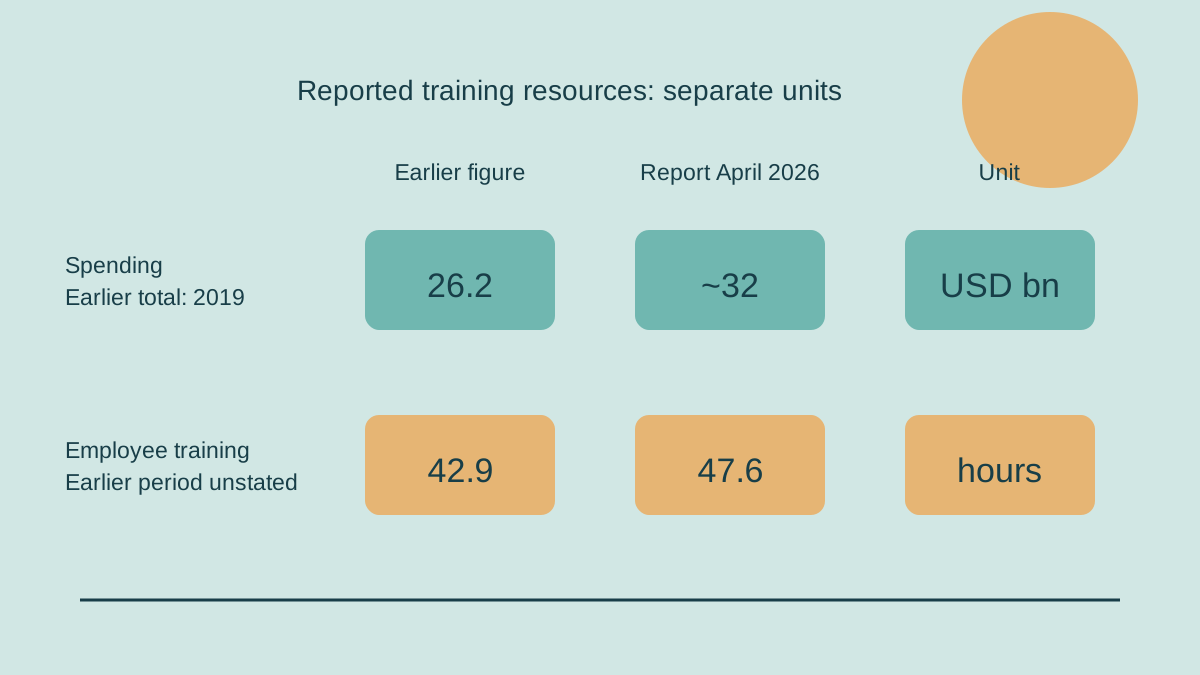
Manufacturing Dive’s April 22, 2026 report describes a Manufacturing Institute survey of industrial training in the United States. Reported spending was about $32 billion, against $26.2 billion in 2019; employee training time was 47.6 hours against 42.9. Respondents cited work interruptions, scheduling and cost as obstacles. The underlying survey methodology was not independently reviewed for this article.
Those figures invite a budgeting question that extends beyond one survey: what must remain comparable before a larger training account can be interpreted? The original analysis below examines accounting scope, time denominators and the way a programme fits into a work schedule. Its examples are constructed illustrations. They describe neither surveyed employers nor a recommended operating procedure for a particular factory. The aim is to make a budget discussion specific enough to distinguish changed resources from changed measurement.
Begin with the boundary of the training account
A total is meaningful only in relation to what enters it. An employer might count external course invoices, internally prepared lessons, paid learner time, trainer time, travel or materials. Another account might include only purchases from providers. Neither list can be inferred from a headline amount. Before comparing periods, a reviewer needs an explicit description of the included categories, the organisational boundary and the period to which each amount belongs. Otherwise a revised definition can look like a revised commitment.
This is especially important when an activity moves between departments. Imagine that a production team formerly recorded an instructor’s time as an ordinary staffing expense, while a later budget identifies it separately as training. A visible training account could rise even if the instructor spends the same time teaching the same group. That is a useful improvement in visibility, but it is a different event from adding instruction. An explanatory bridge between old and new definitions preserves both interpretations instead of forcing one.
A practical scope register could place each cost category beside its treatment in both periods. The register need not be complex: included, excluded, allocated or unavailable are already informative labels. Where a category has changed, the reviewer can describe the change rather than manufacturing a supposedly exact adjustment. A comparison with a known difference is more useful than a smooth chart whose entries silently refer to different things.
Separate a nominal comparison from a real one
A spending figure stated in currency measures a nominal amount. Its movement does not by itself establish how much instruction, equipment access or provider capacity was purchased. Prices, purchased services and internal allocations may all change. A claim about purchasing power would therefore require an appropriate price comparison and an account of the services represented. The reported totals alone do not supply those elements. This article makes no estimate of inflation or real training growth.
There are several questions here, and each deserves its own line. Did the nominal account change? Did the number of learners change? Did purchased hours change? Did the contents of instruction change? Did the organisation record previously hidden costs? A single percentage cannot answer all of them. Choosing the question first prevents an attractive headline from becoming a substitute for the unit the organisation actually wants to understand.
Even an available price index would need careful matching to the account. A general index and a particular mix of internal wages, software licences and course purchases describe different baskets. A reviewer could report an explicitly approximate sensitivity calculation, provided its assumptions are visible, but should not treat that calculation as a measured training volume. Precision in arithmetic cannot repair a mismatch between the economic question and the inputs chosen to represent it.
Keep the learner denominator visible
Total expenditure and expenditure per person can move in different directions without contradicting each other. A larger eligible population may require a larger account even when provision per learner stays unchanged. Conversely, the same total spread across fewer participants may increase a per-person figure. For an internal comparison, the organisation must decide whether its denominator is headcount, average eligible employment, unique participants or completed enrolments. These units should be named rather than used interchangeably.
Consider a wholly hypothetical budget of 120,000 monetary units for 100 unique participants. Its simple average is 1,200 units per participant. If a later account records 150,000 units for 150 participants, the total rises while the average falls to 1,000. Neither movement establishes improved learning. The example merely shows why the population must accompany the amount. It is not an estimate for the survey, an industry benchmark or a recommended level of expenditure.
Repeated enrolments create another boundary. One employee taking three activities may produce three enrolment records but remains one person. A programme can legitimately track both, as long as the labels distinguish people from events. A budget committee asking about access might want unique participants, while a scheduling discussion might need enrolment events. The reporting system becomes clearer when it preserves both counts instead of selecting whichever denominator produces the more persuasive trend.
Hours require a definition of whose time is measured
An hour can refer to a learner, an instructor, a scheduled class or a room reservation. Ten learners in a one-hour session produce ten learner-hours, one session-hour and potentially a separate instructor-hour. These descriptions refer to the same activity through different units. Combining them into a single unnamed total would make later comparisons difficult. A useful internal record therefore states both the person or resource measured and the treatment of simultaneous attendance.
The distinction also applies to planned and used time. A timetable might reserve a two-hour slot while attendance records cover a shorter period. A finance account may use paid hours, while a provider reports delivered hours. Differences between these records can be explainable, but they should not disappear through an assumed conversion. The person reviewing a budget needs to know which record supports a number and whether that support has remained consistent across periods.
Distribution adds information that an average cannot contain. Suppose two hypothetical groups receive different amounts of instruction because their programmes have different aims. Combining them may be useful for a broad resource account, yet the combined average does not describe either group’s experience. A reviewer can retain the aggregate while showing the programme categories beneath it. This is an accounting distinction, not a judgement that every worker should receive the same number of hours.
Bring trainer time into the same discussion
Learner time and preparation time are related resources. An instructor may need to prepare materials, coordinate attendance, revise a lesson and discuss a group’s needs before the visible session begins. Whether those activities enter a training account is a matter of its stated scope. If they are excluded, the account should say so. The point is not to prescribe a universal cost model, but to prevent the visible session from becoming an unexplained proxy for the whole resource commitment.
An internal allocation also differs from a new cash payment. Charging an existing employee’s time to training can improve the budget’s description without producing an additional invoice. Paying an external provider creates a different record. An account can contain both, but a cash-flow question and a resource-allocation question may need separate presentations. Treating every allocated amount as additional cash expenditure would obscure what decision the figures are meant to support.
A clear review can therefore show purchased services, allocated internal time and any unmeasured categories separately. These lines provide a place for uncertainty. If preparation time is not recorded, its amount remains unknown; it should not be estimated from an arbitrary multiplier and presented as a fact. Better information may later permit a fuller account. Until then, preserving the gap gives the next review a specific measurement question.
Scheduling is a capacity question with several moving parts
A training plan occupies time that must fit alongside other obligations. That observation does not establish that any particular employer loses output when staff attend. The effect depends on the work arrangement, coverage, demand and timing, none of which can be inferred from a survey obstacle label. An original scheduling analysis should therefore begin with the available slots and the dependencies that determine participation, while leaving unmeasured production effects unquantified.
For a constructed example, imagine a programme offered twice in one week to accommodate two groups. Its content remains the same, but the second session requires a second instructor slot and another room reservation. The arrangement may permit participation that one session would not accommodate. Whether it is worthwhile depends on the programme’s objectives and available resources. The example illustrates a scheduling trade-off without claiming that duplication improves productivity or represents actual surveyed practice.
A planning record could distinguish the requested slot, agreed slot, attendance capacity and unresolved coverage question. Recording these separately makes a postponement easier to interpret. It might reflect a provider’s availability, a learner’s timetable or an internal resource constraint. The record should retain the stated reason rather than translating every delay into lack of commitment. Such a distinction makes the next conversation more concrete without promising a solution in advance.
Do not add overlapping obstacle shares
Survey percentages about barriers need their own interpretation. A respondent may experience more than one obstacle if the questionnaire allows multiple selections. Without the questionnaire, one cannot assume that the categories are exclusive or that their total describes a single population partition. Nor does a reported obstacle automatically rank its practical severity. The headline account does not establish how the responses were weighted, and this article does not supply those missing methodological details.
A constructed ten-person exercise makes the overlap visible. Six people could mention scheduling and five could mention cost, with four appearing in both groups. The counts would describe eleven mentions across seven distinct people. Adding the two shares would produce 110 percent, which is not an error if multiple answers are allowed. The arithmetic illustrates the distinction between mentions and people; it is not a reconstruction of the institute’s results.
The reporting question is therefore whether a percentage measures respondents, responses or some other unit. A budget discussion should retain the publisher’s attribution and acknowledge missing methodological information. It should also avoid turning a selected barrier into a demonstrated cause of weak training outcomes. The next useful evidence would concern the actual questionnaire and response basis, followed by programme-specific records if a particular organisation wants to understand its own constraints.
Use a comparison checklist before choosing a conclusion
The most useful budget review begins with a short set of definitions rather than a long narrative about success. Those definitions allow participants to identify what changed, what remains comparable and which uncertainty affects a decision. An organisation could adapt the following editorial checklist to its own reporting question. It is a framework for examining information, not a claim that the surveyed companies already use these records.
- Name the accounting period, organisational boundary and included cost categories.
- Separate purchased expenditure from allocated internal resources where the question requires it.
- Identify the learner denominator and distinguish unique people from enrolment events.
- Define each time measure, including whether it is planned, delivered, attended or paid time.
- Show definition changes and missing categories beside the comparison.
- Keep scheduling constraints and learning outcomes in separate records unless evidence connects them.
Each line should lead to an answer or an explicit gap. If a denominator changed, the review can describe that change. If a category cannot be reconciled, the account can show the limitation rather than stretching a percentage beyond its scope. A useful comparison does not need every uncertainty to disappear. It needs enough transparency for the reader to understand which decision the available evidence can support.
Resources and results belong in connected but distinct accounts
A resource account answers what was committed or used. A learning result answers a different question about an identified activity and its aims. An operating result adds another layer involving the work context. These records can be examined together, yet none should automatically stand in for the others. More expenditure may support a programme; more hours may permit additional instruction. Whether either produces a desired change remains a question for evidence about that programme.
This distinction also improves communication with workers and managers. A training budget can be described honestly as a resource commitment while programme-specific findings are reported separately. That description leaves room for a worthwhile activity whose effects are still being examined, or a large account whose composition has changed. It avoids claiming that money alone measures competence and avoids implying that an unresolved scheduling issue makes learning impossible.
The April reporting provides a reason to ask sharper questions about training accounts. The next step in interpretation is to preserve the basis of comparison: category, population, time unit and period. When those remain visible, a nominal total and an average number of hours can contribute to a serious discussion without carrying conclusions they cannot establish. The strongest budget explanation is one whose reader can follow the resources, understand the denominator and see exactly where a result still needs its own evidence.