Rostelecom’s 2024 results show why a growing digital business needs careful measurement before investment decisions. In its report dated 26 February 2025, Interfax described the performance of the operator in Russia. The company’s own revenue tables provide the crucial distinction: digital services and digital management clusters are two classifications of activity, rather than two amounts to add. Understanding that distinction helps turn a revenue headline into a useful question about where additional capital might earn a return.
Two views of the same group
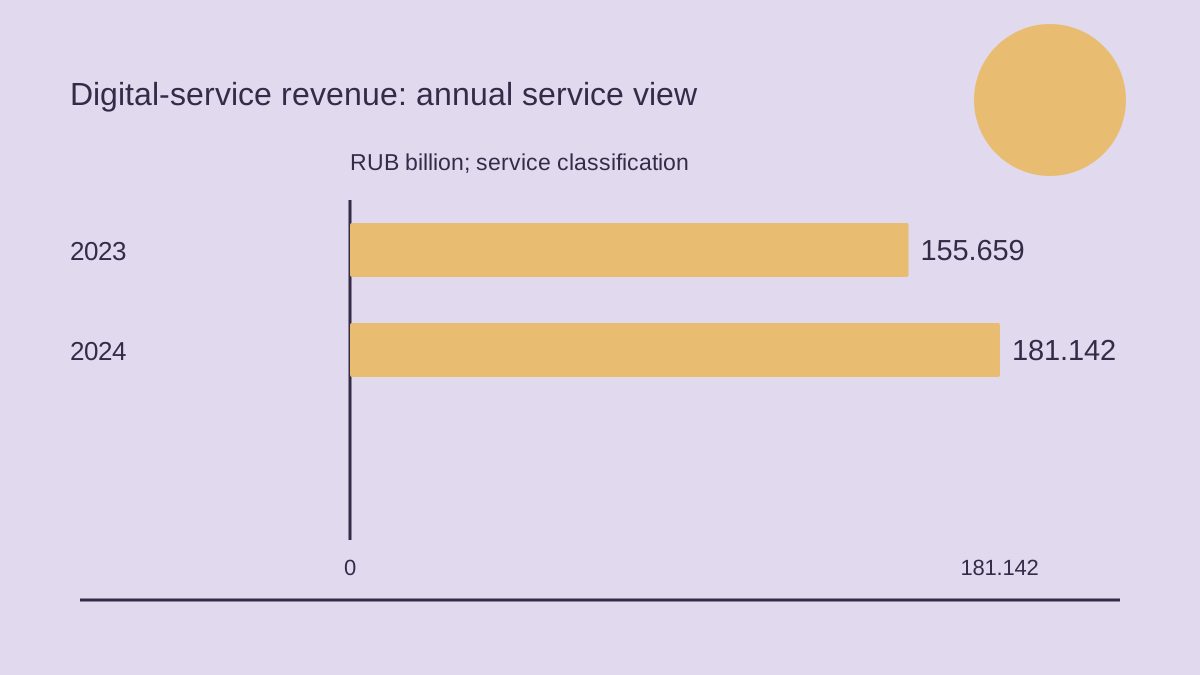
The official revenue review reports RUB 181.142 billion of digital-services revenue for the full year and RUB 172.708 billion for digital clusters. Both appear within a group whose consolidated revenue was RUB 779.945 billion. The service view classifies what is sold; the management view groups activity by organisational responsibility. Combining the two digital amounts would mix those classification systems and count overlapping activity as though it were additional business.
This distinction is familiar in any enterprise that sells several products through several business units. A product can contribute to one service category while the organisation delivering it contributes to a management segment. The classifications serve different purposes. A service view helps explain the customer proposition and its evolution. A management view helps identify who operates the business and takes responsibility for results. Neither perspective becomes redundant because the other exists. The analytical error arises when a reader treats them as mutually exclusive pieces of one total.
Before using either table, define the question. To examine the composition of customer demand, start with the service categories. To discuss resource accountability, start with management categories. To estimate a proposed project’s economics, neither aggregate table is sufficient by itself. That third task requires a narrower boundary around the investment and the transactions it changes. Separating these questions makes the tables more useful and reduces the temptation to select whichever digital total produces the most persuasive investment story.
A reconciliation is part of the interpretation
The annual management view includes RUB 125.959 billion of eliminations and adjustments. Subtracting that line from the displayed management categories reconciles them to consolidated group revenue. The line is an accounting bridge, not evidence that the same amount of money was lost. Nor does its presence establish improper accounting. Without a detailed breakdown, an outside reader should not attribute every adjustment to a particular internal transaction. Its immediate significance is that the gross management categories require reconciliation before they are compared with external group sales.
A hypothetical integrated operator illustrates why this matters. One unit might provide infrastructure used by another unit to deliver a customer service. The first unit’s internal commercial measure can help its managers track activity; the second unit’s measure can help its managers track the finished offer. At group level, the internal relationship cannot create a second external customer payment. This illustration explains the purpose of checking boundaries. It is not a reconstruction of Rostelecom’s individual elimination entries or a claim that all its adjustments arise in this way.
The reconciliation should remain visible when management figures are used in an investment discussion. A project proposal might describe revenue generated for the sponsoring unit, benefits for another unit and savings for the group. Those benefits are not necessarily additive. A transfer charged inside the organisation can be income for one team and cost for another. Group economics requires following the effect through both sides. Otherwise a proposal can appear attractive because the presentation counts an internal benefit without its corresponding internal cost.
The quarter is not the year
The official table gives fourth-quarter digital-services revenue of RUB 69.292 billion. This confirms that the agency report’s use of a percentage sign alongside 69.3 should not be carried into a financial comparison. On the official table’s bases, our calculations put digital services at about 29.6% of fourth-quarter group revenue and 23.2% of annual group revenue. These are separate period shares. The quarter’s higher proportion does not establish that the following year will have the same revenue mix.
A period comparison should first establish what has been measured. An annual amount records activity over twelve months. A fourth-quarter amount records activity over three months. Dividing both by their respective group totals produces valid shares, but it does not explain why they differ. Possible explanations in a general business analysis include project timing, the timing of customer acceptance and changes in the mix of services. Their relevance to a specific company requires evidence. The comparison itself cannot select a cause.
This restraint is useful when evaluating expansion. Annualising a strong quarter can make a proposed asset appear fully utilised before the underlying demand has been demonstrated. Dismissing the quarter can also overlook a genuine change in the business. A better approach records the difference and asks for an order history, delivery schedule and comparable period data. Those records help distinguish a sustained operating pattern from a concentration of activity within one reporting period. A revenue table begins that enquiry; it does not finish it.
Revenue growth is an input to a capital decision
The company’s dated results release discusses investment optimisation and moving some projects to later periods while continuing critical infrastructure investment. These are management plans expressed at the time of publication, not proof of subsequent execution. They frame an important decision: a growing activity can still require choices about sequencing, scale and resource commitment. Growth in sales does not remove the need to assess what the next investment changes.
The relevant comparison is incremental. What happens if the project proceeds, and what happens under a credible alternative? The alternative is rarely a business with no costs and no activity. It may be continued use of an existing asset, a smaller expansion, a different delivery arrangement or a later start. Comparing a proposed project with an unrealistic zero-cost alternative exaggerates its benefit. This is an original analytical framework rather than a calculation of Rostelecom’s undisclosed project returns.
A proposal also needs to distinguish existing revenue from additional revenue. Moving a service to new infrastructure may protect an established customer relationship without creating a new sale. That can still be valuable. Conversely, a project presented as expansion may partly replace existing capacity. The decision should record both effects and avoid counting protected revenue as newly generated turnover. A service table helps identify the activity concerned, but it does not establish how much of that activity depends on the proposed investment.
Shared infrastructure changes the cost boundary
Digital services may use assets and teams that also support other services. For an investment review, this creates two distinct cost questions. The first asks how existing costs should be allocated for internal reporting. The second asks which costs actually change if the decision is made. An allocation can be useful for accountability without representing an avoidable cash expense. Treating every allocated cost as incremental can reject a sensible project; ignoring every shared cost can accept a project that requires a real expansion elsewhere.
Consider a hypothetical service added to infrastructure with available capacity. Its early incremental equipment requirement might be limited. As demand grows, however, the service could bring forward a larger capacity upgrade. A useful decision model identifies that threshold instead of assuming that spare capacity is permanently free. It also records which other activities could use the same capacity. This example explains the importance of opportunity cost. It does not establish Rostelecom’s utilisation, equipment thresholds or project alternatives.
The same reasoning applies to people and operational support. An existing team may absorb a limited workload but require additional staff beyond a defined level. A commercial forecast that assumes unlimited support from an unchanged team can conceal a scaling constraint. The appropriate question is not whether a service is described as digital, but which resources its delivery consumes at each stage. The answer should come from operational planning and measured workload, rather than from a broad revenue category or a general promise of efficiency.
Continuity and expansion need different decision rules
A business must distinguish maintaining an existing service from extending its commercial reach. Maintenance can preserve service availability, contractual performance and customer confidence. Expansion can create new capacity, new offers or access to additional demand. A project can do both, but its justification should separate the purposes. Applying only a new-revenue test to continuity work misses the avoided deterioration it addresses. Applying only a continuity argument to optional expansion can conceal an investment whose commercial case remains weak.
For a continuity project, define the failure or deterioration that the investment is intended to prevent. Then identify the relevant service commitment, available alternatives and evidence about the existing asset. For an expansion project, define the additional capability and evidence of demand for it. These proposed questions do not assert that any Rostelecom asset is failing or that any disclosed expansion lacks customers. They explain how an investment discussion can remain specific when a group supports multiple services with shared infrastructure.
A combined project needs a transparent comparison with a smaller continuity-only option. If the larger project is selected, the extra commitment should be justified by the extra capability rather than hidden within essential expenditure. That comparison can clarify which part of the investment must happen and which part can be sequenced differently. It also gives a later review a meaningful baseline. Without that baseline, a successful continuation of existing service could be reported as proof that every optional element of the project was worthwhile.
A project gate should test the connection to customers
A useful approval process turns broad strategic language into records that can be examined. The proposed asset needs a defined service, an expected use and a person responsible for the assumptions. Demand evidence should distinguish signed commitments from enquiries, trials and internal expectations. A technical plan should distinguish installed capability from capability that can actually be delivered to a customer. The following proposed sequence is an analytical tool, not a description of Rostelecom’s internal investment committee.
- Define the service and the management unit responsible for its delivery, keeping both reporting classifications visible.
- Identify which customer transactions change under the proposal and which would continue without it.
- Specify incremental assets, staffing and support, including thresholds that require further expansion.
- Compare the proposal with a credible smaller or later alternative, using consistent accounting and timing boundaries.
- Set observable completion and utilisation measures before approval so that the outcome can be reviewed.
These records should retain uncertainty. A customer enquiry may become a contract, but the investment model should not silently treat the two as equivalent. A contract may depend on completion of a technical milestone, which introduces a different uncertainty. Assigning a responsible person and a review date makes those dependencies manageable. Replacing them with one optimistic demand number removes information that the decision needs. A clear project case can be less visually impressive than an expansive forecast while being more useful for allocating resources.
Reviewing the result requires more than another revenue chart
After completion, a project should be compared with its original decision boundary. Were the promised capabilities available when required? Did the relevant services use them? Which additional costs appeared, and which forecast customer transactions occurred? These questions distinguish execution from commercial outcome. An asset can be installed successfully while demand develops more slowly than expected. A service can grow while relying on capacity that already existed. Neither situation is understood by looking only at the movement of a broad digital revenue total.
The review should also consider changes in classification. Moving an activity between management units can change a segment’s reported revenue without changing the group’s external business. A product reclassification can similarly affect a service category. A decision review should follow the underlying activity through such changes or explain why comparison is no longer possible. This is a general reporting discipline, not an allegation that Rostelecom changed its categories improperly. Consistent boundaries are necessary whenever an investment is assessed over more than one reporting period.
Finally, lessons should affect the next proposal. If a project reached operational readiness later than expected, the next case should revisit the delivery assumptions. If a demand forecast was inaccurate, the next case should examine how customer evidence was classified. If shared resources became constrained, the next case should make that threshold explicit. A useful review therefore connects finance, operations and commercial records. It helps an organisation improve its decisions instead of using a growing headline as the only measure of success.
What the two revenue views can establish
Rostelecom’s tables establish different ways to describe a substantial digital activity. They also establish the need for reconciliation: service revenue, management revenue and consolidated revenue have different boundaries. The figures do not disclose a return for an individual investment or authorise adding the two digital totals together. Reading them carefully gives a stronger starting point for analysis than selecting the largest number and attaching a capital proposal to it.
The next step is a connection between an identifiable service, the unit responsible for it and the incremental resources needed to deliver it. That connection turns reporting categories into a decision framework. It can accommodate both necessary continuity work and optional growth while keeping their justifications distinct. The annual results offer evidence about the scale and composition of activity; a capital decision requires evidence about the change being proposed. Keeping those two layers connected, without treating them as interchangeable, is the practical value of the comparison.