
A changed guide is a new planning observation
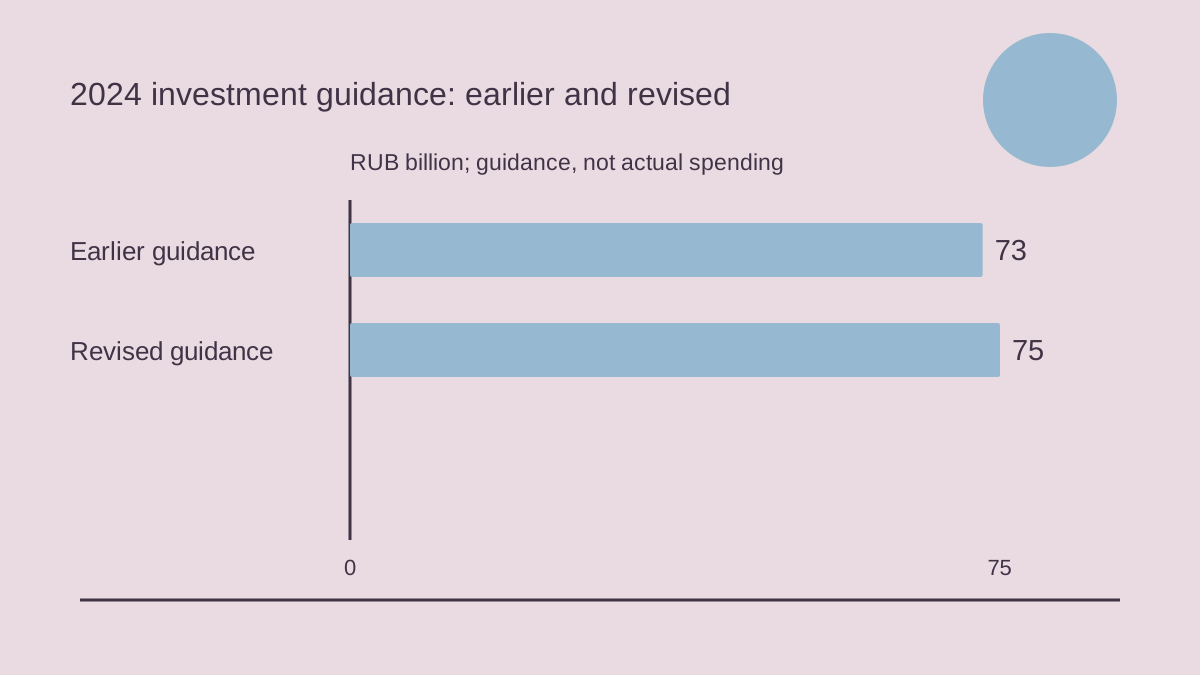
On 7 November 2024, Interfax reported that PhosAgro raised its annual investment guide from 73 billion to 75 billion roubles; the earlier figure included capitalised repairs. The report separately described about 38 billion roubles as total capital expenditure for a new mine. These are attributed company statements, not independently verified expenditure records. The annual guide and the project total have different time boundaries.
The change is useful evidence about the company’s stated plan at a date. It does not identify why the plan changed, establish that the full amount had already been spent or prove that a particular project exceeded its original cost. An assessment of execution requires a defined baseline and observations on a compatible basis. The headline gives a starting point for that assessment rather than its conclusion.
This article proposes a management framework for recording a budget revision. It is original analysis, not an account of the company’s unpublished approval process. The framework asks what scope changed, when the relevant work or payments are expected and which comparison remains valid. It does not supply a financial forecast or recommend an investment. Its purpose is to preserve the meaning of a revised guide so that later evidence can be examined without changing the baseline invisibly.
A version needs an identity, not only a number
A budget figure becomes interpretable when its version is identifiable. The version should specify its date, period and scope, along with the status of the estimate. Without those attributes, a reader may compare two amounts that appear to describe the same programme but actually answer different questions. A change in amount alone cannot explain which boundary moved.
A proposed version record would retain the preceding guide rather than replace it everywhere with the latest figure. It would state when the revision became the relevant planning reference and identify the information available at that point. This would allow a later review to ask both whether the revised plan was executed and how it differed from the earlier plan. Those are related but distinct assessments.
For example, imagine a hypothetical programme whose later version includes an activity outside the earlier version. Comparing the two totals without the scope note would make the additional activity indistinguishable from a price increase on unchanged work. The example does not establish that PhosAgro added scope. It shows why an analyst needs a version description before attributing a difference to execution performance. A well-defined version makes the comparison reproducible; merely preserving the largest or latest amount does not. The proposed requirement is therefore a record of meaning, not an assertion about the company’s actual document system.
Comparable scope is an evidence requirement
A familiar investment label does not settle the population being counted. A proposed comparison would document the included activities for both versions. It would not assume that a shared label proves identical coverage, or that every movement reflects a change in the cost of the same work.
The review could distinguish additions, removals and changes within unchanged scope, provided evidence supports those categories. An unexplained component should remain unexplained. It should not be assigned to the most convenient category simply because a reconciliation needs to balance. The published report does not provide the complete bridge between the two guides, so this article does not invent one.
A hypothetical change in classification could alter a reported planning amount without altering the physical work being considered. A hypothetical scope addition could alter both. A hypothetical price change could alter the amount while leaving the intended deliverable unchanged. These possibilities require different evidence and have different implications for evaluating execution. Naming them does not identify the actual cause of the revision. It establishes a proposed test: before judging performance, determine whether the comparison concerns the same population. If that determination is unavailable, the guide can still be reported accurately while the explanation remains bounded.
Annual timing and lifetime cost are different dimensions
An annual guide describes a period. A total project estimate describes a project across its stated life or scope. Placing them in the same story does not make them additive. The time boundary must therefore remain attached to the amount. It should not be treated as a separate annual expenditure on top of the company’s annual guide without evidence establishing that relationship.
A proposed timing map would distinguish the overall project estimate from the portion relevant to the annual planning period. It would retain the basis of that portion rather than infer it by subtracting unrelated figures. Where the annual portion is not disclosed, the map would mark it unavailable. The absence of a number does not imply a zero contribution, but neither does a project’s headline total identify the missing annual amount.
Consider a hypothetical multi-period project with work and payments spread across several years. Its total estimate could remain stable while the annual profile changes. A movement in this year’s guide could then reflect timing rather than a change in total project cost. This is a possible explanation to investigate, not a finding about the reported revision. The analytical requirement is to keep both dimensions visible. A review that merges them loses the ability to distinguish rescheduling from a change in scope or cost.
Approval, commitment, payment and output need separate states
A planned amount does not establish the state of every activity within it. Approval of a proposal, a commitment to obtain work, a payment and an operating result are different observations. A proposed execution review should keep those states distinct rather than allow a budget headline to stand in for all of them. This framework does not describe the company’s internal approval arrangements.
The useful record would connect each state to its own evidence and date. If the available information concerns a plan, the record should remain a plan observation. If it concerns an achieved operating milestone, that milestone should be described on its stated scope. The presence of a completed milestone in a programme does not prove that every associated payment or other activity is complete.
Imagine a hypothetical project where a payment occurs before an operating result is observed. Another arrangement could produce an observed result while some payments remain outside the current period. Those examples demonstrate why progress cannot be reduced to one state. They do not establish either arrangement at PhosAgro. A proposed review would ask which state is relevant to the decision and whether the evidence supports it. It should avoid both treating money spent as automatic proof of useful output and treating an operating announcement as a complete financial execution record.
The revision bridge should preserve uncertainty
A reconciliation of budget versions can be useful even when it does not explain every component. Its value lies in distinguishing documented changes from unresolved differences. A proposed bridge would begin with the earlier guide, identify supported movements on a consistent basis and end with the revised guide. It would preserve any unexplained remainder rather than conceal it in a catch-all label.
The evidence for a movement should establish its scope and timing. A general statement that projects are continuing does not allocate the change between them. Nor does a list of projects demonstrate that every listed project contributed to the revision. The public report names activities, but the presence of those names should not be converted into an invented distribution of the budget difference.
A hypothetical bridge could include a timing movement and a scope movement that partly offset each other. A small net revision would not establish that the underlying changes were small. Conversely, a larger revision would not identify its cause without the bridge. These examples explain why the net amount is an observation rather than a decomposition. The proposed review would report what can be reconciled, state what remains unknown and resist replacing missing evidence with a confident narrative. This would keep later clarification distinguishable from what was known at the original review date.
An unchanged baseline makes later comparisons meaningful
The latest guide can be the relevant planning reference without erasing the earlier guide’s role in assessing change. A proposed review would state which baseline is being used for each question. Execution against the revised plan and movement relative to the original plan should be labelled separately. Switching between them during an explanation can make the same outcome appear favourable or unfavourable without any change in the outcome itself.
A baseline also needs stable units and scope. If those change, the review should either reconcile the change or explain why the series is no longer directly comparable. A more current number is not automatically a more appropriate comparator for every question. The choice depends on what the review is trying to establish.
For example, a hypothetical programme could meet its revised annual guide while differing from the earlier guide. That would answer one execution question but leave another question about the revision open. The result should not be described as meeting every earlier expectation unless evidence supports that broader claim. Likewise, a difference from an obsolete guide should not automatically be labelled failure against the current plan. The proposed discipline is to preserve both questions and make the reference explicit. That allows a reader to assess the finding without reconstructing a moving target from scattered announcements.
A variance requires a defined cause before a performance label
A change in guide can raise questions about execution, but it does not answer them. Labels such as overrun, acceleration or expansion each imply a different cause and comparison. A proposed review would require evidence for the implied relationship before attaching the label. Otherwise an accurate number can be placed inside an inaccurate explanation.
An execution question would need the relevant work scope, the agreed comparison and an observation of what occurred. A timing question would need evidence about how activity moved between periods. A scope question would need evidence about the added or removed deliverable. These are proposed evidence requirements, not findings about the actual revision. The main report does not establish the complete cause of the changed guide.
A hypothetical amount could rise because the same work becomes more expensive, because different work is included or because the current year contains more of a multi-year programme. Each possibility needs its own explanation. The review should not choose among them by intuition or infer that the largest project named in the article must be responsible. Where the evidence supports only a revised planning amount, that is the appropriate finding. A bounded finding remains useful because it identifies the next question precisely: what documented movement explains the difference on a comparable basis?
A decision record connects the revision to a specific question
A budget revision can be examined more effectively when the decision being reviewed is named. A question about annual scheduling differs from a question about the overall project envelope or readiness for an operating milestone. The proposed record would identify the decision, its horizon and the evidence relevant to it before choosing the comparison.
The record could retain the version used, the scope assumptions, the unresolved components and the observation that would justify another review. That would make later changes interpretable without pretending that the original choice had perfect information. It would also prevent new information from being presented as if it had supported the earlier decision all along.
Consider a hypothetical review concerned with whether a programme’s annual timing remains credible. Evidence about a completed activity could be relevant, but would not by itself settle every payment or remaining milestone. A different review concerned with the total project estimate would need a different boundary. The same public announcement could contribute to both discussions while answering neither in full. A useful proposed record would show that limited contribution. It should not turn a planning statement into an instruction to spend, a claim about internal authorisation or an evaluation of financing suitability. The framework concerns the meaning and traceability of evidence, not an undocumented organisational decision.
The historical conclusion remains within the reported scope
A review can use a dated planning statement while retaining different time horizons. It does not provide a complete execution ledger or the cause of every movement between versions. A responsible interpretation should preserve that boundary rather than use later results to make the original announcement appear more conclusive than it was.
The original management lesson is that a budget amount needs its version, scope, period and state. Those attributes determine which comparison is valid. Keeping them visible allows a review to distinguish a revised expectation from expenditure, a project total from an annual portion and an operating milestone from completion of the entire programme.
The proposed framework would ask for a reconciliation where a causal explanation is required and retain an unresolved remainder where the evidence is incomplete. It would state the baseline before judging execution and record which new observation could change the conclusion. None of those proposed requirements describes an undisclosed company process or supplies a result from a future reporting period. As of the historical publication date, the useful finding is limited but concrete: the guide changed, while a judgement about why it changed or how it was executed needs additional, compatible evidence. That distinction makes the public number usable without granting it a meaning that the source does not establish.
- Record the date and identity of the budget version.
- Preserve scope and period before comparing amounts.
- Distinguish plans, commitments, payments and observed output.
- Explain documented changes and keep unresolved differences visible.