
Rusagro’s export footprint widened, but the number of destinations tells only part of the commercial story. Reporting on the annual account on 14 May 2025, Interfax put the group’s 2024 export revenue at RUB 97 billion, including RUB 76 billion from oils and fats. The business in Russia served 36 foreign markets, against 23 a year earlier. Those figures describe reach and product mix; they do not establish how evenly sales, customers, routes or settlement risks were distributed.
The map and the portfolio answer different questions
A destination count is a useful measure of commercial access. A sale in a previously unserved market may require finding a distributor, agreeing specifications, arranging transport and obtaining acceptable payment terms. Recording another country therefore can signal a genuine expansion of the organisation’s selling capabilities. It deserves attention. Yet a map treats a small trial shipment and a recurring large contract as equivalent marks. For decisions about capacity, financing and resilience, that equality can conceal the very differences that matter.
Consider two hypothetical exporters with an identical list of destinations. One spreads repeat orders among several buyers and routes; the other earns most of its turnover from one buyer, while making occasional sales elsewhere. Their maps look alike, but losing a principal customer has different consequences. This is an analytical illustration, not a description of Rusagro’s contracts. The disclosed market count does not identify either arrangement. The question raised by the annual account is which additional evidence would let an observer distinguish them.
The same discipline applies to change over time. Adding markets can make the portfolio less concentrated, leave concentration unchanged or increase it if a dominant existing buyer grows faster than the newcomers. Without destination revenue and repeat-order data, all three possibilities remain open. Expansion should therefore be assessed against two separate objectives: developing new commercial options and building an economically balanced order book. The first can advance before the second becomes measurable. Treating them separately avoids turning evidence of access into an unsupported claim of resilience.
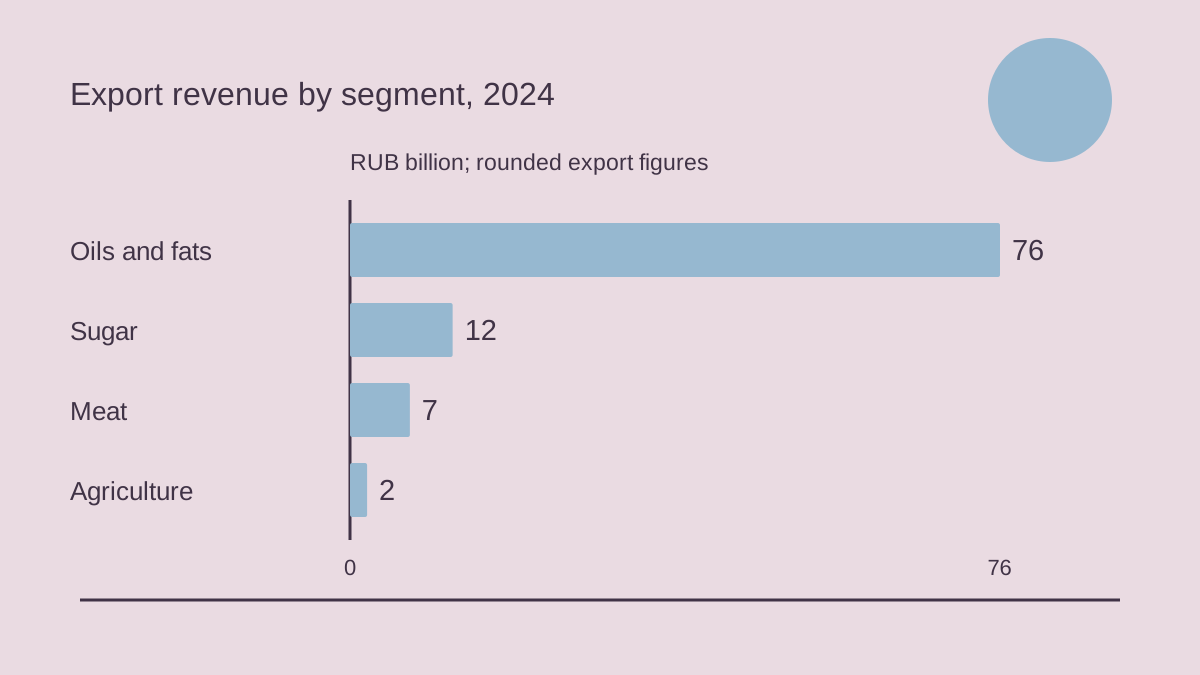
Product concentration is visible; other concentrations are not
Using the rounded export amounts reported by Interfax, dividing 76 by 97 gives approximately 78%. This is our calculation of the oils-and-fats contribution to export revenue, not a disclosed share for any single country or customer. It indicates that the foreign-sales portfolio was weighted toward one business area. It cannot reveal whether that area itself contained a varied set of products, destinations and counterparties. A broad group label may encompass exposures that move together as well as exposures that behave differently.
There are several independent ways to classify a sale. The product determines the production process and quality requirements. The buyer determines contractual credit exposure. The delivery corridor determines operational dependencies. The settlement arrangement determines how proceeds reach the seller. Looking at only one classification can make an export portfolio appear more diverse than it is. Conversely, a large product share does not by itself prove an unstable portfolio: several independent buyers with repeat demand may support a concentrated manufacturing specialism.
A meaningful review would cross those classifications instead of adding their counts. Separate destinations might share a distributor, a transport bottleneck or an intermediary. Different products might be sold to the same corporate group. A new buyer might use the existing corridor and payment chain. These are possible relationships to test, not relationships established by the sources. The analytical aim is to discover common dependencies before calling a set of contracts independent. Counting categories without checking their overlap leaves that aim unmet.
Why group earnings cannot price an export contract
Foreign sales form part of a wider operating business. A consolidated earnings measure combines activities with different customers, cost structures and accounting adjustments. Even a segment margin can include both domestic and export orders. Applying such a margin mechanically to a foreign-sales total would create an apparently precise export profit figure without an appropriate allocation of costs. The annual account’s export revenue should therefore remain a revenue measure unless the company separately discloses the associated earnings basis.
The distinction matters when comparing commercial channels. An export order can carry additional freight, documentation, inspection and payment costs, but may also offer a different selling price or use capacity that would otherwise remain idle. The direction of the net effect is contract dependent. None of those general considerations proves that Rusagro’s export channel was more or less profitable than its domestic channel. They explain why a comparison requires a matched product, period and cost boundary rather than a group average.
A useful accounting boundary follows the order from production to collection. The analyst should first identify which costs are already included in the reported selling price or product cost. Otherwise a freight charge can be deducted twice, or an expense paid by the buyer can be mistakenly attributed to the seller. Group accounting also eliminates some transactions between businesses. Internal transfers may help explain how an integrated exporter operates, but they cannot be added indiscriminately to external sales. The revenue total and the underlying commercial flows answer different questions.
A contract-level comparison starts with a net receipt
For an original diagnostic framework, begin with the amount the seller expects to retain from a defined order. Deduct the costs that the seller must bear to deliver and collect it, using the contract’s actual allocation of responsibilities. The result is a net commercial receipt before any broader allocation of overhead. Compare that receipt with the relevant production and procurement costs. This is a proposed analytical method, not a calculation of Rusagro’s undisclosed export profitability. No company-specific assumptions are required to explain the method.
The inputs need consistent units. A price per tonne should be compared with costs per tonne of the same product, quality and delivery basis. Currency conversion should use the agreed accounting or decision convention rather than whichever exchange rate creates the strongest result. A quoted price, an invoice and a bank receipt are separate records. Reconciling them is particularly useful when deductions or fees are charged after invoicing. The purpose is to understand the realised transaction, not to infer missing terms from an aggregate annual number.
Time is another cost boundary. If payment arrives later than the commercial comparison assumes, the order may require additional financing. An analyst can calculate that effect only after defining the amount financed, the duration and the applicable cost of funds. A delayed-payment scenario should be labelled as a scenario; it is not evidence of overdue receivables. Rusagro’s destination count and export revenue do not provide those inputs. Leaving a field unknown is more informative than inserting an unverified industry average and presenting the result as the company’s economics.
The risk register provides questions, not proof of outcomes
The company’s 2024 risk discussion identifies cross-border payment and logistics concerns alongside currency, product-price and counterparty risks. These are management disclosures. Identifying a risk does not establish that a particular contract suffered a loss, while describing a mitigation measure does not establish its effectiveness. The distinction is essential when connecting a corporate risk register to the export figures: the document supplies categories for investigation rather than a complete account of transaction outcomes.
For payment exposure, the relevant questions concern who owes the money, when it becomes due and which arrangements protect collection. For route exposure, they concern the resources required to complete delivery and the available alternatives. For currency exposure, they concern the denomination and timing of receipts and costs. Those questions can be applied to an actual contract once its records are available. They should not be answered by assuming that every order in a region uses the same channel or faces the same constraint.
The interaction between risks deserves particular attention. A route disruption can change the delivery date, which may change invoicing and collection timing. A price change during that interval can alter a replacement order’s economics. Currency movements may affect receipts and costs differently. This is a general causal framework, not a reconstruction of losses reported by Rusagro. Its value is that it encourages a coherent scenario rather than several isolated percentage shocks whose combined meaning is unclear.
Stress tests should specify what stops working
A useful stress test starts with a defined failure, not a dramatic headline. For example, suppose a hypothetical exporter temporarily loses access to one logistics service. The test should identify affected contracts, inventory locations, alternative capacity and contractual delivery deadlines. It should then distinguish sales that can be rerouted from sales that would be delayed or cancelled. Applying an arbitrary reduction to total export revenue skips those operational relationships. A portfolio-wide sensitivity can be a screening tool, but it should not masquerade as an order-level forecast.
A customer test needs a similarly clear boundary. Losing a buyer’s future orders differs from failing to collect invoices for goods already delivered. The first affects demand and capacity utilisation; the second affects an existing asset and cash availability. Both can occur together, but combining them without explanation risks double counting the same exposure. A proposed review of Rusagro’s portfolio would need customer-level orders and receivables to distinguish those effects. The public figures discussed here do not supply them.
An alternative-route test should also examine feasibility. Naming another port or carrier is not the same as securing available service for the required product and date. A practical plan needs compatible handling, documented commercial terms and a responsible person who can authorise the change. This reasoning does not assert that Rusagro lacks alternatives. It establishes the evidence that would support an assertion that the portfolio has them. Resilience becomes a demonstrable capability when an option can be executed within the relevant contract’s constraints.
A dashboard that distinguishes activity from durability
Management can preserve the destination count while adding measures that answer more demanding questions. A trial order measures access; a repeat order measures continuity. A signed contract measures a commitment; a collected invoice measures completion of its payment cycle. None replaces the others. Showing them together helps prevent a fast-growing sales footprint from being interpreted as a mature portfolio before repeat demand and settlement behaviour are visible. The following is a proposed dashboard, not a claim about Rusagro’s internal reporting.
- Separate trial destinations from markets with recurring orders, using a stated observation period.
- Show revenue concentration by product, buyer group and delivery corridor rather than only by country.
- Compare expected and realised net receipts on a consistent delivery and currency basis.
- Track payment timing against contractual terms, keeping overdue balances distinct from ordinary credit periods.
- Record which alternative routes have usable capacity and commercial approval, and which remain untested options.
The dashboard should include denominators and missing information. A buyer share calculated from invoiced sales differs from a share calculated from receipts. A route share measured by tonnage differs from one measured by revenue. Those are legitimate choices if the question is clear, but changing the denominator between periods can produce a misleading trend. Unknown fields should remain visible. A report that exposes missing customer or corridor data is more useful for a portfolio decision than a complete-looking table assembled from incompatible measures.
Expansion decisions need an explicit evidence threshold
Rusagro’s strategy discussion includes developing export operations among its expansion priorities and states that detailed strategy targets are not publicly disclosed. That supports an interpretation of export reach as strategically relevant. It does not authorise an outsider to invent a target market count, required export margin or timetable. The practical question is how a business might decide whether to deepen an existing market, enter another one or improve the execution of its current orders.
An initial entry decision can use a limited order to learn about specifications, delivery and settlement. A larger commitment requires a stronger evidence threshold because it may absorb more inventory, capacity or credit. That threshold should be agreed before the sales proposal is judged. Otherwise enthusiasm about a new market can influence which uncertainties are treated as acceptable. This is an original governance recommendation: distinguish the evidence needed to test access from the evidence needed to allocate lasting commercial resources.
The review should record both the proposed benefit and the dependency it introduces. An additional destination may diversify demand while relying on a familiar customer group. A second buyer may reduce credit concentration while using the same corridor. A new product may improve commercial variety while requiring another production constraint to be managed. Such combinations are not automatically undesirable. They become assessable when the responsible team explains the tradeoff and identifies what would trigger a reassessment. The destination count alone cannot perform that task.
What the export account establishes
The annual export figures establish a wider selling footprint and a product-weighted foreign-sales portfolio. They leave several economically important dimensions undisclosed. Reading those boundaries together produces a more useful interpretation than either celebrating every additional destination as diversification or treating product concentration as proof of fragility. The evidence supports asking how commercial dependencies are distributed. It does not support supplying the missing distribution from assumptions about geography, customers or payment practices.
For an exporter, the next layer of information is the relationship between orders, costs, delivery dependencies and collected proceeds. For an outside reader, the corresponding discipline is to separate reported results, calculations from rounded figures and hypothetical tests. Rusagro’s account provides a concrete starting point for that discipline. A larger map can expand commercial options; a robust portfolio requires evidence about how those options work together. The two assessments should develop alongside each other, with each claim kept within the information that can substantiate it.