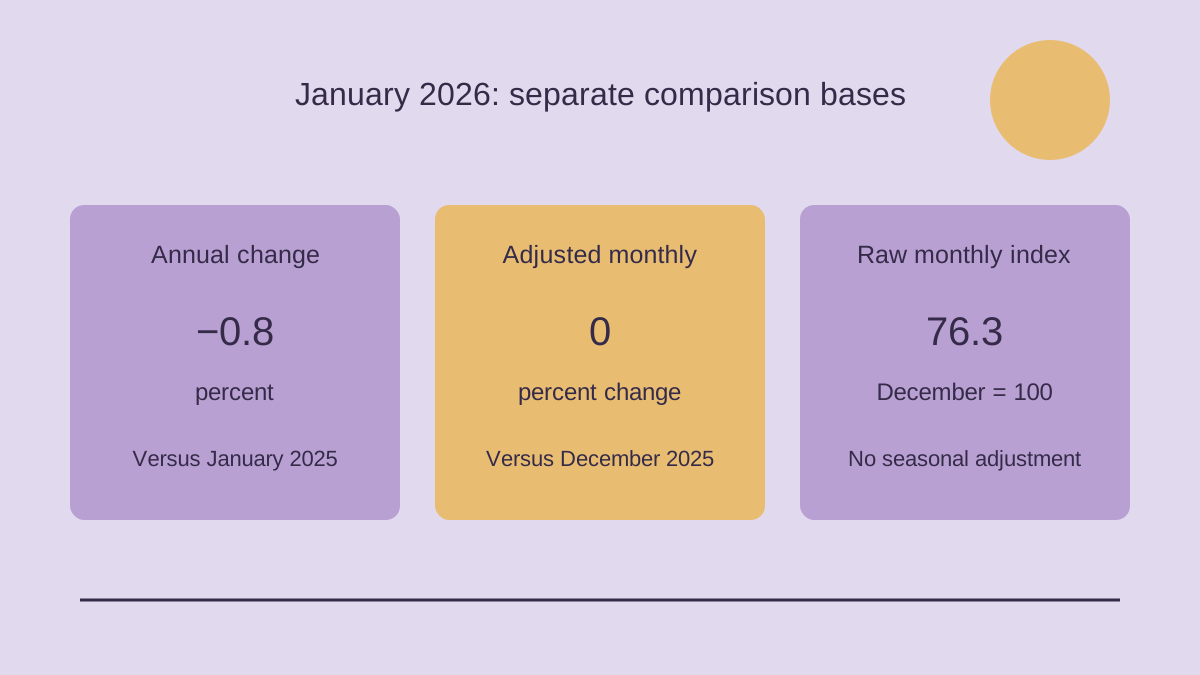
Industrial production in Russia fell 0.8% in January 2026 from January 2025, Interfax reported on 27 February. Output was unchanged from December after seasonal and calendar adjustment. The agency’s economist consensus had expected annual growth of 0.9%, leaving the reported annual result 1.7 percentage points below that forecast.
Four sectors moving in different directions
Manufacturing output declined 3% year on year, while mining increased 0.5%.
The dated Rosstat release’s indexed section gives an unadjusted January/December index of 76.3, alongside the annual index of 99.2. Thus the raw monthly change was −23.7%, while the adjusted monthly change was zero. The series use different treatments of January’s calendar and seasonal pattern.
Steel products: volumes as well as rates
A separate same-day report on steel production records 4.5 million tonnes of rolled steel, down 9.1% annually and 6.8% monthly. Alloy-steel output was 0.9 million tonnes, falling 24.4% annually. Pig iron totalled 4.4 million tonnes, down only 0.3% annually.
- Steel pipes, hollow profiles and fittings: 0.6 million tonnes.
- Their year-on-year decline: 38.2%.
- Non-alloy steel in ingots and semi-finished products: 4.5 million tonnes, down 3.2% annually.
These are separate product series.
Contrasting railway-equipment results
Interfax’s railway-production report published earlier that evening puts freight-wagon output at 2,800 units, approximately 1.8 times lower than a year earlier. Passenger-coach production rose 15.8% to 44 units, while mainline electric locomotives fell 17.6% to 14.
The railway figures show divergent results within transport equipment. A percentage increase in a small unit-count series does not offset another series’ decline by simple subtraction, and neither unit counts nor tonnes of steel are directly interchangeable with the weighted industrial-production index.