On 8 October 2024, Reuters reported that the Biden administration had finalized a requirement for water utilities to replace virtually all lead pipes within ten years. The announcement put drinking-water infrastructure in the United States at the centre of a national replacement programme. The agency report, by Daphne Psaledakis and Jarrett Renshaw, describes the announcement in its 8 October coverage.
The replacement programme has five connected parts
The Environmental Protection Agency’s October 2024 technical fact sheet describes the Lead and Copper Rule Improvements as an extension of the 2021 Lead and Copper Rule Revisions. It identifies five areas of change: replacing pipes, finding legacy connections, improving tap sampling, lowering the lead action level and strengthening measures to reduce exposure. These are separate operational requirements within the same regulatory programme. A water system has to maintain records of its connections while also organizing construction, monitoring water and communicating with people who use the service.
The EPA technical fact sheet for states and public water systems sets out the scope of replacement. Systems must fully replace lead service lines and galvanized lines requiring replacement that are under their control, normally within ten years or less. The requirement applies regardless of the system’s 90th-percentile lead result. Replacement therefore has its own timetable rather than beginning only after a particular monitoring result exceeds the action level. States must set shorter deadlines for individual systems where they determine that faster replacement is feasible.
Which connections fall within the work
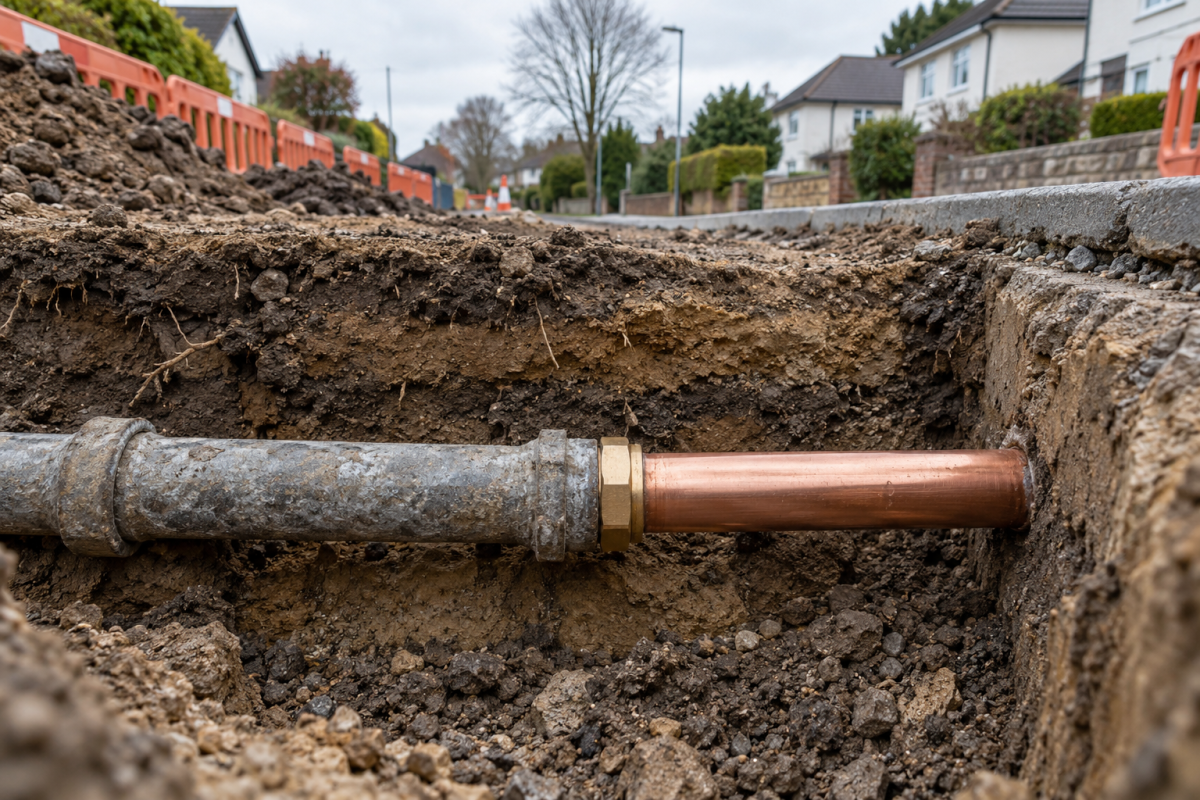
EPA defines a galvanized line requiring replacement as a galvanized service line that is, or has previously been, downstream of a lead service line, or is currently downstream of a line made from an unknown material. The definition ties the classification to the connection’s position and history, rather than treating every galvanized line as an identical case. That category appears alongside lead, non-lead and unknown lines in the inventory requirements. Connectors have their own information requirements, including identification of lead connectors and connectors whose material is not known.
The technical sheet defines control through a water system’s access to conduct full replacement, including legal and physical access. Its replacement-plan provisions require identification of state and local laws and water-tariff agreements that affect access. These provisions place access arrangements within the documented replacement programme. They also establish a role for the plan in describing standard operating procedures for full replacement. For systems finding lead-lined galvanized connections, the plan must include a strategy to establish how extensively those lines have been used and to classify them accordingly.
Inventory comes before a complete replacement schedule
The initial service-line inventory deadline retained from the 2021 revisions is 16 October 2024. The new improvements also require an updated baseline inventory, due by the LCRI compliance date. That baseline includes updated service-line information and connectors. Systems must review specified information sources for connector materials, include the locations of identified connectors and validate the accuracy of the non-lead category. The October fact sheet thus describes both an initial submission and subsequent work to improve the inventory, rather than a single list that remains fixed throughout the programme.
Annual updates must be submitted to the state. They include totals for lead, galvanized requiring replacement, non-lead and unknown service lines, as well as lead and unknown-material connectors. Systems must record the number of lead and galvanized requiring replacement lines fully or partially replaced in the preceding year. Unknown service-line materials must be identified by the replacement deadline. Customers and other people served by lead, galvanized requiring replacement or lead-status-unknown lines must receive notification. The replacement programme consequently includes both asset classification and a continuing account of completed work.
The replacement plan is more than a construction list
EPA specifies distinct elements that must be included in the service-line replacement plan:
- A strategy for identifying unknown connections and a standard operating procedure for full replacement.
- Communication before full or partial replacement, plus procedures for flushing service lines and building plumbing.
- Priorities based on known lead and galvanized requiring replacement lines and community-specific factors, including disproportionately affected or sensitive populations.
- A funding strategy and communication about the replacement programme for residential and non-residential consumers.
- Identification of laws and tariff agreements affecting access, with additional documentation where a deferred deadline is proposed.
The plan must be submitted to the state by the compliance date and updated periodically when information changes. It must also be publicly accessible. The requirements connect the inventory with a documented procedure for deciding how work will proceed, how it will be funded and how affected consumers will receive information. Systems serving more than 50,000 people must post both their publicly accessible inventory and their replacement plan online. Smaller systems still have public-access requirements, although the technical sheet singles out larger systems for online publication.
Funding announced with the rule
In its 8 October 2024 announcement, EPA made $2.6 billion in additional drinking-water infrastructure funding available through the Bipartisan Infrastructure Law. The funding is to flow through drinking water state revolving funds and can support pipe replacement and inventory projects. EPA stated that 49% must reach disadvantaged communities as grants or principal forgiveness, assistance that does not have to be repaid. Inventory work is therefore included in the announced uses alongside the physical replacement of pipes.
The agency separately announced $35 million in competitive grants for reducing lead in drinking water, with communities invited to apply directly. Its broader funding description identifies $50 billion under the infrastructure law for drinking-water and wastewater upgrades, including $15 billion over five years dedicated to lead service-line replacement and $11.7 billion in general drinking water state revolving funds that may also support that work. These amounts describe different programmes and time horizons. The announcement also identifies annual revolving-fund financing and the Water Infrastructure Finance and Innovation Act programme as additional financing routes.
Local programmes show different starting positions
EPA’s announcement names four local examples with different allocations and stated schedules. Milwaukee received approximately $30 million in infrastructure-law funding during 2024 to replace 3,400 lead service lines. EPA described the city’s water utility as on track to replace its remaining lead pipes within the ten-year period. For Detroit, the agency reported $90 million in administration funding and a plan to replace more than 8,000 lines during 2024. That statement describes the year’s intended work and the agency’s assessment of the city’s overall timetable.
For Erie, Pennsylvania, EPA reported $49 million to enable replacement within five years rather than twenty-five. Denver Water’s example involved $76 million from the infrastructure law, which EPA said had accelerated its programme and put it on course for replacement within a decade. The examples describe funding received and programme schedules as reported on 8 October. They do not provide a common completed-output measure across the four utilities. Their documented differences include the funding amount, the annual workload where specified and the stated period for removing remaining lead connections.
Partial replacement has a restricted role
The final improvements prohibit partial replacement of lead or galvanized requiring replacement lines except during emergency repairs or in coordination with planned infrastructure work affecting service lines. Work undertaken solely to replace lead or galvanized requiring replacement lines does not qualify as that planned-infrastructure exception. Where partial replacement occurs, additional public education and risk-mitigation measures are required. Full replacement is therefore the programme’s normal construction requirement, while the technical sheet describes specific circumstances in which a partial intervention remains possible.
EPA also requires certified pitcher filters or point-of-use devices after replacement and certain other disturbances. The sheet gives examples such as changing a connector, an inline water meter or a meter setter, and disturbance during inventory work. Its outreach provisions cover physical action or vibration affecting lead, galvanized requiring replacement or unknown lines. Where a connection is not shut off or bypassed, notification must be delivered within 24 hours of the disturbance. For some disturbances, households must receive a suitable filter and replacement cartridges lasting six months, alongside information on reducing exposure.
Tap sampling changes the monitoring process
The technical sheet prioritizes sampling at sites served by lead service lines where those sites are available. It places known lead connections and lead building plumbing in the highest-priority site categories and revises the category covering lead connectors and specified galvanized connections or plumbing. Systems with lead service lines must collect paired first-liter and fifth-liter samples at those sites. The higher of the two results is used in calculating the 90th-percentile lead level. This requirement changes the sampling protocol at the connection, while the rule retains the minimum required number of samples.
Sampling instructions must omit recommendations to clean or remove aerators and to flush before the stagnation period preceding collection. The specified wide-mouth bottle has an internal mouth diameter of at least 40 millimetres. Before the first lead and copper monitoring period, systems must submit a sampling plan listing sites drawn from the highest-priority inventory categories, together with entry-point and distribution locations for water-quality parameters. The calculation provisions identify eligible samples and, where the highest-priority categories are insufficient, the sequence for moving to lower categories to reach the required site count.
Monitoring schedules and the lower action level
EPA’s October document states that systems with lead or galvanized requiring replacement lines must begin standard six-month monitoring on 1 January 2028. Systems already meeting the new sampling requirements, including the lower action level, may remain on their existing schedules under the conditions described. Qualification for annual monitoring requires two consecutive six-month periods without exceeding the lead action level of 0.010 milligrams per litre or the copper action level of 1.3 milligrams per litre. Annual monitoring uses the standard number of sites for lead and a reduced number for copper.
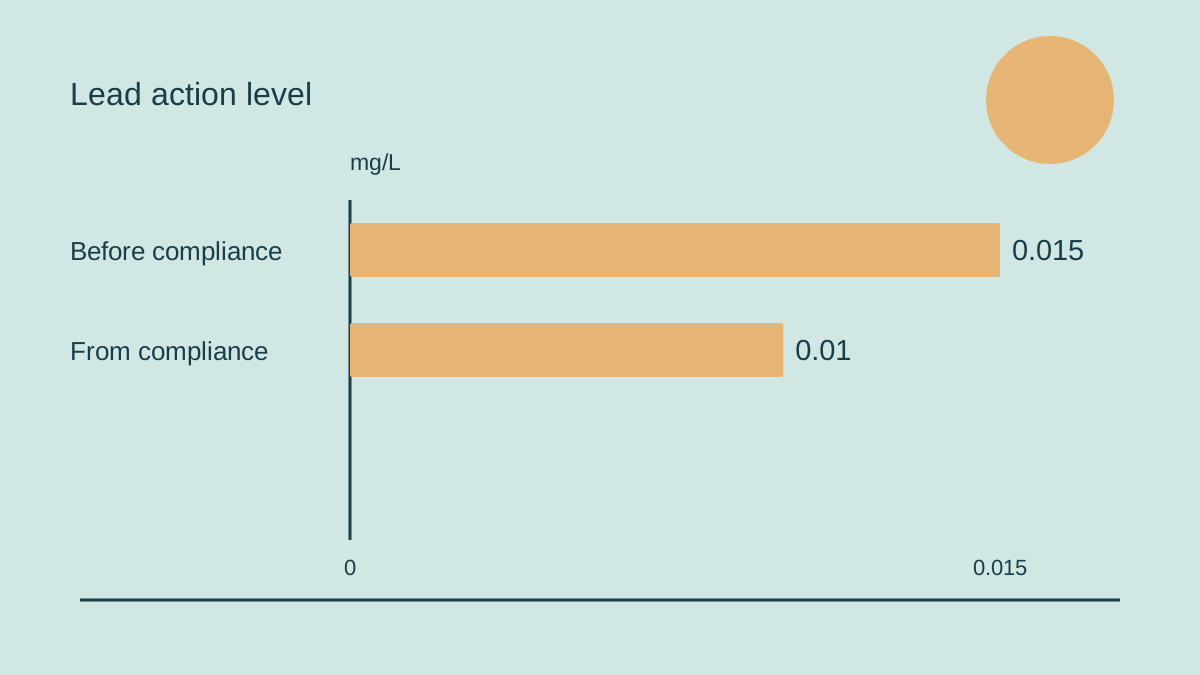
The sheet also specifies reduced-frequency conditions for smaller systems and for systems with results below the practical quantitation limits. Separately, the final rule removes the former lead trigger level and lowers the lead action level from 0.015 to 0.010 milligrams per litre. Exceeding the action level requires public notification within 24 hours, actions associated with corrosion-control treatment and public education. The document distinguishes the notification requirement taking effect on 16 October 2024 at the existing 0.015 level from the revised 0.010 level applicable at the LCRI compliance date.
Repeated exceedances create further duties
After two action-level exceedances in five years, a system must submit a filter plan to the state within 60 days of the second exceedance. The plan describes how filters and cartridges will be made available and how barriers to obtaining them will be addressed. State approval is required within 60 days. After three exceedances in a rolling five-year period, systems must provide lead-reducing devices certified by an accredited certifier, six months of replacement cartridges and user instructions, following the approved plan.
The filter arrangements must be in place within 60 days after the monitoring period in which the third exceedance occurs. Additional community outreach is also required, with options including a public meeting, participation in a community event, direct customer contact or a social-media campaign. Outreach must recur every six months until the specified discontinuation conditions are met. EPA describes two routes for ending these obligations: the system no longer has three exceedances within five years, or the state exercises its discretion after two consecutive periods without an exceedance and actions to reduce lead levels.
Information requirements extend beyond the bill payer
The improvements require sampling-result notices within three business days of the system learning the results, regardless of lead or copper concentration. This covers compliance samples and supplemental monitoring, including consumer-requested samples. Delivery may use electronic messages, telephone or voice messages, hand delivery, mail or another state-approved method. Telephone and voice notices require written follow-up within thirty days. Public education following an exceedance must reach every service-connection address as well as the customer receiving the bill, extending the notification requirement to renters and other users.
The October technical document also requires more accessible educational materials for communities with limited English proficiency. Consumer confidence reports must include updated information about lead, sampling at schools and childcare facilities and access to the replacement plan. In its funding announcement, EPA estimated up to nine million homes were served through legacy lead pipes and described the rule’s public-health and economic benefits as potentially up to thirteen times its costs. Those are the agency’s estimates. The operational programme described in the same October documents consists of identifiable assets, replacement plans, funding channels, monitoring duties and communication requirements, with implementation still ahead at the announcement date.