
A priority statement needs a sequence
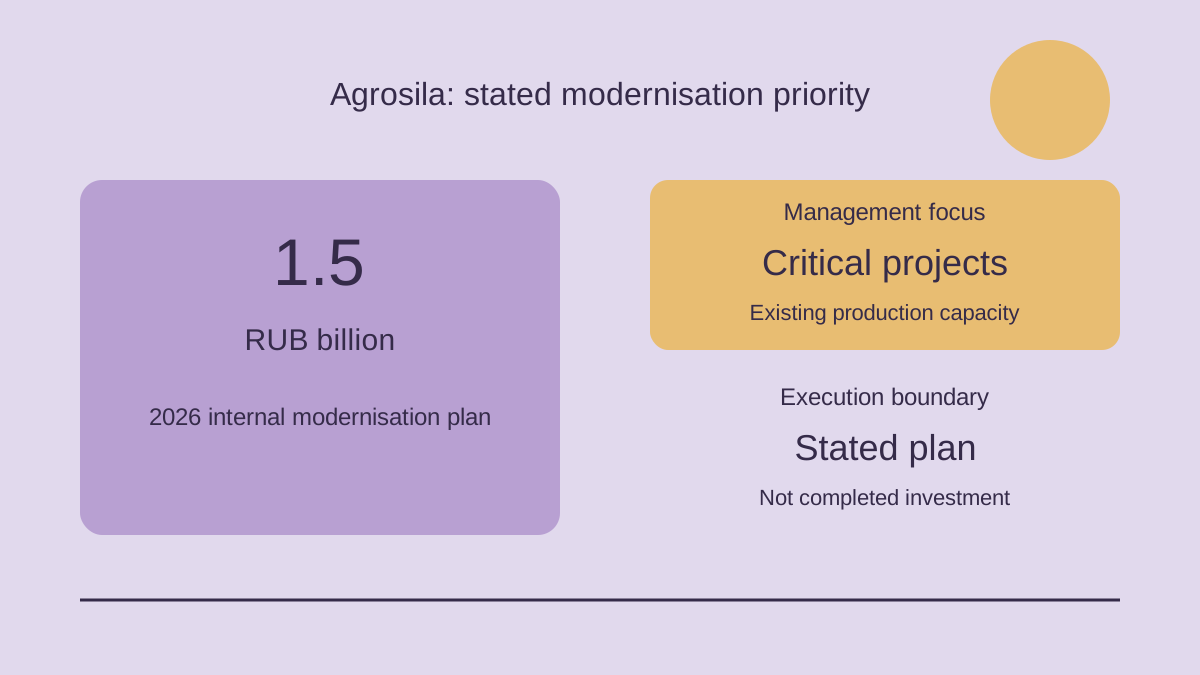
In a 20 February 2026 Interfax interview, Agrosila CEO Svetlana Barsukova described prioritising critical projects and existing capacity while deferring some nonurgent initiatives. She stated a 2026 internal modernisation priority of 1.5 billion rubles. This is a management account and a stated plan in Russia, rather than evidence that the planned work has been completed.
A focus on critical projects raises an operating question before it becomes a list of purchase orders. Which work can be organised, completed, evaluated and used within the relevant production window? A project can be important in principle while its usefulness depends on the timing of several connected activities. Equipment arrival, access to the installation area, availability of an operating team and the point at which the result can be checked do not necessarily occur together. Prioritisation therefore needs a sequence as well as a label.
The analysis below proposes a way to examine that sequence. It does not describe undisclosed procedures at Agrosila or predict the execution of its investment programme. Its subject is the relation between maintenance, modernisation and the calendar of an operating production process. A stated budget can establish the context of management’s intention, but it does not show which task is ready to begin or which completed action will support the next production period. Those questions need a project record with an explicit operating boundary.
Define what makes a task critical
The word critical should identify an operating consequence rather than merely signal that a project is important. A task might preserve an existing activity, remove an identified constraint or complete work needed before another project can be used. Those are different reasons for priority. The project team should describe the relevant consequence and the information supporting it. Without that description, a collection of critical labels can become a competition between persuasive descriptions instead of a comparison of the work needed by the production process.
The consequence also needs a time boundary. A task required before a particular operating window has a different scheduling question from an improvement that can be introduced later. The team can identify the window and explain what would remain possible if the task were not completed by that point. This does not require assuming a breakdown, lost output or a precise financial loss. It requires a clear account of the dependency between the work and the intended activity. The distinction helps the team discuss priority without inventing a certainty that the available information does not establish.
Maintaining an existing capability and adding a new capability should remain separate descriptions. A project that restores the intended use of an existing asset does not necessarily increase capacity. A project that adds equipment does not necessarily establish a usable increase in output until its interfaces and operating arrangements are understood. The team can recognise both kinds of value while preserving what each task is expected to accomplish. This makes a priority statement more informative and prevents a maintenance milestone from being reported as a demonstrated expansion of the production system.
Use the production calendar as a boundary
A production calendar provides a practical reference for asking when work can be performed and when its result will be needed. The relevant calendar must be the one used for the actual process under discussion. It should not be inferred from a broad description of an industry or from the assumption that every site has the same window. The project team can identify the intended operating period, the opportunities for site work and the dependencies that may restrict those opportunities.
The calendar should distinguish the period available for physical work from the period needed for preparation. Drawings, component identification, procurement enquiries and coordination with other participants may need to be resolved before the installation window begins. A plan that shows only the visible site activity can therefore omit the work that makes that activity possible. The team can map the preparation tasks backwards from the intended start of use, while marking unresolved durations as unresolved rather than assigning them an unsupported precise date.
It should also distinguish completion of site work from the opportunity to evaluate the result. If an operating condition needed for evaluation is not available immediately after installation, the schedule needs to show that dependency. A completed installation can be a meaningful milestone while a performance question remains open. This is a scheduling distinction, not a judgement that the equipment is unsuitable. Keeping it visible helps the team understand what can be concluded before the operating window and what requires evidence obtained during a later activity.
Map dependencies before combining projects
A modernisation programme can contain tasks that appear independent on a list but share a physical area, a resource or an operating interface. The team should identify those connections before interpreting the combined schedule. Two projects may both need access to the same part of a site, or one may require information produced by the other. A common completion target does not resolve the order in which those needs must be met. The useful question is what has to be true before each task can proceed.
The dependency record can separate an input that has been confirmed from one that remains an assumption. A supplier may have confirmed an equipment configuration while the team still needs to resolve the arrangement at the site interface. A drawing may be current while the delivery estimate remains conditional. These are different kinds of uncertainty and may require different next enquiries. Grouping them under a single general risk label can hide the action needed. A task-specific record makes it easier to identify the relevant participant and the information that would change the next step.
Combining projects can be useful when it reduces repeated disruption, but the benefit should not be assumed for every combination. A combined scope can also create a new dependency or make the meaning of completion harder to see. The team can ask which activities benefit from being organised together and which need their own milestone. This is an original scheduling framework, not a claim about how the interviewed company groups its projects. The aim is to preserve the operating reason for the sequence rather than make a large combined package appear simpler than its execution.
A hypothetical window shows why arrival is insufficient
Consider a hypothetical processing site with a defined period for planned installation work before its next operating window. The example is invented and does not describe an actual Agrosila project. Suppose equipment arrives during the planned work period, but the site team still needs information about an interface with existing infrastructure. The delivery is a completed action. It does not establish that the installation sequence can be finished or that the operating team will receive the information required to use the result.
The team could separate the enquiry into three parts. What equipment and information have arrived? Which site tasks remain dependent on an unresolved input? What evidence will support the handover for the next operating activity? These questions can have different responsible participants and different dates. Asking them does not imply that a supplier has failed or that the whole project is late. It makes the dependency visible before an arrival milestone is treated as proof of readiness for the operating window.
The same example clarifies the role of a contingency discussion. The team can ask what work remains possible if a particular input is not confirmed in time, without predicting that the condition will occur. It can record the proposed alternative and the information needed to assess it. A hypothetical alternative is not an authorised technical procedure or a claim about actual production continuity. Its management value lies in clarifying the next decision and preserving the difference between a completed action, a conditional plan and a demonstrated operating result.
Equipment renewal needs a defined result
A renewal project should state what the team expects to learn from completion. The result might concern restoration of a capability, a change in a represented operating constraint or a better-defined maintenance arrangement. Each expectation needs its own evidence. A statement that equipment has been replaced does not by itself establish a particular change in performance. The team should therefore connect the intended result with the observation that would support it and the conditions under which that observation can be obtained.
Comparison requires attention to the operating boundary. If the process, material or represented period differs between two observations, the difference should remain visible before it is attributed to the renewal. The team may still obtain useful information, but its interpretation needs to reflect the conditions actually observed. This article does not prescribe testing methods or equipment settings. It proposes that the management record should clearly distinguish the completed replacement, the observed behaviour and the conclusion drawn from that behaviour.
The record can also state what remains unexamined. An initial observation might support a conclusion about one operating mode while leaving other modes for later enquiry. It may confirm that a particular task is usable without showing the long-term experience of maintenance. These limits should accompany the result when it is reported to another project participant. A clear, bounded outcome is more useful than a general declaration of improvement that leaves readers unable to identify the evidence behind it or the conditions in which it applies.
Parts and service work belong in the sequence
A maintenance or renewal schedule can depend on the identification, availability and suitability of components. The team should keep those questions separate. Identifying a component is not the same as confirming a delivery date, and receiving a component is not the same as establishing its suitability for the intended configuration. A project note can connect the request, the supporting information and the next activity. This keeps a broad statement about access to parts from replacing an answer about the item needed for a particular task.
If a project considers an internally produced or restored component, the relevant enquiry is still about the defined task and the evidence required for that configuration. The source of a component does not automatically establish its suitability. The team needs an accountable record of what was supplied, which task it supports and which questions remain for appropriate evaluation. This is not a technical acceptance procedure or a statement that the interviewed company uses a particular method. It is a management boundary that applies to the interpretation of a project milestone.
Service capacity also needs a time reference. The availability of a support organisation in general does not establish the availability of the required activity during the relevant work window. The team can ask who will perform the task, which information is needed and what conditions attach to the proposed timing. The answer can then be connected with the installation and operating sequence. This makes the support enquiry useful for the actual programme rather than leaving it as an isolated assurance that cannot be linked to the next practical action.
Keep a postponed initiative visible
Postponing a nonurgent initiative does not necessarily remove every task connected with it. The team may need to preserve design information, record the reason for the change or identify a future condition under which the initiative will be reconsidered. Those activities have a different purpose from executing the postponed project now. Keeping the distinction visible helps a programme remain understandable when priorities change and prevents an inactive initiative from appearing either fully cancelled or still scheduled without an explicit decision.
A useful postponement record can identify the current status, the information that remains relevant and the decision that would reopen the enquiry. It should not invent a future execution date simply to complete a table. If the date depends on an operating window or another unresolved input, that condition should remain visible. The record can also identify any effect on other tasks in the programme. This allows the team to understand whether the postponement is independent or changes a dependency that another project participant was relying on.
The programme can be reviewed when new evidence appears, with the date of that evidence recorded. A new supplier response, an updated configuration or a changed operating plan may justify another enquiry. The earlier record should still explain why the previous decision was made, rather than disappear when the status changes. This creates a usable account of the programme’s development without claiming that management can foresee every future condition. The value lies in connecting each change of priority with the information and operating question that prompted it.
Report readiness through observable stages
A programme report should distinguish intention, preparation, completed work and observed use. A stated modernisation priority belongs to the first category. A confirmed input can support preparation. A delivered item or completed site task establishes a narrower milestone. An observation under defined conditions supports a conclusion about use. These stages can all matter, but none should silently substitute for another. The report becomes more useful when readers can identify which stage a statement describes and what information would support the next one.
- Explain the operating consequence that makes a task a priority.
- Identify the actual production window rather than assuming a shared calendar.
- Connect preparation, site work and evaluation through their dependencies.
- Keep delivery, installation and observed operating use as separate milestones.
- Record component and service assumptions against the relevant configuration and timing.
- Preserve the reason and reopening condition for a postponed initiative.
The management account in the interview provides a starting point for examining how a modernisation priority becomes useful work. The operating enquiry concerns the sequence: what can begin, what depends on another action and what evidence will support the result within the relevant calendar. A clear programme record answers those questions without presenting an intention as an achievement. Its practical strength is that another participant can understand both the next action and the limits of what has already been established.