
A recovery story needs more than one inventory measure
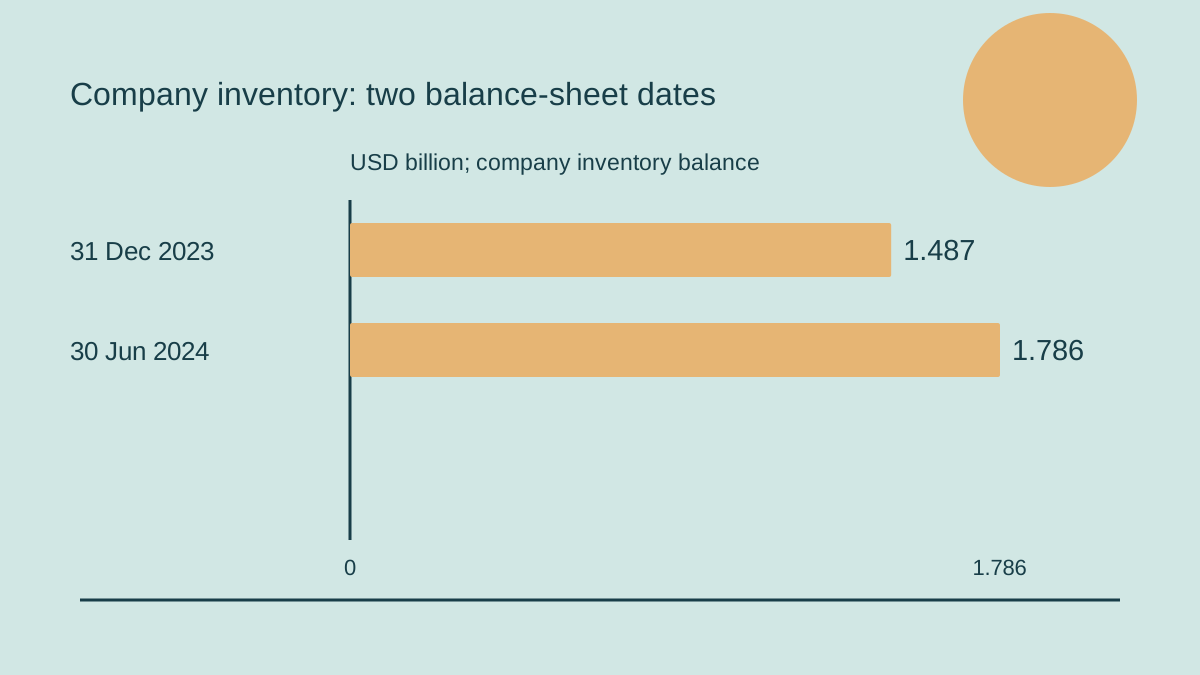
On 12 August 2024, Manufacturing Dive reported management’s account of inventory normalisation at GlobalFoundries and uneven end-market demand. The company’s preliminary, unaudited release reported second-quarter revenue of $1.632 billion, up 5% sequentially and down 12% annually. Its balance sheet showed inventories of $1.786 billion at 30 June against $1.487 billion at 31 December.
These observations should be kept on their stated bases. A narrative about customer adjustment cannot automatically be tested against the manufacturer’s own balance, and a comparison between year-end and June is not a comparison between the first and second quarters. The apparent tension becomes a useful analytical question once ownership and dates are written down. It does not establish that one of the reports is false.
This article proposes an operating framework for examining that question. It distinguishes stock, demand and production evidence, without describing the company’s unpublished planning process. The framework does not establish an inventory target, forecast a future recovery or recommend an investment. Its purpose is to make the evidence needed for a claim of recovery explicit, so that an encouraging statement is neither dismissed prematurely nor promoted into a result it does not demonstrate.
Ownership is the first boundary
The word inventory can refer to goods held at different points in a commercial relationship. A supplier’s reported stock and a customer’s stock describe different resources under different observation. A reduction in one does not logically require a reduction in the other during the same period. The direction of both could depend on timing, planned activity and the products involved, none of which is fully determined by a single headline.
A proposed ownership map would name the population behind every inventory statement. It would distinguish an accounting balance from a management description of customer adjustment. Where the description covers several markets, the map would retain that scope rather than assume that every customer behaves identically. An unavailable customer-level measure should be marked unavailable; the manufacturer’s balance should not be substituted merely because it is published.
Imagine a hypothetical customer using existing stock while its supplier prepares a different order. The customer’s stock could move down while the supplier’s rises. This is a possible relationship, not a finding about GlobalFoundries. The example demonstrates that direction alone cannot settle whether an adjustment is progressing. The review needs ownership, product relevance and timing. Once those boundaries are recorded, the analyst can ask whether the supplier’s stock supports credible demand or represents exposure that requires further explanation.
A balance is a stock, while revenue is a flow
A balance-sheet amount describes a position at a date. Revenue describes activity recognised over a period. Their relationship can be informative, but it requires a stated question and compatible definitions. Comparing them casually can make a normal timing difference appear to be a contradiction, or make an important change disappear behind an annual average.
A proposed reconciliation would preserve the opening position, the relevant additions and reductions, and the closing position where the necessary records are available. It would distinguish changes in physical quantities from changes in the amount attached to them. A higher reported balance does not, by itself, establish an identical proportional increase in physical stock. Nor does higher revenue establish that every item in the balance has become easier to use or sell.
The public release provides a dated accounting observation, not the complete operating bridge needed to explain every movement. An analyst should not manufacture that bridge from revenue alone. The useful next evidence would concern the components and timing relevant to the proposed explanation. Until then, the balance can be described accurately while its operational interpretation remains open. This is a disciplined boundary on the conclusion, rather than a reason to ignore the reported figure or replace it with an unsupported estimate.
Sequential and annual comparisons can point in different directions
A sequential comparison asks how a period differs from its immediate predecessor. An annual comparison asks how it differs from the corresponding period a year earlier. Both can be true while pointing in different directions. The company’s reported revenue comparisons illustrate the distinction, but the logic does not determine what will happen next or which comparison should be declared the definitive recovery measure.
A proposed review would state the base beside every change. It would avoid describing a sequential improvement as a return to a previous annual level unless that level had actually been reached on a comparable basis. It would also avoid dismissing the improvement simply because the annual comparison remained weaker. Each measure contributes evidence about a different interval.
A hypothetical business could move upward from a weak preceding period and remain below a stronger year-earlier period. That tells the reader about its position relative to two bases, not the permanence of its direction. To investigate durability, the review would need more observations and a consistent scope. A management expectation can identify what the company hopes will drive a later change, but cannot supply those future observations. The question of recovery therefore remains a question about defined evidence across time, rather than a contest to choose whichever percentage sounds more convincing.
Product relevance matters more than an aggregate direction
An aggregate stock total cannot show whether its components match the demand the business expects to serve. A proposed operating review would therefore separate the amount of inventory from its relevance to a defined requirement. The question is not merely whether stock is higher or lower, but whether it can support the particular activity being planned within the required period.
This review would need to identify the product population, its intended use and the evidence linking it to demand. It should not infer interchangeability between different items or markets. A favourable signal in one market cannot automatically validate stock associated with another. Equally, a weaker signal in one part of the business does not prove that every other part lacks opportunity.
Consider two hypothetical groups of items moving in opposite directions. Their aggregate could remain stable while the operating problem changes substantially. A single total would conceal that redistribution. The example does not establish an actual composition change at the company. It demonstrates why a proposed recovery assessment should retain enough detail to distinguish useful preparation from an unmatched accumulation. Where that detail is unavailable, the analyst can identify the missing evidence without inventing an ageing profile, a write-down or a product-level sales result.
Utilisation is not the same as useful output
Factory utilisation describes activity relative to a capacity definition. Useful output concerns what that activity produces for a defined requirement. Those concepts can be connected, but they are not identical. A proposed review should therefore ask what a utilisation measure covers before interpreting an increase as evidence of improved commercial performance.
The denominator matters. A measure based on one capacity scope should not be compared with another without explaining the difference. The timing matters too: production activity and customer acceptance need not be observed at the same point. These are analytical questions, not findings about the company’s factory procedures. The published aspiration to improve utilisation should remain an aspiration until the relevant result is observed.
A hypothetical factory could increase activity by producing items ahead of confirmed need. Another could increase activity against requirements that are both defined and credible. The same direction of utilisation would have different implications for stock exposure. A useful proposed decision record would connect the activity to the intended demand and describe the evidence for that connection. It would not turn a high utilisation percentage into proof of cash generation, nor assume that lower utilisation automatically identifies waste. The operating choice needs the composition, timing and purpose of the activity alongside its aggregate rate.
Demand signals need an explicit level of commitment
A statement about improving demand is not necessarily equivalent to a firm requirement for a specified item at a specified time. A proposed planning framework would distinguish signals by their meaning, rather than treating every positive contact as the same commercial commitment. This does not claim that the company lacks confirmed orders; the available article does not provide the records needed to assess that question.
The framework could distinguish an expression of interest, a planning assumption and a requirement with defined scope. It would preserve the date of the information and identify what could change it. Where an analyst cannot establish the status of a signal, uncertainty should remain explicit. A general market narrative should not be substituted for evidence about the particular population of stock under review.
For example, a hypothetical customer might discuss a future programme while still adjusting its current stock. Both statements could be true, but they would concern different horizons. Responding to the future programme as if it required immediate output could create a timing mismatch. Ignoring it because current stock is high could miss a different requirement. The proposed response is to retain the horizon and degree of commitment, then make the production question specific enough to test. An attractive broad story cannot settle the timing of an individual operating decision.
Cash evidence needs its own definition
A stock explanation should not silently become a cash explanation. The company’s release distinguishes its adjusted cash measure and notes a methodology change involving grants from the first quarter, without restating earlier periods. This specific note is a reason to preserve the measure’s definition when comparing results. It does not prove that a reported cash improvement is entirely due to one component.
A proposed cash review would separate the stock position from movements during the period and separate the reported measure from any adjusted measure. It would identify the scope of the adjustment and whether the comparison uses the same definition. A measure labelled adjusted remains useful only for a question compatible with those adjustments; it cannot replace every other view of the business.
The operational framework here does not calculate liquidity needs or advise on financing. It asks whether an explanation connects the right evidence. If a stock balance rises while a selected cash measure improves, the analyst should investigate the documented components rather than impose a rule that the two must move in opposite directions. Several movements can contribute to a period’s cash outcome. Attributing the entire outcome to inventory requires a supporting reconciliation that the headline alone does not provide.
Scenarios should specify what would change the decision
A scenario is useful when it identifies the evidence that would lead to a different response. A general optimistic and pessimistic pair may organise discussion, but it does not necessarily tell a planner what to observe. The proposed framework would therefore connect each scenario to a defined demand population, time horizon and stock exposure.
One hypothetical scenario could concern a stronger confirmed requirement for an existing item. Another could concern a weaker requirement for that same item. A third could concern demand shifting toward a different population. The point is not to assign probabilities without evidence or to claim these scenarios are the company’s forecasts. It is to prevent an aggregate recovery story from supplying the same answer to materially different operating situations.
A proposed decision record would state the information available at the time, the action considered and the condition that would justify revisiting it. Later observations could then be assessed against the original condition rather than retrofitted into a success story. If no relevant new observation appears, the review should not invent a confirmation from unrelated market news. This preserves the difference between a plausible scenario, a planning choice and an observed outcome, while allowing the question to become more specific as evidence improves.
A reproducible record prevents a headline from becoming a conclusion
The proposed record begins with a simple set of distinctions: who holds the stock, what date or period is measured, which product population is covered and what decision is being examined. It then records the source of each observation and labels management expectations separately. These choices make an analysis reproducible without pretending that every operating detail is publicly available.
A reviewer should be able to identify which conclusion follows from the published number and which remains a question. If an ownership link, product match or timing bridge is missing, the record should preserve the gap. A later improvement in evidence could close it, but the current analysis should not behave as if that improvement has already occurred.
The reported revenue comparisons and inventory positions provide a basis for asking more precise questions. They do not establish a completed recovery, a single explanation for the balance change or the commercial value of every item held. As of the historical article date, the useful conclusion is bounded: customer adjustment, company inventory and factory activity need separate observation before they can support one operating story. The original framework offers a method of connecting evidence; it adds no undocumented company result and makes no prediction about what subsequent quarters actually delivered.
- Identify the inventory owner and observation dates.
- Keep stock, revenue and utilisation on their stated bases.
- Match product relevance to credible demand.
- Record expectations and unresolved evidence separately.