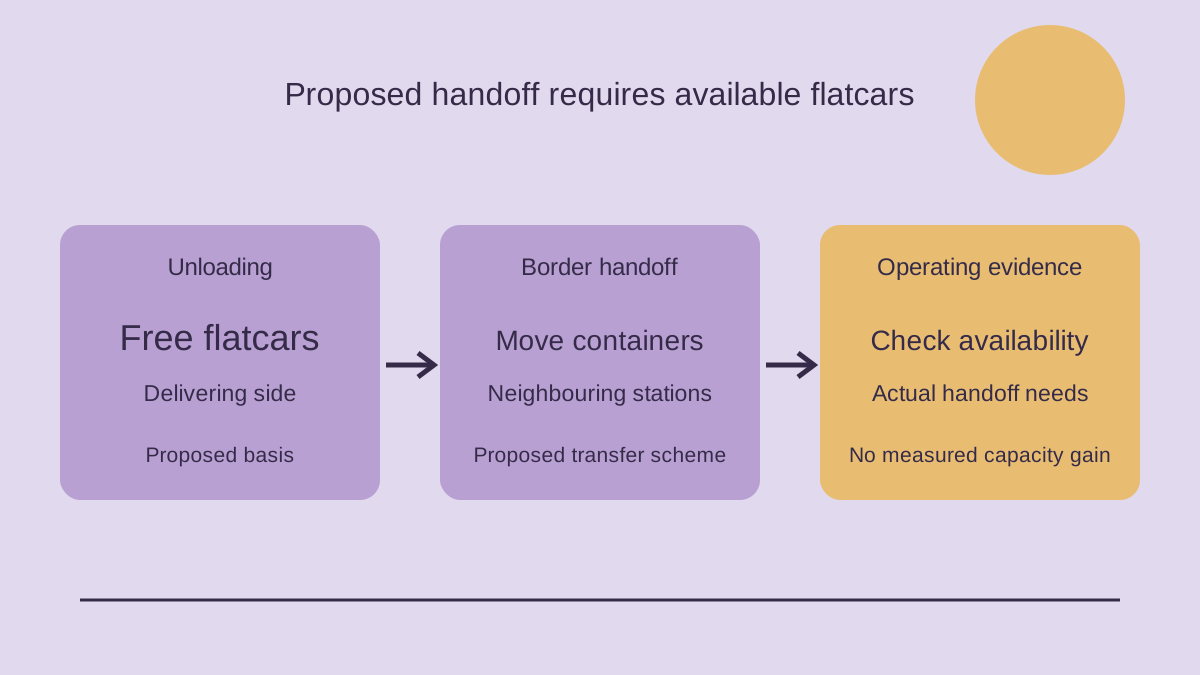
In railway cooperation between Russia and China, Russian Railways proposed container transfer at neighbouring border stations using flatcars made available after unloading on the delivering side. Interfax reported the proposal on May 16, 2024, attributing it to Russian Railways. The report describes a proposal within cooperation with China Railways, rather than a verified operating scheme or measured capacity gain.
The useful analytical question is what the word available means in a wagon cycle. A wagon can have finished one task without yet being an identifiable resource for another. The difference matters when an infrastructure discussion turns into a question about useful freight movements. The analysis below examines that difference through an explicitly invented accounting example. It does not describe the operators’ private dispatching arrangements, give technical railway instructions or estimate the performance of a real border crossing.
Unloading is a milestone, while availability is a decision
For an abstract resource model, the end of one task and the eligibility for the next are different states. Unloading can identify a completed step in the previous movement. Availability identifies whether the planning discussion can treat the resource as usable for a specified next assignment. The model needs both concepts, because counting the first as the second would silently add an assumption. The actual criteria for a wagon’s use must come from the responsible operator, not from this article.
This distinction does not require a claim that unloaded wagons routinely wait, fail checks or face any particular restriction at these stations. It is a question about what a capacity statement includes. If someone says that a quantity of platforms has become available, the reader should know whether the statement refers to physical unloading, an eligibility decision or an assignment to a next task. Each describes a different boundary in the resource cycle, and the practical meaning depends on that boundary.
A clear explanation could therefore preserve the preceding task, the availability state and the proposed next task as separate references. That would let a planner discuss the handoff without claiming that the entire cycle is complete. It would also make a question about an unresolved resource more precise: is the previous task unfinished, is the next-use decision open, or has an eligible platform not yet been assigned? These are proposed analytical categories, not reported operating states of either railway company.
The resource count needs a common time window
A stock of resources and a flow of completed movements do not describe the same thing. In an illustrative model, a count of wagons at a particular moment is a stock. A count of completed tasks during a period is a flow. Comparing the two without identifying their time boundaries can produce an impressive number with little explanatory value. A useful discussion should state the observation moment for the stock and the beginning and end of the period for the flow.
The distinction is particularly relevant to a cycle, because the same resource may appear in more than one observation. A wagon seen after one task and seen again after another is not automatically two separate resources. Equally, a resource entering the model near the end of the period may not complete a next task within that period. A count that combines such observations needs an explanation of what it measures. The article does not infer any actual cycle time from the proposal.
A shared time window also gives the two sides of a handoff a common reference. One side’s report about the end of a task should not be compared casually with the other side’s count from a different moment. A mismatch may reflect the observation boundary rather than a change in the physical resource. This is a reason to define the record before interpreting the difference, not a claim that the operators’ reports currently disagree or that their information systems are deficient.
A next assignment needs a direction and a purpose
A reusable resource is useful in relation to a task. An abstract count of eligible wagons therefore still needs a connection with the proposed next movement. For analytical purposes, the task description can identify where the resource is needed and what assignment it is intended to support. Those fields help distinguish an eligible resource from an eligible resource relevant to the present question. They do not establish actual compatibility or prescribe a railway operating decision.
Direction matters in this model because demand on one side of a handoff is not necessarily the same object as demand on the other. A balanced total can conceal an uneven distribution of the resources and tasks being discussed. Two sets that both contain ten items do not necessarily form ten useful pairs. The relationship has to be established within the model’s assumptions. In a real railway discussion, the relevant matching criteria would have to be supplied and assessed by the responsible organisations.
The purpose also prevents a resource count from becoming a universal capacity claim. A set of platforms identified for one proposed assignment does not demonstrate that every possible freight requirement can be met. A narrow description is more informative: it says which resource set and which demand set are being compared. The partnership announcement provides a reason to ask that question, but does not supply the full operational information necessary to answer it for a particular shipment or station.
An invented balance with twelve released resources
Consider a purely hypothetical observation window in which twelve abstract platforms are recorded as having completed unloading. All numbers and states in this example are invented; they are not Russian Railways, China Railways or border-station data. Suppose four of the twelve have not yet received the model’s eligibility designation for the next assignment. That leaves eight designated as eligible. The example deliberately treats the designation as a given input and does not describe how a railway would determine it.
Now suppose the same model contains six next-task requests, with one eligible platform assumed to support one request. Under those simplified assumptions, six requests can be matched and two eligible resources remain unmatched. The result is not twelve available assignments, even though twelve resources completed unloading. Nor is it eight completed movements. It is six possible matches in the stated model, before any later task has been counted as complete. Keeping these labels separate preserves the meaning of the arithmetic.
- Record twelve resources at the stated unloading boundary in the invented window.
- Keep four resources with an open eligibility designation outside the eligible set.
- Compare the eight eligible resources with six defined next-task requests.
- Label the six pairings as possible matches under the model’s assumptions.
- Keep the two unmatched eligible resources distinct from the four with an open designation.
- Require another observation before describing a matched task as completed.
The example is a bookkeeping exercise, not an operational forecast. It omits the actual constraints of a railway movement and therefore cannot estimate throughput, train length or waiting time. Its value is narrower: it demonstrates how a count changes when the question moves from the end of unloading to eligibility and then to matching. A reader can use that distinction to ask what a published capacity statement actually counts without pretending to know the operator’s answer.
A balanced exchange does not guarantee a useful match
Suppose another entirely invented window contains ten eligible resources and twelve next-task requests, again under a one-resource-per-request assumption. At most ten requests can be matched inside this stripped-down model, leaving two unmatched requests. The statement concerns the model alone. It does not establish that any real operator lacks resources, that a border is congested or that adding two wagons would resolve an operating problem. Those conclusions would require information that the example intentionally does not contain.
The comparison with the first window shows why a phrase such as balanced exchange needs an identified boundary. A balance of incoming and outgoing resources is not automatically a balance between eligible resources and the next tasks being considered. Likewise, a balance for the whole observation period may conceal a difference at a particular moment. The analytical question is which sets are being balanced and whether their definitions make the comparison useful.
That question can remain simple in a business discussion. A report should identify the resource set, the demand set and the period, then explain any unresolved matching question. If the report describes only a proposal to organise the exchange, it should retain that status. Calling the proposal balanced does not itself demonstrate an operating outcome. For the May cooperation report, the useful next evidence would concern the actual scheme and its observed resource states, rather than an invented conclusion drawn from the proposal’s wording.
The handoff needs one recognisable resource state
A resource handoff involves at least two perspectives: the preceding task and the intended next task. A clear analytical record connects them through an identifiable resource and an agreed meaning of its state. The record might distinguish completion of the preceding task, eligibility for consideration and assignment to the next task. This is a proposed information structure for discussing the question. It does not assert that the railway partners use these exact labels or transfer responsibility at any particular technical point.
A difference between records should first be described before it is explained. If one record shows an eligible resource and another shows an open designation, the difference does not prove which record is wrong. They may refer to different times, definitions or objects. Establishing those boundaries is necessary before assigning a cause. The original analysis therefore avoids turning a hypothetical information mismatch into an allegation about either operator’s competence, compliance or service reliability.
For a customer-facing capacity discussion, the important outcome is an intelligible statement. The customer need not receive every internal record, but should be able to understand what the supplier means by available capacity for the specified request. A resource that is merely counted somewhere in the wider cycle cannot automatically answer that request. Connecting the state with the proposed task would make the statement more useful while preserving the limits of what the operator has actually confirmed.
Infrastructure and circulation remain separate objects
A physical infrastructure project and a resource-circulation proposal can both belong to cooperation, while answering different questions. Infrastructure concerns the facilities under discussion. Circulation concerns how the model follows a reusable resource through successive states and assignments. A change to one does not automatically quantify a change to the other. The analyst should therefore resist expressing a circulation proposal as a measured increase in infrastructure capacity, or interpreting an infrastructure intention as evidence of a completed resource cycle.
This separation helps explain why the article focuses on the proposed use of platforms after unloading. The useful question is not how many kilometres of railway a cooperation agreement mentions, but which count would show that a resource is relevant to a next movement. That is a narrower question with a different evidence requirement. Answering it would need a defined operating scheme and observations from that scheme; the announcement alone cannot substitute for those observations.
The distinction also limits the hypothetical arithmetic. Six possible matches in an abstract window do not describe how a physical station would handle six tasks. They say nothing about actual infrastructure, resource suitability or scheduling. The model is useful precisely because its scope is visible. It makes an information boundary clear while leaving physical operating decisions to the organisations with the necessary knowledge and responsibility.
A capacity claim should identify the end of its cycle
A reusable-resource discussion can stop at several points. It can count the end of unloading, the eligibility decision, the assignment or a later completed movement. Any of these counts may be useful if its meaning is stated. Trouble arises when a narrow observation is presented as if it described every later step. An explicit end boundary prevents that expansion of meaning and lets the reader understand which further observation would support the next claim.
For example, the invented six matches would need another defined observation before becoming six completed tasks. Even then, the conclusion would concern the tasks and period actually observed, not every future use of the resources. A subsequent window with different resource and demand sets would need its own explanation. This is not a demand for an elaborate performance dashboard. It is a basic requirement that the label on a number should match the object and period the number describes.
The May report therefore raises a concrete question without resolving it: how would an unloaded platform become a recognisable and relevant resource for the next movement within the proposed exchange? An answer would need the actual scheme’s definitions and evidence. Until then, the proposal can be described as an intention to improve resource use, while the claims about availability, useful matches and completed movements remain separate. That separation gives the cooperation story a practical subject without inventing its outcome.