
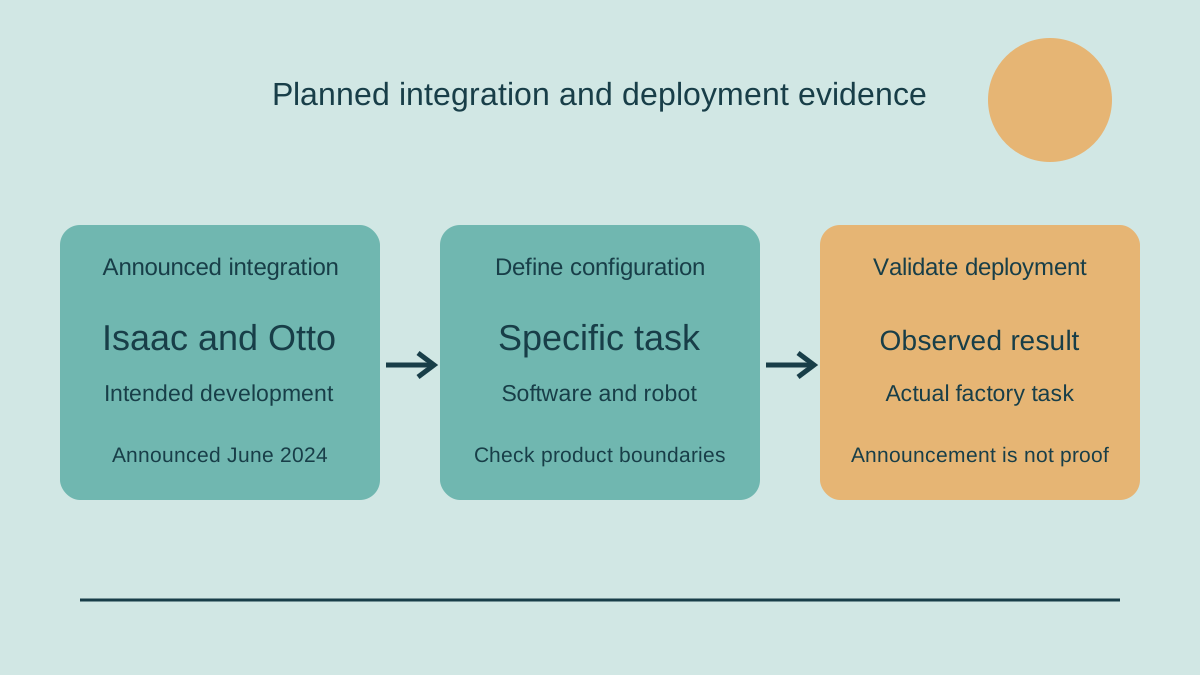
Rockwell Automation plans to integrate Nvidia’s Isaac robotics platform into its Otto autonomous mobile robots for manufacturing facilities, according to Manufacturing Dive’s June 12, 2024 report. Rockwell’s June 3 announcement confirms the collaboration. These statements describe intended development, rather than an already verified configuration at a customer’s factory.
The useful business question is how that intention becomes a product someone can evaluate, maintain and question. A partnership connects organisations; a release must connect specified software components. Between those two things lies a boundary: what the integrated product actually includes, what it expects from surrounding systems, and which party explains its behaviour when the expected result does not arrive. The analysis below develops that question without claiming access to either partner’s private development or support arrangements.
A partnership is a direction, while a release is a definition
An announcement can reasonably describe a direction before every release detail is settled. That makes it useful for understanding the partners’ intentions, but insufficient for choosing a particular installed configuration. A prospective customer needs a narrower statement: which capability is being offered, on which product version, with which dependencies, and for what task. Those questions do not contradict the announcement. They identify the additional information needed before a general direction can become a specific purchasing or operating decision.
Consider the difference between saying that a robot will use an AI platform and saying that a particular release contains a named component for a defined function. The first sentence identifies a relationship. The second allows someone to ask whether that function is present, enabled and supported in the configuration under discussion. Neither sentence, on its own, establishes an improvement in production. A disciplined product description keeps the organisational relationship, the available component and the intended customer outcome in separate fields.
This matters because an enthusiastic reader can silently add missing steps. Planned integration becomes assumed availability; availability becomes assumed compatibility; compatibility becomes assumed operational benefit. Each step needs its own evidence. A release record that marks those steps explicitly would help prevent a project team from treating an announcement as a complete specification. That record would be an evaluation tool, not an assertion that Rockwell or Nvidia currently uses any particular internal document or process.
Define the smallest useful capability
A useful starting point is one capability expressed in terms that a customer can observe. A description might identify an input, an output and a condition under which the output is useful. It should also identify what remains outside that description. For example, a hypothetical component that produces a recommendation is different from one that issues an instruction, and both are different from the surrounding software that decides when a task is complete. These are analytical distinctions, not reported Isaac or Otto specifications.
The smallest useful capability should be narrow enough to explain without borrowing the reputation of the wider partnership. If its value depends on another component, that dependency belongs in the description. If the capability is intended for a particular workflow, the workflow should be identified rather than replaced with an expansive phrase such as intelligent automation. A narrower definition can make a product easier to assess because it gives the evaluator something concrete to compare with the requirement that started the project.
There is also a commercial consequence. A buyer may be interested in a broad technology direction while only needing a limited function in the next release. Treating those interests as identical can produce a proposal that sounds relevant but leaves the immediate requirement unresolved. A capability description can therefore serve as a meeting point between product development and customer expectations. It establishes the scope of the discussion before anyone attempts to estimate a benefit or attribute a result to the partnership.
The interface belongs inside the explanation
A software boundary becomes meaningful when someone explains what passes across it. At an abstract level, that may include a request, its associated context, a response and a status indicating whether the response is usable. The important issue is their relationship. Does the receiving component know which request a response belongs to? Can it distinguish an unavailable answer from a completed task? These questions describe information responsibilities; they do not prescribe a robot control method or infer the partners’ actual architecture.
Responsibility for an interface should include responsibility for explaining its meaning. Two components might accept the same field while interpreting its significance differently. A value that is valid as an input may still be unsuitable for the receiving workflow. An evaluation document should therefore distinguish a message being accepted from the intended task being understood. This helps a customer ask the right question when a demonstration succeeds at transferring information but leaves the practical outcome unclear.
The boundary also needs a vocabulary for incomplete situations. A request can be pending, declined, unavailable or finished; those states should not be collapsed into one attractive success counter. The precise vocabulary depends on the product and cannot be recovered from a partnership announcement. The general analytical point is that a supported integration must make its states intelligible to whoever depends on them. Otherwise, even a technically functioning connection can leave a project team uncertain about what has actually happened.
A configuration is more than a platform name
A named platform gives a reader an orientation, but a configuration identifies the combination under consideration. For an evaluation, a compact record could describe the product release, the included component, the interface revision and any relevant settings that the supplier says affect compatibility. That is a proposed structure for a question, not a list of confirmed dependencies for this collaboration. Its purpose is to avoid discussing several different combinations as if they were one stable product.
Version information is especially valuable when a conversation crosses organisational boundaries. A development team, a supplier representative and a customer may each refer to the latest version while meaning different things. One could mean a development branch, another a generally offered release, and another the version installed for an evaluation. Giving each reference an explicit label reduces that ambiguity. It also allows a change to be discussed in terms of the configuration it affects rather than the partnership as a whole.
A configuration record need not become an exhaustive catalogue of every software detail. The useful scope is the information needed to identify the offered capability and its relevant dependencies. Too little detail makes comparisons unreliable; too much can bury the decision in facts that do not affect it. The supplier is best placed to explain which details matter for its product. The customer’s role is to ask for enough specificity to connect a claim with the configuration being considered.
A hypothetical release review
Imagine a purely illustrative project with two candidate software configurations, A and B, and one defined material-transfer request. These labels and results are invented for analysis; they are not Rockwell, Nvidia or customer data. Suppose both candidates accept the request, but only B returns a clearly interpretable completion status in the surrounding workflow. The example shows why counting accepted requests alone would not answer the project team’s question about the end of the task.
That observation still would not establish that B is a better product in general. It would support a narrower conclusion about the specified request and the stated configurations. Before extending it, the team would need to understand what differs between A and B and whether the comparison kept the relevant conditions consistent. A changed interface revision and a changed surrounding workflow could produce a difference that cannot be attributed to a single component. The review should preserve that uncertainty rather than conceal it behind a headline.
- Identify the task that the candidate configuration is expected to support.
- Record the product and interface versions relevant to that task.
- Separate acceptance of a request from completion of the intended outcome.
- Describe unresolved behaviour without assigning an unverified cause.
- State which conclusion the observation supports and which questions remain open.
- Ask who will explain the result for the configuration under consideration.
This hypothetical review deliberately stops short of a production recommendation. It is a way to organise product evidence, not a procedure for commissioning equipment or changing robot behaviour. Its benefit is logical: it prevents one observed interface result from becoming a claim about an entire operating environment. The same discipline can help an editor describe a future software release without accidentally presenting an unmeasured customer outcome as an established feature.
Support needs an identifiable subject
Once several organisations contribute technology, a customer’s question can move between them without acquiring an answer. A supportable product needs an identifiable subject: the particular configuration and the behaviour being questioned. The customer should be able to describe that subject in a form that the relevant supplier can recognise. This is a reason to request clarity about support scope, not evidence that either partner currently has an inadequate or unusually effective support arrangement.
The scope can be explored through ordinary questions. Who explains the included function? Who identifies whether the surrounding configuration is supported? Where should a question about a changed interface go? Answers might vary by product, agreement and release, so they should come from the supplier rather than be inferred from the announcement. The point is to give a future customer a path from an observed result to an informed response without pretending to know the contractual division of responsibility.
Support scope also affects how a claim is read. A component may be described accurately within its own boundary while the customer’s concern lies in the wider workflow. That difference does not automatically establish a defect in either component. It identifies a gap between the unit being explained and the unit the customer needs to understand. Naming those units helps both sides decide whether the question concerns the offered feature, its connection to another system, or an expectation outside the described scope.
A future change should have a named effect
Integration is easier to discuss when change is attached to something identifiable. A future revision might change a capability, an interface or the supported combinations of components. These possibilities have different consequences for a customer’s evaluation. A release explanation should say which kind of change is involved and which existing statement needs reconsideration. Describing every revision as a general AI improvement would make it harder to understand whether the customer’s original requirement has become better supported.
This is also why a broad roadmap should remain distinguishable from an available release. A roadmap can convey intention and sequence without promising that every item is currently present. A release description should explain the product being offered now. The June announcement gives a reason to watch the collaboration’s development; it does not remove the need for that later release information. Maintaining this distinction gives a reader a more accurate basis for following progress than assuming that all planned capabilities arrive together.
For a prospective buyer, the practical question is which evidence would need updating after a revision. A comparison tied to one configuration may no longer describe another. That does not mean the earlier observation was useless; it means its scope should remain visible. A clear release record can preserve both the value and the limit of previous evidence. It allows a team to discuss continuity and change without claiming that an earlier result guarantees the behaviour of a later configuration.
The proposal should preserve unanswered questions
A proposal can acknowledge missing release information without losing its usefulness. For the hypothetical configuration comparison, it could retain the observed difference in completion status while leaving the cause open. It could then request the supplier’s explanation of the relevant interface and supported combinations. That would keep the next conversation focused on the evidence actually available. Removing the unanswered question would make the document look more complete while making its conclusion less reliable.
Different audiences may need different descriptions of the same boundary. A purchasing discussion needs the scope of the offered capability; a product discussion needs the relevant configuration; a support question needs the observed behaviour. These descriptions should remain connected, so that a statement does not acquire a broader meaning as it moves between teams. A shared reference to the release and task can provide that connection without assuming that every participant requires the same level of technical detail.
Keep benefits attached to their evidence
The attraction of a robotics software partnership is the possibility of a more useful product. Possibility is a legitimate subject for analysis, provided it remains labelled as such. A customer benefit would require evidence connected to a defined task and configuration. Until that evidence is available, an editor can explain the questions that matter without inventing improvements in throughput, labour requirements, safety or operating cost. Those outcomes should not be inferred merely from the inclusion of an AI platform.
Several different claims can otherwise become entangled. A component may perform a function, a workflow may use that function, and an organisation may experience a business outcome. Explaining one does not prove the others. Keeping the claims separate helps the customer understand what further information would make the next step credible. It also leaves room for a useful capability whose value is limited to a narrow task, rather than forcing every release into an expansive story about factory-wide transformation.
For the Rockwell and Nvidia announcement, the strongest current conclusion is therefore about direction and the questions that direction opens. Planned integration creates a reason to seek a defined capability, a recognisable configuration and an explanation of support boundaries. It does not supply those answers by itself. A future product description would be most useful when it connects each claim to a named release and an observable task, allowing the partnership’s promise to be assessed one supported boundary at a time.