
Manufacturing Dive reported on 6 April 2026 that manufacturers were testing translation tools for workplace communications. Its account included an unnamed foundry considering live captions for meetings. These are reported experiments and plans, rather than evidence that every language version was implemented or kept current. The report provides a starting point for a separate question about documents: when the source changes, what shows which translated edition follows that change?
The analysis below is original document-management reasoning. Its examples concern invented meeting announcements and ordinary business notices. They do not describe the foundry’s arrangements or evaluate any translation product. A readable translation, a reviewed translation and a translation of the latest source are different propositions. Keeping these propositions separate helps explain why a fluent document can still convey yesterday’s announcement with complete confidence.
The relationship is between two particular editions
A document can have a stable title while its contents change. Consider a hypothetical notice called Monthly Planning Meeting. Edition one says the meeting takes place on Tuesday at ten. Edition two changes the day to Wednesday, leaving the title and time unchanged. A translation made from edition one may accurately convey Tuesday. Its language has not deteriorated when the source changes. What has changed is the relationship between that translation and the announcement the organisation now intends to distribute.
Calling both source editions Monthly Planning Meeting obscures this relationship. A useful record identifies the source edition used for a particular language edition. The identifier need not be an elaborate technical mechanism. In the example, source one and source two are sufficient names because they point to definite texts. The important property is that someone can distinguish the original basis of a translation from a later text carrying the same familiar title.
This distinction also prevents a misleading correction. Replacing the source file beneath an unchanged link does not make an earlier translation a translation of the replacement. A reader following that link might see Wednesday alongside a target that still says Tuesday. The link now connects two accessible documents, but accessibility alone does not establish derivation. The record needs to preserve which edition was used, while separately showing which edition is currently intended for circulation.
Readable, accurate and current ask different questions
Readability concerns whether a reader can understand the wording. Accuracy concerns whether the wording conveys the relevant meaning of its stated source. Currentness concerns whether that source is the edition applicable to the present announcement. These questions overlap in practical work, but none can answer the others by itself. In the invented notice, an elegant rendering of Tuesday can be both intelligible and faithful to source one while being unsuitable for announcing the Wednesday meeting.
Even a visible approval label needs a defined object. A reviewer might have checked target one against source one before the day changed. That review can remain a valid observation about those two texts. It cannot establish agreement with source two without an additional comparison. Treating the earlier review as worthless loses useful history; treating it as approval of every later source edition extends the observation beyond what was actually examined.
The same reasoning applies to a new translation that is still awaiting review. It may already be linked to source two, yet the link does not prove that Wednesday was translated correctly. A revision relationship records the basis of the work. A review records an examination of that work. Combining the two into a single green status makes it difficult to tell whether an unresolved issue concerns the chosen source, the target wording or the intended release.
A simple five-language example
Suppose an imaginary team maintains five language editions of the meeting notice. After the change to Wednesday, three editions have been prepared from source two. Two still refer to source one. Counting the editions gives three out of five linked to the newer source, or sixty per cent. That calculation describes the distribution of recorded source relationships. It does not measure translation accuracy, reader understanding or the reliability of the tools used.
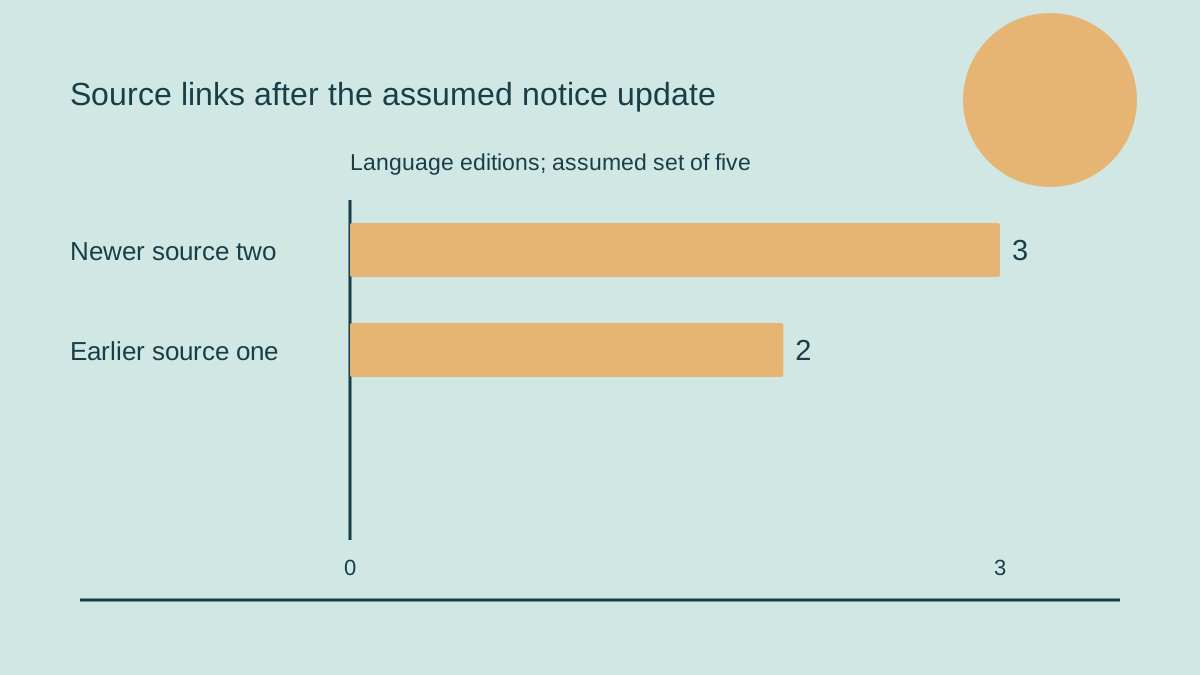
The distinction matters because the remaining two editions could be excellent translations of the previous announcement. Conversely, any of the three newer editions could contain a wording error. The count gives a useful answer to a narrow question: how many language editions have the stated newer basis? Expanding it into a general quality score would require observations that the example has not supplied. A precise small measure is more informative than a broad percentage with an unstated denominator.
A compact record could therefore distinguish the following items for each language edition. This is a proposed analytical structure for the invented notice, rather than a description of an employer’s actual process:
- The identifier of the source edition used to prepare the target.
- The identifier of the target text that was examined.
- The source and target pair covered by any review.
- The target edition selected for the particular announcement.
- The distribution channel and the edition actually placed there.
These items answer different questions even when one person handles all of them. Their value comes from making the relationships visible, not from multiplying approvals. For a small notice, a short table may be enough to show that an updated draft exists but the shared invitation still points to the older edition.
A newer timestamp can still belong to an older basis
It is tempting to sort files by modification time and assume the newest target corresponds to the newest source. The invented example shows why that inference is uncertain. Someone may adjust punctuation in the Tuesday translation after the Wednesday source has been issued. The target now has a later modification time, although its substantive basis remains source one. Chronological order describes file activity; it does not identify the source used for that activity.
A target can also acquire a new timestamp through formatting or moving between folders. These possibilities are examples of ordinary document operations, rather than claims about a particular application. They explain why a timestamp needs context. Recording the source edition explicitly avoids asking the timestamp to perform a task it cannot perform alone. Dates can help reconstruct the sequence, while identifiers show the relationships within that sequence.
The reverse assumption is also unsafe within the model. An older target timestamp does not necessarily mean the translated meaning requires a change. Source two might correct an internal note that is not part of the public announcement. Whether the existing target remains suitable depends on the scope of the source change and the intended target content. The useful question is what changed in the relevant material, rather than which file happens to display the latest clock value.
Changing a sentence and replacing the whole translation
For the meeting notice, changing Tuesday to Wednesday may appear to be a local task. Yet even a small edit can affect a second sentence referring to the following day or an attached calendar invitation. The proposed comparison starts with the meaning of the change and then follows its references. It does not assume that every character needs replacement, and it does not assume that only the visibly changed word matters.
Two approaches are possible in this invented setting. A team could amend the affected passage in an existing target, or prepare a complete new target from source two. Neither choice settles the review question automatically. A local amendment needs an examination of the amended meaning and related references. A complete replacement needs an examination of the replacement text. The amount of newly produced wording and the amount of meaning requiring attention are related, but they are not interchangeable measures.
A sensible comparison can preserve evidence about unchanged passages while recording the limits of that evidence. If the original review covered a paragraph that remains identical in meaning and context, that history is useful. If a changed date alters the interpretation of the paragraph, identical wording alone does not settle suitability. This is an argument for stating the scope of a comparison, rather than inventing a universal rule that all earlier review must either survive or disappear.
One announcement can appear in several places
The language file is only one possible carrier of the announcement. In the hypothetical case, a calendar invitation, an email summary and a shared meeting page might repeat the day. Updating the full translation does not establish that those other carriers now say Wednesday. Each publication can refer to a particular edition or reproduce a fragment from it. The relationship becomes harder to see when fragments circulate without their original context.
This does not mean every channel requires a separate complex system. It means the announcement has a distribution boundary that deserves an explicit description. If the team promises an updated email but leaves an older invitation active, recipients can encounter conflicting notices. The conflict concerns the published editions, even if the translation itself has been reviewed successfully. Examining the text and observing its distribution remain separate kinds of evidence.
A useful release note for the invented change would identify the Wednesday source, the selected language editions and the places where those editions are intended to appear. A later check could compare that intention with what is accessible in each place. The release note is a statement of the chosen publication; the check is an observation of the publication. Keeping both prevents a planned update from being recorded as a completed one merely because the draft was ready.
Receipt is not evidence of understanding
Suppose the imaginary team can observe that an email was delivered to a recipient. That observation concerns delivery through the chosen channel. It does not establish that the person read the notice, understood Wednesday correctly or adjusted a calendar. Even an acknowledgement may indicate only that the message was received. The example supplies no observations about individual behaviour, and no such behaviour should be inferred from the existence of a current language file.
Different questions call for different evidence. A check of the shared page can show which edition was available at a given moment. A comparison of source and target can address whether the changed day is conveyed. A response concerning the meeting date can provide evidence about that response. These observations cannot be collapsed into a single completion figure without first defining what the figure is supposed to describe.
This separation also makes gaps easier to state. If a team has verified the published target but has no information about recipients, the recipient state is unknown. It is neither confirmed understanding nor confirmed failure. Naming the unknown leaves room for a suitable follow-up without making an unsupported accusation about readers or an unsupported success claim about the communication.
Matching meaning without requiring matching words
Language editions need not share the same sentence order to convey the same announcement. One might place Wednesday before the meeting title; another might mention the title first. In the invented example, the substantive comparison concerns the day, time and event being announced. A superficial comparison of word positions would not establish whether those elements agree. The relationship to the source remains useful even when the target adopts a different natural form.
Nor does consistency mean erasing every local presentation choice. The imaginary notice might express the time in different familiar formats while preserving the intended meeting time. Such choices need to be distinguished from changes to the announcement itself. This discussion does not prescribe a translation technique or claim that any product can make the distinction automatically. It identifies the object a reviewer would need to consider when assessing the particular notice.
A source revision record helps frame that assessment. It tells the reviewer which announcement the target is meant to convey and which changes prompted the comparison. Without that basis, a disagreement may be mistaken for a translation error when the two participants are actually looking at different source editions. Establishing the common object of comparison can therefore resolve confusion before anyone debates the wording.
Retaining history while identifying the active edition
Keeping an earlier target can be useful for understanding what was previously announced. Historical retention, however, needs to be distinguished from present availability. In the hypothetical case, the Tuesday edition belongs in the record of the earlier notice. It should not become the current announcement simply because its familiar link remains easy to find. A record can preserve both history and the identity of the edition selected for the present release.
The history also helps explain a correction without rewriting the past. Source one said Tuesday; source two says Wednesday; target one followed source one; target two was prepared for source two. These statements are compatible. There is no need to pretend that target one originally contained Wednesday or that its earlier review covered the later change. The sequence is understandable when each statement has a defined edition and scope.
The practical insight is modest: a translation needs a visible relationship to a definite source, and a release needs a visible relationship to a definite target. The reported experiments in workplace translation do not establish how those relationships are managed in any individual business. They make the separate document question timely. Answering it requires records of editions and observations of publication, alongside whatever evidence is used to assess the wording itself.
Source: Manufacturing Dive, 6 April 2026. Examples and document-management analysis are original.