
Interfax’s January 14, 2025 report described a ministry proposal to extend a building-material marking trial in Russia until August 31. The ministry cited further testing of identifier application and interaction with an information system. A proposed extension describes intended work; it does not establish a completed technical result.
The original analysis below examines one question such a trial can raise: what does a successful reading of a package identifier actually demonstrate? It separates a readable carrier, an association with an identified package and an association with the expected product record. Its terminology and numerical examples are editorial constructions, rather than descriptions of the national platform’s specifications. The discussion concerns data quality and the meaning of a test report. It does not interpret marking obligations or prescribe a compliance procedure.
A readable carrier answers the first question
A physical carrier can be examined for whether a reading produces an identifier. That observation is already useful, but its scope is narrow. It concerns a particular carrier, reading attempt and observation setting. It does not by itself establish that the returned value belongs to the package under examination or that a record associated with it describes the expected product. Those are additional relationships requiring additional evidence. Treating them as one result makes an apparently simple success label difficult to interpret.
The distinction can be stated without choosing a printing technology or scanning device. A test could record whether it obtained a value, which object was presented and which reference information it used for comparison. These are conceptual fields, not a technical recipe. Their usefulness comes from keeping the observation attached to its object. If an account records only the returned identifier, later readers may lack the information needed to understand what that reading was supposed to identify.
Conditions matter to the claim’s scope. An observation made on a particular package in one setting does not automatically cover every material, presentation or stage of handling. A report can retain the successful observation while naming the setting it covered. That is more informative than either declaring universal success or dismissing the result because it is limited. A bounded finding becomes useful when its reader can see precisely which question was tested.
Reading and association are separate checks
A returned identifier and a package are different objects. To say that they are correctly associated, the reviewer needs an expected relationship against which the observation can be compared. Otherwise the reading can be recorded as successful without checking identity. A clear test account therefore distinguishes obtaining a value from checking its association. The same account can describe both, provided it does not silently let the first stand in for the second.
For an invented example, imagine two sample packages, A and B, with separate expected identifiers. A reading from package A produces a value assigned in the reference set to package B. The carrier was readable, yet the association disagreed with the reference. This example supplies no explanation of the discrepancy. It illustrates only why a readable value can coexist with an unresolved identity question. It is not evidence that such an error occurred in the reported trial.
The next question would concern the reference itself. Was the expected relationship recorded accurately, and was it current for the test? A disagreement should not automatically be blamed on the carrier or the information system. The test account should preserve the observation and the reference version so that the relationship can be investigated. This avoids turning an unexplained mismatch into a confidently named failure cause before the relevant evidence has been examined.
A product record adds another relationship
Even a correctly associated package identifier does not establish every statement in an associated product record. The record may describe a named item, a category, a batch or some other unit. A reviewer must know which unit it represents before interpreting its agreement with the package. A comparison at one level cannot automatically answer a question at another. The article does not specify how any actual marking system defines these relationships.
A constructed record could contain a product name and a pack description. Checking that the identifier points to that record would establish a link, while checking that the record matches the intended test object would examine its content. Both checks can matter, but they are different observations. A test report becomes easier to read when it shows the linkage result and the content comparison separately, rather than folding them into one unexplained approval.
Content can also change over time. If a reference record is revised during a trial, an earlier comparison may refer to an earlier description. A later reader needs to know which version supported the decision. Preserving the version does not mean the older record was wrong; it means the result belongs to a specific reference. A report should not attach a new description retrospectively to an old observation without explaining the change.
Define the unit before calculating a success rate
A reading attempt is an event, while a unique package is an object. One package can produce several attempts. A report that mixes these units can give a percentage that looks clear but answers an unexpected question. Before calculating a rate, the reviewer should identify the denominator and the rule for counting repeats. This is a basic requirement of interpretation, regardless of the technical means used to record the readings.
Consider a wholly invented test with 100 unique packages and 120 reading attempts. The first attempt succeeds for 90 packages. The remaining 10 packages each receive two further attempts, producing 20 additional attempts. Suppose every one of those 10 packages is read on its second further attempt. Then 100 attempts succeed out of 120, while all 100 packages are eventually read. The attempt success rate is about 83.3 percent; eventual package coverage is 100 percent.
Neither percentage is false in this example, but they describe different things. The first concerns attempts, the second concerns packages after retries. Reporting only eventual coverage would conceal the repeated attempts; reporting only attempt success would omit that every package eventually yielded a value. The example is not a result from the ministry’s trial or a target for manufacturers. It demonstrates why a denominator and a retry rule belong beside a rate.
Keep a retry distinct from a repeated message
A second observation of a package and a second transmission of one observation are also different events. A retry can produce new evidence about readability. A repeated message can reproduce evidence already obtained. If both are counted as new successful readings, the report may inflate its event total without adding observed packages. A clear account should retain the difference between a new observation and a second copy of an existing observation.
This can be illustrated without specifying a network protocol. Imagine one successful reading recorded once but delivered to a receiving account twice. There is one observed reading and two received messages. Counting the messages answers a delivery question; counting the observation answers a reading question. The two counts can legitimately appear in separate lines. The error would be to label both messages as two independently observed successful package readings.
An editorial report could therefore ask how it distinguishes observation identity from message identity. The answer depends on the actual records and should not be invented from a general description of the trial. Where the distinction cannot be verified, the report can describe received records rather than unique observed events. Accurate naming of a limited count is preferable to a broader claim whose underlying unit has not been established.
Separate missing evidence from contradictory evidence
A missing reference prevents a comparison. A reference that disagrees with an observation permits a comparison but leaves a discrepancy. These situations deserve different descriptions. Combining them into one failure category can make it difficult to decide what information is needed next. The missing case may require an identified reference; the disagreement may require examination of both records. Neither should automatically be presented as a confirmed defect in a product.
For a constructed sample, a test could report readable carriers with matching references, readable carriers with disagreements, readable carriers lacking a reference and unsuccessful reading attempts. These are editorial categories, not official status names. Their purpose is to keep the report’s claims within the available evidence. A readable carrier without a reference cannot be described as a confirmed correct association, but it also cannot be described as a confirmed incorrect one.
The distinction matters when a result is revised. Adding an available reference can change an unresolved case into a checked case. Resolving a disagreement may require a different action and a record of the explanation. The report should show which transition occurred rather than announcing that an aggregate improved without describing the changed evidence. A later result becomes more useful when its reader can follow the reason for the revision.
Use a reference set whose boundaries are known
A reference set is part of the test, not an invisible background assumption. It should have a stated scope and an identifiable version if the comparison depends on them. A set covering one group of packages cannot automatically establish agreement for another group. The reviewer should also distinguish the expected relationship used in the test from a claim about the complete commercial history of a product. This article makes no such history claim.
A simple editorial account might explain where the expected identifiers and descriptions came from, which objects they cover and which entries were unavailable. It should not publish private records merely to appear detailed. The information necessary to understand a result can be described at an appropriate level while preserving its scope. What matters is that the reader knows the basis of comparison and can see where that basis is incomplete.
The reference also needs a consistent role. If the same source creates both the observation and its supposed independent confirmation, the report should explain that relationship. Agreement within one account can be useful, but it is not automatically an independent verification. A stronger claim requires evidence appropriate to that claim. A trial can report internal consistency honestly without implying that every associated statement has been independently established.
Aggregate results without losing the stages
A summary can be brief and still preserve the distinctions. It could state how many unique test objects were examined, how many produced readable values and how many had a checked agreement with the selected reference. It could then identify unresolved cases. Such a summary lets the reader see how far the evidence extends. A single success rate may be easier to promote, but it often conceals the question each stage actually answered.
Consider another invented set of 40 packages. Thirty-six yield a readable value. Of those, 30 have a matching association, four disagree with the selected reference and two lack an available reference. This means that readability covers 36 of 40 packages, while a checked matching association covers 30 of 40. The four unreadable packages, four disagreements and two unresolved reference cases belong to different categories. The arithmetic supplies no cause for any category.
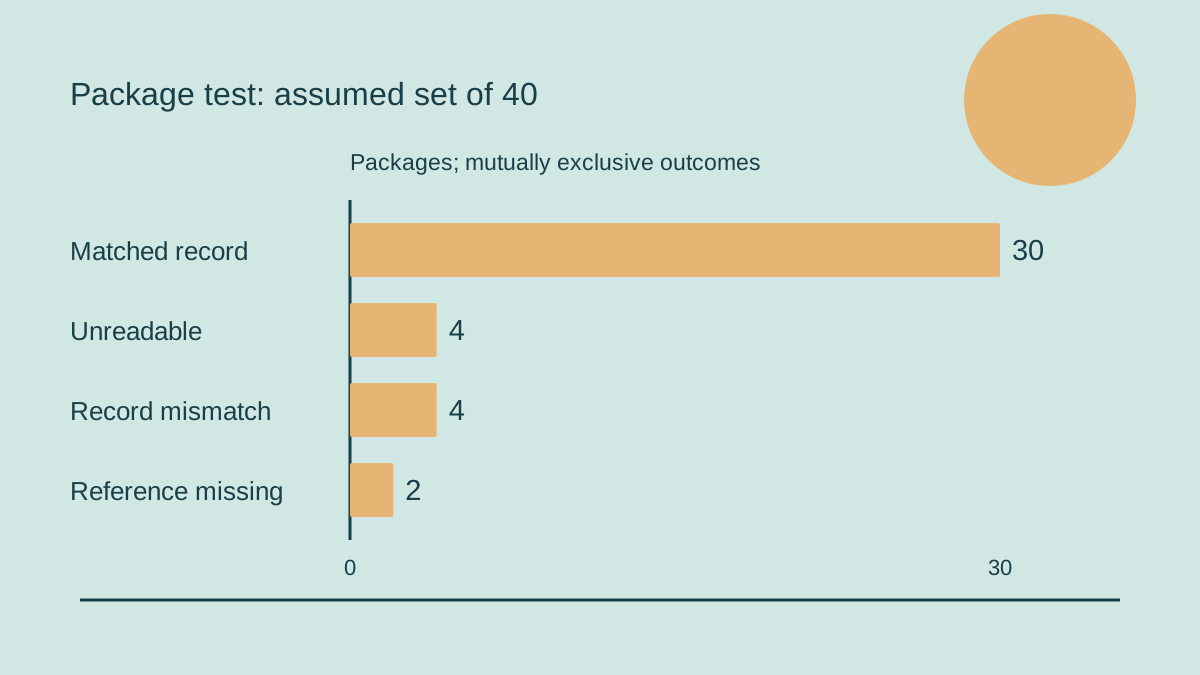
The purpose of this example is to make the stages visible, rather than to suggest an acceptable rate or predict a real programme. A report could use a different structure if its question requires it. The important point is to retain the denominator and avoid presenting a later-stage conclusion for objects that reached only an earlier stage. Counts become meaningful through their definitions, not through the number of decimal places in the percentages.
Time spent on unresolved cases belongs beside the totals
A trial can yield useful information about the work of explaining discrepancies. The existence of an unresolved case does not by itself reveal how difficult it is to examine. A review may need to distinguish the first observation, the availability of supporting records and the point at which an explanation was reached. These timestamps describe an investigation account. They do not establish a national platform’s response times or any particular manufacturer’s staffing requirements.
Keeping unresolved cases visible also prevents an account from reporting only the easiest completed comparisons. A cutoff date can leave some objects still awaiting a reference or an explanation. Those cases should retain their unresolved state rather than being assigned an invented outcome. A later account can update them when new evidence arrives, with the reason for the change stated. This produces a more informative history than silently replacing the earlier total.
The useful follow-up question is what the additional observation period made possible to examine. It might allow more test objects, more settings or better explanations of earlier discrepancies, but those are possibilities that need actual records. A longer calendar period is an opportunity for investigation, not a result in itself. Its value becomes demonstrable through what was observed and resolved within a defined scope.
Questions for a package-to-record test report
The following editorial checklist brings the discussion back to a readable identifier and its associated record. It does not assert that the reported trial used these fields, nor does it interpret legal requirements. It gives readers a way to ask what a published technical result means and which evidence supports it. An actual report may use different terminology, provided the underlying distinctions remain understandable.
- What is the unique test object, and what counts as one reading attempt?
- Which observation establishes readability, and which checks the expected association?
- What unit and version does the associated product record describe?
- How are retries distinguished from repeated copies of one observation?
- Are missing references separated from disagreements with available references?
- Which denominator, observation setting and cutoff date support each summary?
The January report provides a historical reason to examine the boundary between applying an identifier and working with information about it. It does not establish that an extension was adopted or that any particular technical outcome followed. A useful later account would preserve the package, the reading event, the expected association and the reference version as distinct objects. That would let a readable identifier support exactly the conclusion observed, while a correct product-record relationship retained its own requirement for evidence.